Marchette Renata C N, Gregory-Flores Adriana, Tunstall Brendan J, Carlson Erika R, Jackson Shelley N, Sulima Agnieszka, Rice Kenner C, Koob George F, Vendruscolo Leandro F
Neurobiology of Addiction Section, Integrative Neuroscience Research Branch, National Institute on Drug Abuse, Intramural Research Program, Baltimore, MD, USA.
Department of Pharmacology, Addiction Science, and Toxicology, The University of Tennessee Health Science Center, Memphis, TN, USA.
Neurobiol Stress. 2021 Apr 14;14:100325. doi: 10.1016/j.ynstr.2021.100325. eCollection 2021 May.
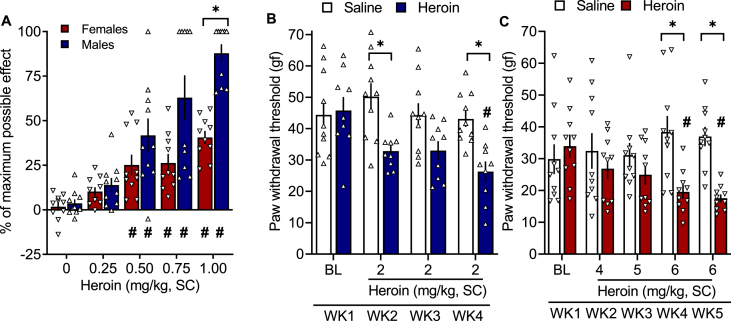
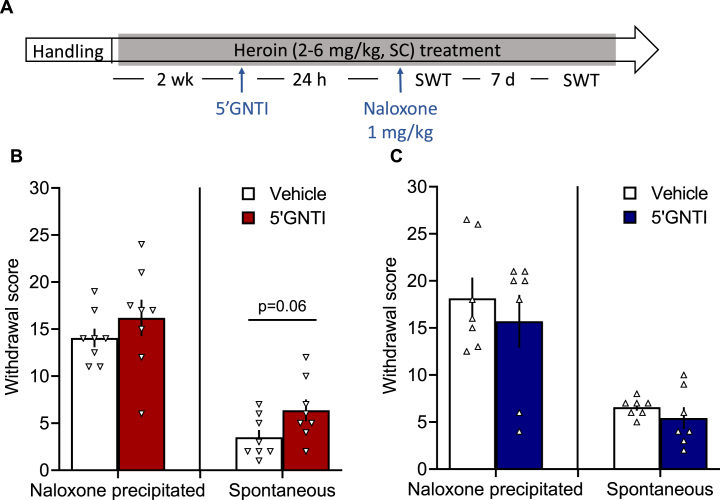
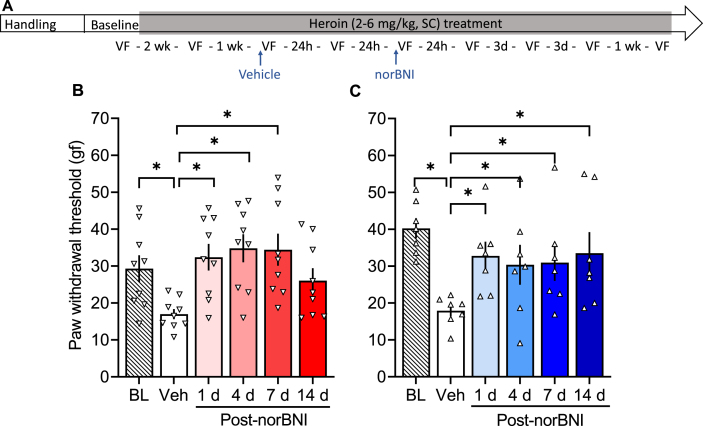
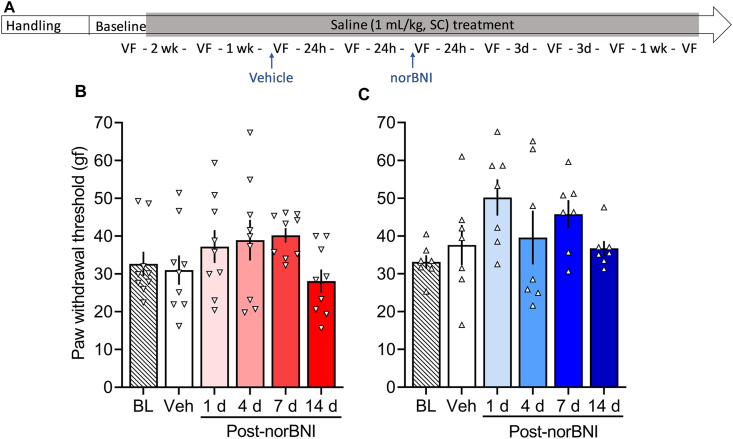
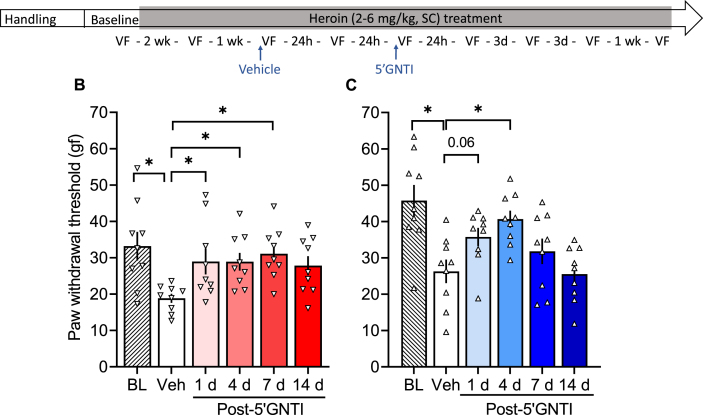
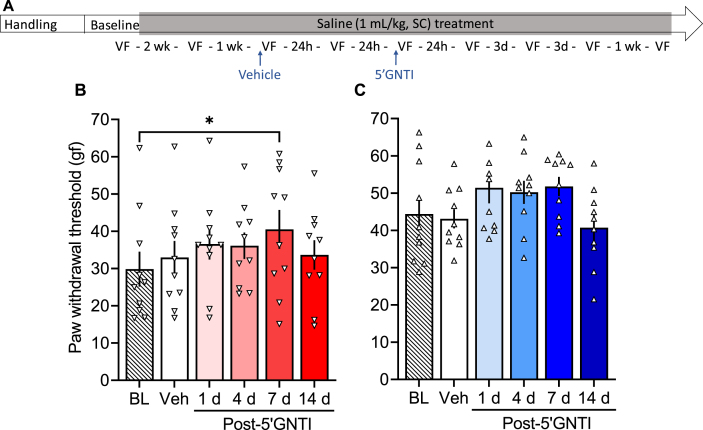
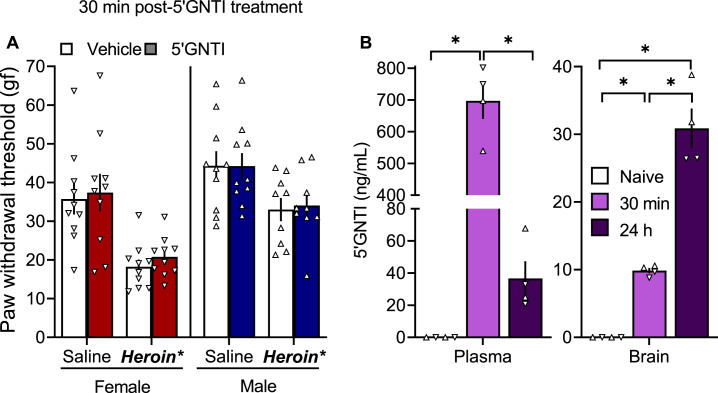
Although opioids are potent analgesics, a consequence of chronic opioid use is hyperalgesia during withdrawal, which may contribute to opioid misuse. Dynorphin, the endogenous ligand of κ-opioid receptors (KORs), is upregulated in opioid-dependent rats and in animal models of chronic pain. However, the role of KORs in opioid withdrawal-induced hyperalgesia remains to be determined. We hypothesized that KOR antagonism would reverse opioid withdrawal-induced hyperalgesia in opioid-dependent rats. Male and female Wistar rats received daily injections of heroin (2-6 mg/kg, SC) and were tested for mechanical sensitivity in the electronic von Frey test 4-6 h into withdrawal. Female rats required significantly more heroin than male rats to reach comparable levels of both heroin-induced analgesia and hyperalgesia (6 mg/kg 2 mg/kg). Once hyperalgesia was established, we tested the effects of the KOR antagonists nor-binaltorphimine (norBNI; 30 mg/kg, SC) and 5'-guanidinonaltrindole (5'GNTI; 30 mg/kg, SC). When the animals continued to receive their daily heroin treatment (or saline treatment in the repeated saline group) five times per week throughout the experiment, both KOR antagonists reversed heroin withdrawal-induced hyperalgesia. The anti-hyperalgesia effect of norBNI was more prolonged in males than in females (14 days 7 days), whereas 5'GNTI had more prolonged effects in females than in males (14 days 4 days). The behavioral effects of 5'GNTI coincided with higher 5'GNTI levels in the brain than in plasma when measured at 24 h, whereas 5'GNTI did not reverse hyperalgesia at 30 min posttreatment when 5'GNTI levels were higher in plasma than in the brain. Finally, we tested the effects of 5'GNTI on naloxone-induced and spontaneous signs of opioid withdrawal and found no effect in either male or female rats. These findings indicate a functional role for KORs in heroin withdrawal-induced hyperalgesia that is observed in rats of both sexes.
尽管阿片类药物是强效镇痛药,但长期使用阿片类药物的一个后果是戒断期间痛觉过敏,这可能导致阿片类药物滥用。强啡肽是κ-阿片受体(KORs)的内源性配体,在阿片类药物依赖的大鼠和慢性疼痛动物模型中上调。然而,KORs在阿片类药物戒断引起的痛觉过敏中的作用仍有待确定。我们假设KOR拮抗作用将逆转阿片类药物依赖大鼠中阿片类药物戒断引起的痛觉过敏。雄性和雌性Wistar大鼠每天注射海洛因(2 - 6mg/kg,皮下注射),并在戒断4 - 6小时后通过电子von Frey试验测试机械敏感性。雌性大鼠达到与海洛因诱导的镇痛和痛觉过敏相当水平所需的海洛因量明显多于雄性大鼠(6mg/kg对2mg/kg)。一旦建立痛觉过敏,我们测试了KOR拮抗剂nor - binaltorphimine(norBNI;30mg/kg,皮下注射)和5'-胍基纳曲酮(5'GNTI;30mg/kg,皮下注射)的作用。当动物在整个实验过程中每周接受五次每日海洛因治疗(或重复生理盐水组中的生理盐水治疗)时,两种KOR拮抗剂都逆转了海洛因戒断引起的痛觉过敏。norBNI的抗痛觉过敏作用在雄性中比在雌性中持续时间更长(分别为14天和7天),而5'GNTI在雌性中的作用比在雄性中持续时间更长(分别为14天和4天)。在24小时测量时,5'GNTI的行为效应与大脑中5'GNTI水平高于血浆中的情况一致,而当血浆中5'GNTI水平高于大脑时,5'GNTI在治疗后30分钟并未逆转痛觉过敏。最后,我们测试了5'GNTI对纳洛酮诱导的和自发的阿片类药物戒断体征的影响,发现对雄性或雌性大鼠均无影响。这些发现表明KORs在海洛因戒断引起的痛觉过敏中具有功能性作用,这种作用在两性大鼠中均有观察到。