Matsumine Hajime, Giatsidis Giorgio, Fujimaki Hiroshi, Yoshimoto Nobuyuki, Makino Yuma, Hosoi Satoshi, Takagi Mika, Shimizu Mari, Takeuchi Masaki
Department of Plastic and Reconstructive Surgery, Yachiyo Medical Center, Tokyo Women's Medical University, Yachiyo-shi, Chiba, 276-8524, Japan.
Division of Plastic Surgery, University of Massachusetts Medical School, Worcester, MA, 01655, USA.
Regen Ther. 2021 Apr 23;18:82-87. doi: 10.1016/j.reth.2021.04.001. eCollection 2021 Dec.
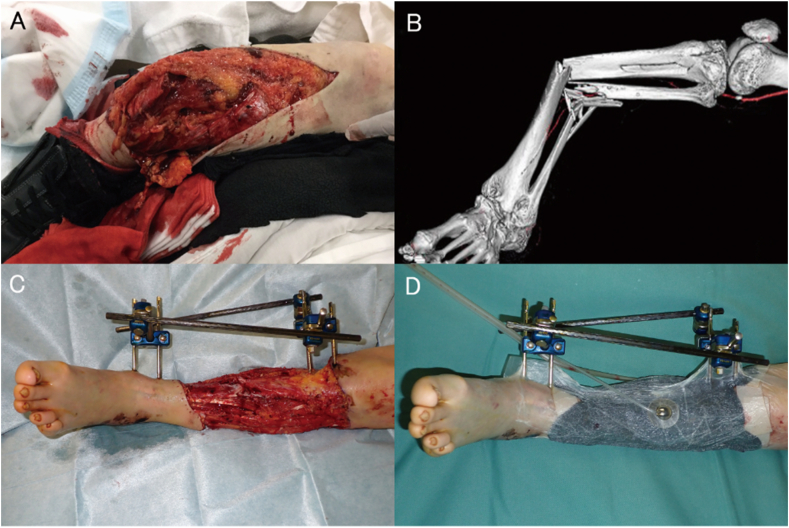
Free flap lower extremity repair is associated with a high complication rate (>31%); higher rates are observed in more severe patients. In cases requiring prior systemic/local stabilization, delayed repair increases complication rate (+10% at 7 days): Negative-pressure Wound Therapy (NPWT) decreases complications but only when applied for less than 7 days. Recent limited evidence suggests that augmentation of NPWT with instillation for wound irrigation (NPWTi) might safely extend such window. This study hypothesizes that, through the combined cleansing effect of NPWT and instillation, NPWTi allows safe (low complication rate) delayed free flap repair in severe patients with Gustilo IIIb injuries (GIIIb).
A prospective case series was designed (inclusion criteria: GIIIb requiring microsurgical repair, severe patient/injury condition preventing immediate/early repair; exclusion criteria: allergy to NPWTi dressing). Patients received NPWTi (suction: 125 mmHg continuous; irrigation: NaCl 0.9%) until considered clinically ready for repair. Preoperative/postoperative complications (dehiscence, wound infection, bone non-union, osteomyelitis, flap failure) were monitored with clinical signs, imaging, and serum markers (CRP, WBC).
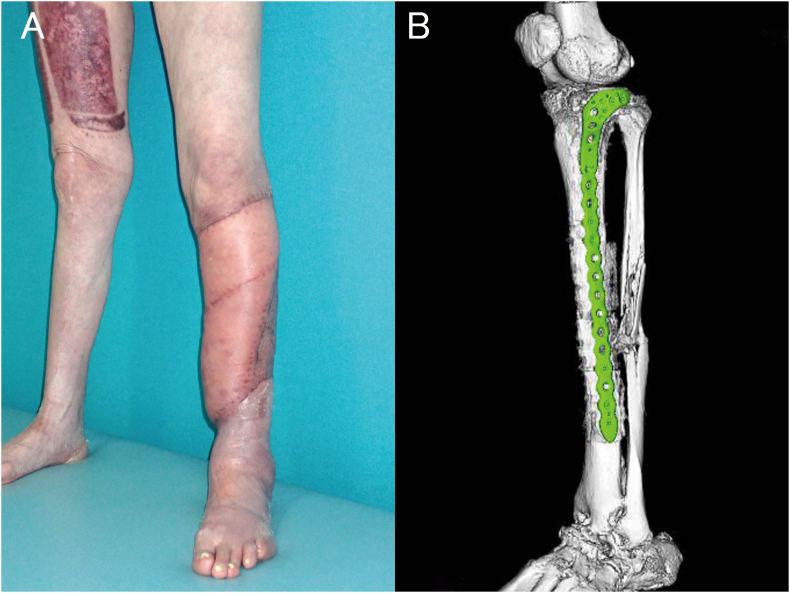
Four patients (male: N = 4, female N = 1; Age: 59 [44-75] years-old) were treated. NPWTi was applied for 15.2 [9-28] days. No complication (0%) was observed preoperatively or postoperatively. Delayed repair occurred by latissimus dorsi musculocutaneous flap (N = 3), and anterolateral thigh flap (N = 2). All patients walked weight-bearing 12 [6-20] weeks after injury.
NPWTi seems to allow safe delayed free flap repair in patients with severe lower extremity injuries unable to undergo immediate/early repair.
游离皮瓣修复下肢的并发症发生率较高(>31%);病情越严重的患者发生率越高。在需要先行全身/局部稳定治疗的病例中,延迟修复会增加并发症发生率(7天时增加10%):负压伤口治疗(NPWT)可降低并发症发生率,但仅在应用时间少于7天时有效。最近的有限证据表明,采用滴注法进行伤口冲洗的增强型负压伤口治疗(NPWTi)可能会安全地延长这一窗口期。本研究假设,通过NPWT和滴注法的联合清洁作用,NPWTi能够在患有Gustilo IIIb型损伤(GIIIb)的重症患者中实现安全(低并发症发生率)的延迟游离皮瓣修复。
设计了一项前瞻性病例系列研究(纳入标准:需要显微外科修复的GIIIb型损伤、严重的患者/损伤情况妨碍立即/早期修复;排除标准:对NPWTi敷料过敏)。患者接受NPWTi治疗(吸引:持续125 mmHg;冲洗:0.9%氯化钠溶液),直至临床认为适合进行修复。通过临床体征、影像学检查和血清标志物(CRP、白细胞)监测术前/术后并发症(裂开、伤口感染、骨不连、骨髓炎、皮瓣坏死)。
共治疗了4例患者(男性:N = 4,女性N = 1;年龄:59 [44 - 75]岁)。NPWTi治疗持续了15.2 [9 - 28]天。术前和术后均未观察到并发症(0%)。采用背阔肌肌皮瓣(N = 3)和股前外侧皮瓣(N = 2)进行了延迟修复。所有患者在受伤后12 [6 - 20]周开始负重行走。
NPWTi似乎能够在无法立即/早期修复的严重下肢损伤患者中实现安全的延迟游离皮瓣修复。