Guan Ge, Huo Da, Li Yanzhao, Zhao Xiaolin, Li Yinghao, Qin Zhongliang, Sun Dayu, Yang Guanyuan, Yang Mingcan, Tan Ju, Zeng Wen, Zhu Chuhong
Department of Anatomy, State Key Laboratory of Trauma, Burn and Combined Injury, Key Lab for Biomechanics and Tissue Engineering of Chongqing, Army Medical University (Third Military Medical University), Chongqing, 400038, China.
Chongqing Institute of Zhong Zhi Yi Gu, Shapingba District, Chongqing, 400030, China.
Bioact Mater. 2021 May 3;6(12):4415-4429. doi: 10.1016/j.bioactmat.2021.04.010. eCollection 2021 Dec.
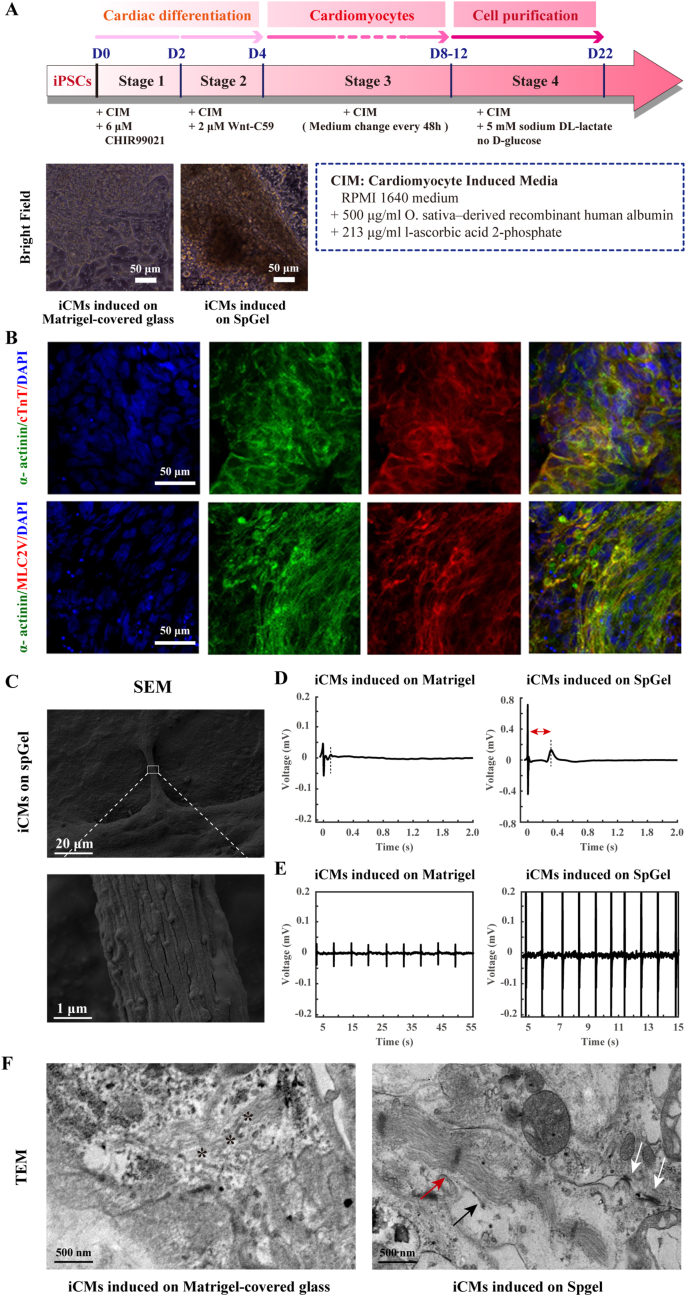
Cell therapy has been a promising strategy for cardiac repair after myocardial infarction (MI), but a poor ischemic environment and low cell delivery efficiency remain significant challenges. The spleen serves as a hematopoietic stem cell niche and secretes cardioprotective factors after MI, but it is unclear whether it could be used for human pluripotent stem cell (hiPSC) cultivation and provide a proper microenvironment for cell grafts against the ischemic environment. Herein, we developed a splenic extracellular matrix derived thermoresponsive hydrogel (SpGel). Proteomics analysis indicated that SpGel is enriched with proteins known to modulate the Wnt signaling pathway, cell-substrate adhesion, cardiac muscle contraction and oxidation-reduction processes. studies demonstrated that hiPSCs could be efficiently induced into endothelial cells (iECs) and cardiomyocytes (iCMs) with enhanced function on SpGel. The cytoprotective effect of SpGel on iECs/iCMs against oxidative stress damage was also proven. Furthermore, studies revealed that iEC/iCM-laden SpGel improved cardiac function and inhibited cardiac fibrosis of infarcted hearts by improving cell survival, revascularization and remuscularization. In conclusion, we successfully established a novel platform for the efficient generation and delivery of autologous cell grafts, which could be a promising clinical therapeutic strategy for cardiac repair and regeneration after MI.
细胞疗法一直是心肌梗死(MI)后心脏修复的一种有前景的策略,但缺血环境恶劣和细胞递送效率低仍然是重大挑战。脾脏作为造血干细胞龛,在MI后分泌心脏保护因子,但尚不清楚它是否可用于人类多能干细胞(hiPSC)培养,并为细胞移植提供一个合适的微环境以对抗缺血环境。在此,我们开发了一种源自脾脏细胞外基质的热响应水凝胶(SpGel)。蛋白质组学分析表明,SpGel富含已知可调节Wnt信号通路、细胞与底物粘附、心肌收缩和氧化还原过程的蛋白质。研究表明,hiPSC可在SpGel上高效诱导分化为内皮细胞(iEC)和心肌细胞(iCM),且功能增强。还证实了SpGel对iEC/iCM抗氧化应激损伤的细胞保护作用。此外,研究表明,负载iEC/iCM的SpGel通过提高细胞存活率、促进血管再生和心肌再生,改善了梗死心脏的心脏功能并抑制了心脏纤维化。总之,我们成功建立了一个用于高效生成和递送自体细胞移植物的新平台,这可能是MI后心脏修复和再生的一种有前景的临床治疗策略。