Grupo de Investigación de Fotoquímica y Fotobiología, Química, Universidad del Atlántico, Carrera 30 Número 8-49, Puerto Colombia 081008, Colombia.
Department of Chemical and Biomolecular Engineering, University of Tennessee, Knoxville, TN 37996, USA.
Molecules. 2023 Feb 17;28(4):1920. doi: 10.3390/molecules28041920.
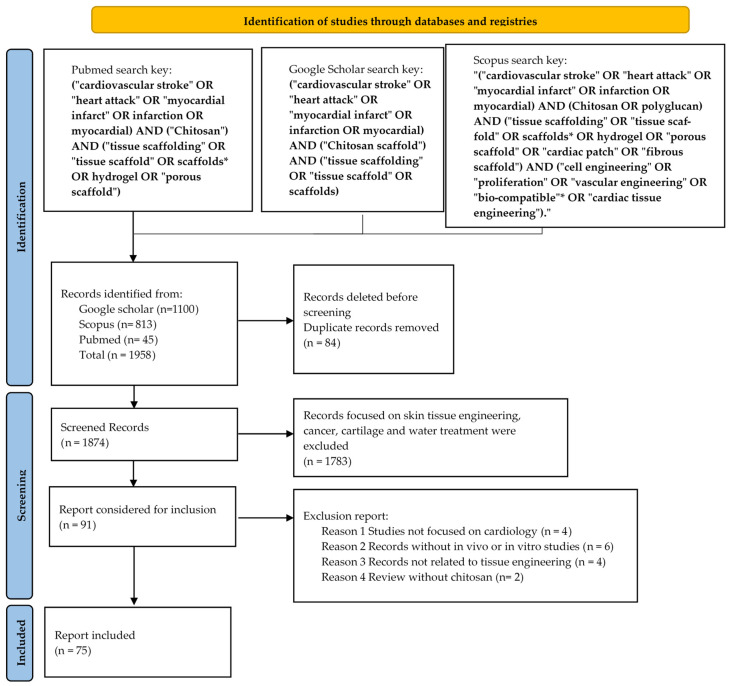
Cardiovascular diseases (CVD), such as myocardial infarction (MI), constitute one of the world's leading causes of annual deaths. This cardiomyopathy generates a tissue scar with poor anatomical properties and cell necrosis that can lead to heart failure. Necrotic tissue repair is required through pharmaceutical or surgical treatments to avoid such loss, which has associated adverse collateral effects. However, to recover the infarcted myocardial tissue, biopolymer-based scaffolds are used as safer alternative treatments with fewer side effects due to their biocompatibility, chemical adaptability and biodegradability. For this reason, a systematic review of the literature from the last five years on the production and application of chitosan scaffolds for the reconstructive engineering of myocardial tissue was carried out. Seventy-five records were included for review using the "preferred reporting items for systematic reviews and meta-analyses" data collection strategy. It was observed that the chitosan scaffolds have a remarkable capacity for restoring the essential functions of the heart through the mimicry of its physiological environment and with a controlled porosity that allows for the exchange of nutrients, the improvement of the electrical conductivity and the stimulation of cell differentiation of the stem cells. In addition, the chitosan scaffolds can significantly improve angiogenesis in the infarcted tissue by stimulating the production of the glycoprotein receptors of the vascular endothelial growth factor (VEGF) family. Therefore, the possible mechanisms of action of the chitosan scaffolds on cardiomyocytes and stem cells were analyzed. For all the advantages observed, it is considered that the treatment of MI with the chitosan scaffolds is promising, showing multiple advantages within the regenerative therapies of CVD.
心血管疾病(CVD),如心肌梗死(MI),是全球主要的年度死亡原因之一。这种心肌病会产生组织疤痕,具有较差的解剖学特性和细胞坏死,可能导致心力衰竭。需要通过药物或手术治疗来修复坏死组织,以避免这种损失,因为这会带来不良的副作用。然而,为了恢复梗死的心肌组织,可以使用基于生物聚合物的支架作为更安全的替代治疗方法,因为它们具有更好的生物相容性、化学适应性和生物降解性,因此副作用更少。出于这个原因,对过去五年关于壳聚糖支架在心肌组织重建工程中的生产和应用的文献进行了系统综述。使用“系统评价和荟萃分析的首选报告项目”数据收集策略,共纳入了 75 份记录进行综述。观察到壳聚糖支架通过模拟其生理环境和具有控制的孔隙率,具有恢复心脏基本功能的显著能力,这允许营养物质的交换、电导率的提高和干细胞的分化刺激。此外,壳聚糖支架可以通过刺激血管内皮生长因子(VEGF)家族的糖蛋白受体的产生,显著促进梗死组织中的血管生成。因此,分析了壳聚糖支架对心肌细胞和干细胞的可能作用机制。鉴于观察到的所有优势,认为壳聚糖支架治疗 MI 是有前途的,它在 CVD 的再生治疗中具有多种优势。