Schauwvlieghe A, Dunbar A, Storme E, Vlak A, Aerts R, Maertens J, Sciot B, Van Der Wel T, Papageorgiou G, Moors I, Cornelissen J J, Rijnders B J A, Mercier T
Department of hematology, Ghent University Hospital, Gent, Belgium.
Internal Medicine, Infectious Diseases, Erasmus University Medical Center, Rotterdam, Netherlands.
EClinicalMedicine. 2021 Apr 25;35:100855. doi: 10.1016/j.eclinm.2021.100855. eCollection 2021 May.
Induction chemotherapy for acute myeloid leukemia (AML) or myelodysplastic syndrome (MDS) is almost universally complicated by febrile neutropenia(FN). Empirical broad-spectrum antibiotic therapy (EBAT) strategies advocated by guidelines result in long periods of broad-spectrum antibiotic therapy. We compared the outcome of AML/MDS patients treated with a 3-day versus a prolonged (until neutrophil recovery) regimen.
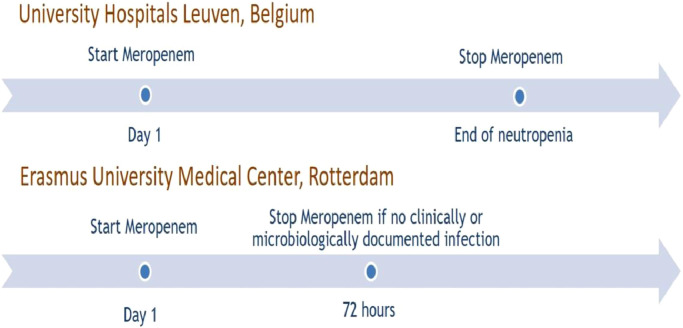
This is a retrospective comparative cohort study in AML or MDS patients undergoing remission-induction chemotherapy from 2011 to 2019, comparing 2 tertiary care hospitals with different strategies regarding antibiotic treatment for FN. At Erasmus University medical center(EMC), EBAT was stopped after 3 days of FN, in absence of a clinically or microbiologically documented infection. In the University Hospitals Leuven(UZL), a prolonged strategy was used, where EBAT was given until neutrophil recovery. The primary endpoint was a serious medical complication(SMC) defined as death or ICU admission in the 30 days after the start of chemotherapy.
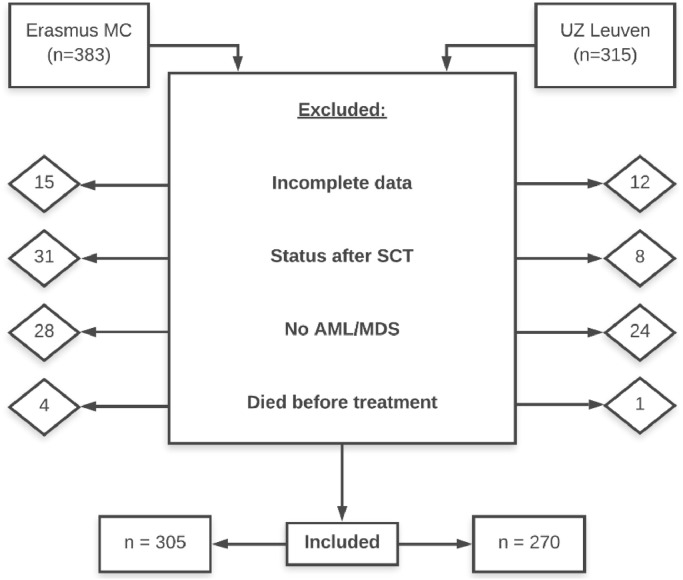
305 and 270 AML or MDS patients received chemotherapy at EMC and UZL, respectively. Broad-spectrum antibiotic treatment was given for a median of 19 days (IQR13-25) at UZL versus 9 days at EMC (IQR5-13) ( <0·001). With the 3-day EBAT strategy, an SMC was observed in 12·5% versus 8·9% with the prolonged strategy ( = 0·17). The hazard ratio for an SMC was not significantly higher with the 3-day strategy (HR 1·357,95%CI 0·765-2·409).
This study suggests that during remission induction chemotherapy it is safe to stop antibiotics after 3 days of FN in absence of infection. A comparison of both strategies in a prospective trial should be pursued.
急性髓系白血病(AML)或骨髓增生异常综合征(MDS)的诱导化疗几乎普遍会并发发热性中性粒细胞减少症(FN)。指南所倡导的经验性广谱抗生素治疗(EBAT)策略会导致长时间的广谱抗生素治疗。我们比较了接受3天疗程与延长疗程(直至中性粒细胞恢复)治疗的AML/MDS患者的结局。
这是一项针对2011年至2019年期间接受缓解诱导化疗的AML或MDS患者的回顾性比较队列研究,比较了两家采用不同FN抗生素治疗策略的三级医疗机构。在伊拉斯谟大学医学中心(EMC),若不存在临床或微生物学记录的感染,FN持续3天后即停止EBAT。在鲁汶大学医院(UZL),采用的是延长疗程策略,即EBAT持续至中性粒细胞恢复。主要终点是严重医学并发症(SMC),定义为化疗开始后30天内的死亡或入住重症监护病房。
分别有305例和270例AML或MDS患者在EMC和UZL接受了化疗。UZL的广谱抗生素治疗中位时长为19天(四分位间距13 - 25),而EMC为9天(四分位间距5 - 13)(P<0·001)。采用3天EBAT策略时,观察到SMC的比例为12·5%,延长疗程策略为8·9%(P = 0·17)。3天策略的SMC风险比并无显著更高(风险比1·357,95%置信区间0·765 - 2·409)。
本研究表明,在缓解诱导化疗期间,若不存在感染,FN持续3天后停用抗生素是安全的。应在前瞻性试验中对这两种策略进行比较。