
挽救性与初次机器人辅助根治性前列腺切除术:一项来自大型三级中心的倾向评分匹配比较有效性研究。
Salvage Versus Primary Robot-assisted Radical Prostatectomy: A Propensity-matched Comparative Effectiveness Study from a High-volume Tertiary Centre.
作者信息
Nathan Arjun, Fricker Monty, De Groote Ruben, Arora Amandeep, Phuah Yuzhi, Flora Kiran, Patel Sonam, Kasivisvanathan Veeru, Sridhar Ashwin, Shaw Greg, Kelly John, Briggs Tim, Rajan Prabhakar, Sooriakumaran Prasanna, Nathan Senthil
机构信息
Department of Uro-oncology, University College London Hospitals NHS Foundation Trust, London, UK.
University College London, London, UK.
出版信息
Eur Urol Open Sci. 2021 May;27:43-52. doi: 10.1016/j.euros.2021.03.003.
BACKGROUND
Salvage robot-assisted radical prostatectomy (sRARP) is a potential treatment option for locally recurrent prostate cancer (PCa) after nonsurgical primary treatment. There are minimal data comparing outcomes between propensity-matched sRARP and primary robot-assisted radical prostatectomy (RARP).
OBJECTIVE
The primary objective is to compare perioperative, oncological, and functional outcomes of sRARP with primary RARP, and the secondary is to compare outcomes between sRARP after whole and focal gland therapy.
DESIGN SETTING AND PARTICIPANTS
A 1:1 propensity-matched comparison was carried out of 135 sRARP cases with primary RARP cases from a cohort of 3852 consecutive patients from a high-volume tertiary centre.
OUTCOME MEASUREMENTS AND STATISTICAL ANALYSIS
Perioperative, oncological, and functional outcomes including complication rates, positive surgical margins, biochemical recurrence (BCR), continence, and erectile dysfunction (ED) were retrospectively collected.
RESULTS AND LIMITATIONS
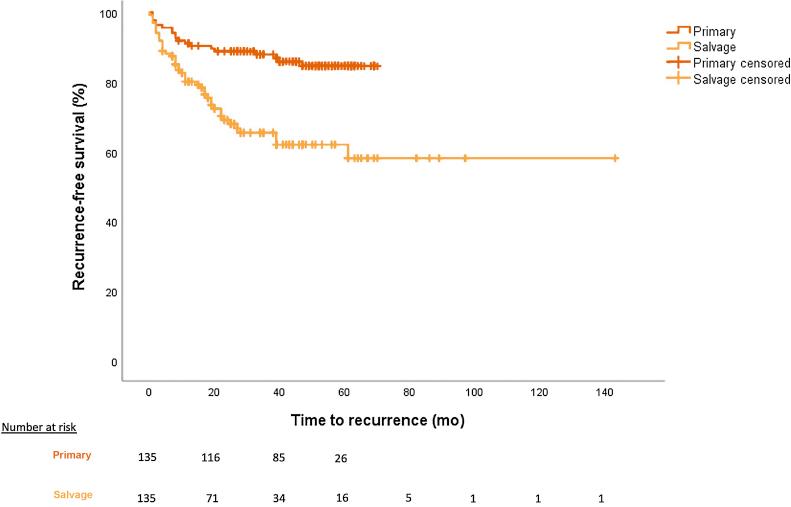
There were no significant differences in patient characteristics between sRARP and primary RARP groups. In the salvage and primary groups, median (interquartile range) follow-up periods were 521 (304-951) and 638 (394-951) d, grade III-V Clavien-Dindo complication rates were 1.5% and 0% ( = 0.310), BCR rates were 31.9% and 14.1% ( < 0.001) at the last follow-up, pad-free continence rates were 78.8% and 84.3% at 2 yr ( = 0.337), and ED rates were 94.8% and 76.3% ( < 0.001), respectively. Comparing the whole and focal gland groups, BCR rates were 36.7% and 29.1% ( = 0.687) at follow-up, pad-free continence rates were 53.1% and 89.3% at 2 yr ( < 0.001), and ED rates were 98% and 93% ( = 0.214), respectively.
CONCLUSIONS
Salvage RARP has similar perioperative outcomes to primary RARP with inferior potency rates. Post-focal therapy sRARP has similar recurrence and continence rates to primary RARP. Post-whole gland therapy, complication, and recurrence rates are higher, and there is a higher risk of urinary incontinence.
PATIENT SUMMARY
We report the largest propensity-matched comparison of salvage robot-assisted radical prostatectomy (RARP) after focal and whole gland therapy. Salvage RARP is a feasible procedure for the treatment of locally recurrent prostate cancer in high-volume centres; however, patients should be counselled appropriately as to the different outcomes.
背景
挽救性机器人辅助根治性前列腺切除术(sRARP)是局部复发前列腺癌(PCa)经非手术初始治疗后的一种潜在治疗选择。关于倾向评分匹配的sRARP与初始机器人辅助根治性前列腺切除术(RARP)疗效对比的数据极少。
目的
主要目的是比较sRARP与初始RARP的围手术期、肿瘤学及功能学疗效,次要目的是比较全腺治疗和局灶性治疗后的sRARP疗效。
设计、地点和参与者:对来自一家大型三级中心的3852例连续患者队列中的135例sRARP病例与初始RARP病例进行1:1倾向评分匹配比较。
结局测量和统计分析
回顾性收集围手术期、肿瘤学及功能学疗效,包括并发症发生率、手术切缘阳性、生化复发(BCR)、控尿及勃起功能障碍(ED)情况。
结果与局限性
sRARP组与初始RARP组患者特征无显著差异。在挽救性治疗组和初始治疗组中,中位(四分位间距)随访时间分别为521(304 - 951)天和638(394 - 951)天,Ⅲ - Ⅴ级Clavien - Dindo并发症发生率分别为1.5%和0%(P = 0.310),末次随访时BCR发生率分别为31.9%和14.1%(P < 0.001),2年时无尿垫控尿率分别为78.8%和84.3%(P = 0.337),ED发生率分别为94.8%和76.3%(P < 0.001)。比较全腺治疗组和局灶性治疗组,随访时BCR发生率分别为36.7%和29.1%(P = 0.687),2年时无尿垫控尿率分别为53.1%和89.3%(P < 0.001),ED发生率分别为98%和93%(P = 0.214)。
结论
挽救性RARP围手术期疗效与初始RARP相似,但性功能恢复率较低。局灶性治疗后sRARP的复发率和控尿率与初始RARP相似。全腺治疗后,并发症和复发率更高,尿失禁风险更高。
患者总结
我们报告了局灶性和全腺治疗后挽救性机器人辅助根治性前列腺切除术(RARP)最大规模的倾向评分匹配比较。挽救性RARP是高容量中心治疗局部复发前列腺癌的可行方法;然而,应就不同疗效对患者进行适当的咨询。

 Zotero 插件