Canopy Growth Corporation, Smiths Falls, Ontario, Canada.
NemaLife, Inc., Lubbock, Texas, USA.
Cannabis Cannabinoid Res. 2021 Dec;6(6):522-527. doi: 10.1089/can.2020.0103. Epub 2020 Nov 20.
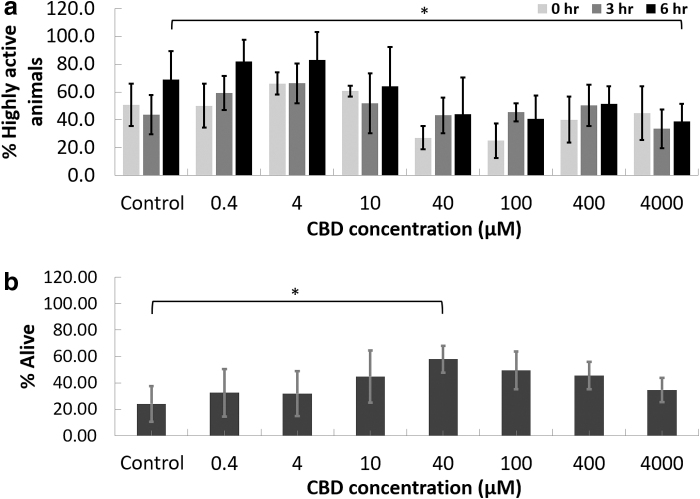
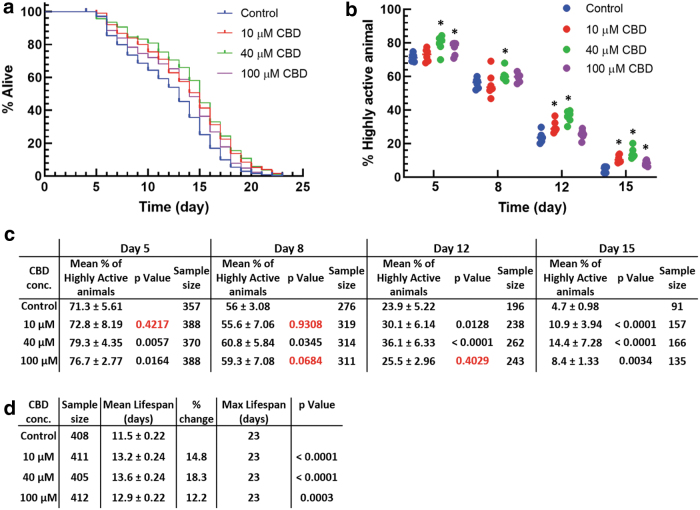
Despite widespread use of cannabidiol (CBD), no lifelong toxicity study has been published to date. is often used in preclinical lifelong toxicity studies, due to an estimated 60-80% of their genes having a human ortholog, and their short lifespan of ∼2-3 weeks. In this study, we examined both acute and long-term exposure studies of CBD at physiologically relevant concentrations. Acute toxicity was determined by treating day 1 adults with a wide range of CBD concentrations (0.4 μM to 4 mM) and assessing mortality and motility compared to control animals. Thermotolerance was examined by treating adult animals with CBD (0.4 μM to 4 mM) and exposing them to 37°C for 4 h, and then scoring for the number of alive animals treated with CBD compared to controls. Long-term toxicity was assessed by exposing day 1 adults to 10, 40, and 100 μM CBD until all animals perished. Control animals had no active drug exposure. We report both acute and long-term exposure studies of CBD to adult at physiologically relevant concentrations. Acute toxicity results showed that no animal died when exposed to 0.4-4000 μM CBD. The thermotolerance study showed that 40 μM CBD, but not other treatment levels, significantly increased resistance to heat stress by 141% compared to the untreated controls. Notably, whole-life exposure of to 10-100 μM CBD revealed a maximum life extension of 18% observed at 40 μM CBD. In addition, motility analysis of the same groups revealed an increase in late-stage life activity by up to 206% compared to controls. These results serve as the only CBD lifelong exposure data in an model to date. While further research into the lifelong use of CBD should be carried out in mammalian models, the model indicates a lack of long-term toxicity at physiologically relevant concentrations.
尽管大麻二酚(CBD)被广泛应用,但迄今为止尚未公布其终生毒性研究结果。由于其约 60-80%的基因与人源基因具有同源性,且寿命较短(约 2-3 周),因此常被用于临床前的终生毒性研究。在本研究中,我们检测了 CBD 在生理相关浓度下的急性和长期暴露研究。急性毒性通过用广泛浓度范围的 CBD(0.4 μM 至 4 mM)处理第一天的成虫,并与对照动物相比评估死亡率和运动性来确定。耐热性通过用 CBD(0.4 μM 至 4 mM)处理成年动物并将其暴露于 37°C 4 小时来检测,然后计算用 CBD 处理的存活动物数量与对照动物相比。长期毒性通过将第一天的成虫暴露于 10、40 和 100 μM CBD 中,直到所有动物死亡来评估。对照动物未进行药物暴露。我们报告了 CBD 对成年 生理相关浓度的急性和长期暴露研究。急性毒性结果表明,当暴露于 0.4-4000 μM CBD 时,没有动物死亡。耐热性研究表明,40 μM CBD 而不是其他处理水平,与未处理的对照相比,使对热应激的抗性显著增加了 141%。值得注意的是,对 10-100 μM CBD 的终生暴露显示,在 40 μM CBD 下观察到最大寿命延长 18%。此外,对同一组的运动性分析表明,与对照相比,晚期生命活动增加了高达 206%。这些结果是迄今为止在 模型中唯一的 CBD 终生暴露数据。虽然应该在哺乳动物模型中进行 CBD 终身使用的进一步研究,但 模型表明在生理相关浓度下没有长期毒性。