Department of Computational Medicine and Bioinformatics, University of Michigan, Ann Arbor, Michigan, USA.
Department of Microbiology and Immunology, University of Michigan, Ann Arbor, Michigan, USA.
Clin Infect Dis. 2021 Oct 20;73(8):1431-1439. doi: 10.1093/cid/ciab457.
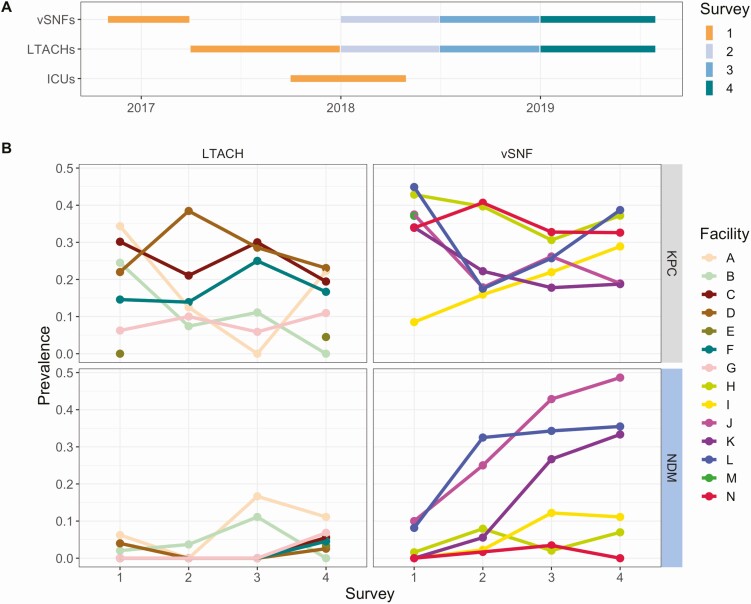
Carbapenem-resistant Enterobacterales (CRE) harboring blaKPC have been endemic in Chicago-area healthcare networks for more than a decade. During 2016-2019, a series of regional point-prevalence surveys identified increasing prevalence of blaNDM-containing CRE in multiple long-term acute care hospitals (LTACHs) and ventilator-capable skilled nursing facilities (vSNFs). We performed a genomic epidemiology investigation of blaNDM-producing CRE to understand their regional emergence and spread.
We performed whole-genome sequencing on New Delhi metallo-beta-lactamase (NDM)+ CRE isolates from 4 point-prevalence surveys across 35 facilities (LTACHs, vSNFs, and acute care hospital medical intensive care units) in the Chicago area and investigated the genomic relatedness and transmission dynamics of these isolates over time.
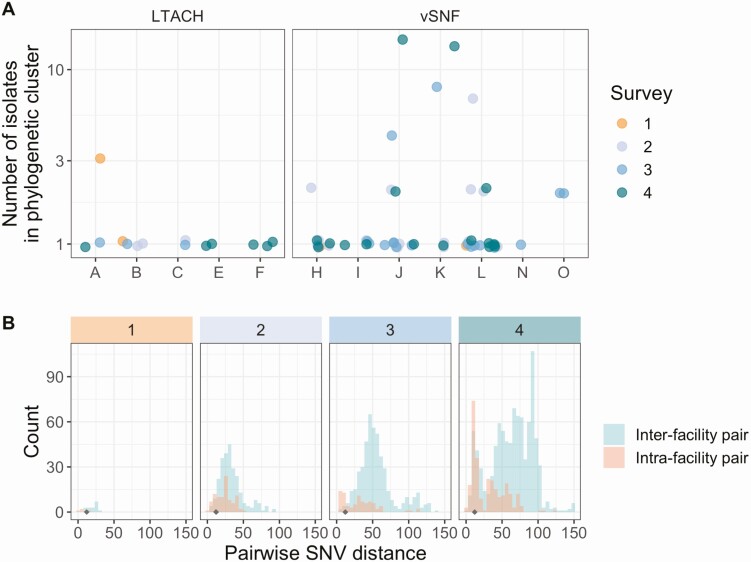
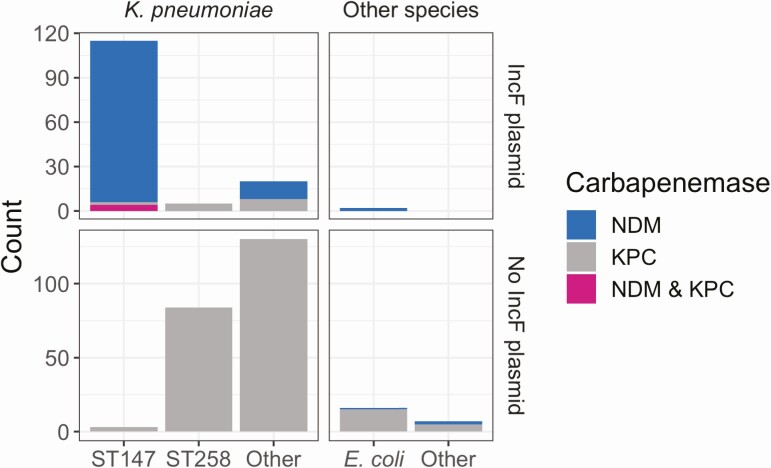
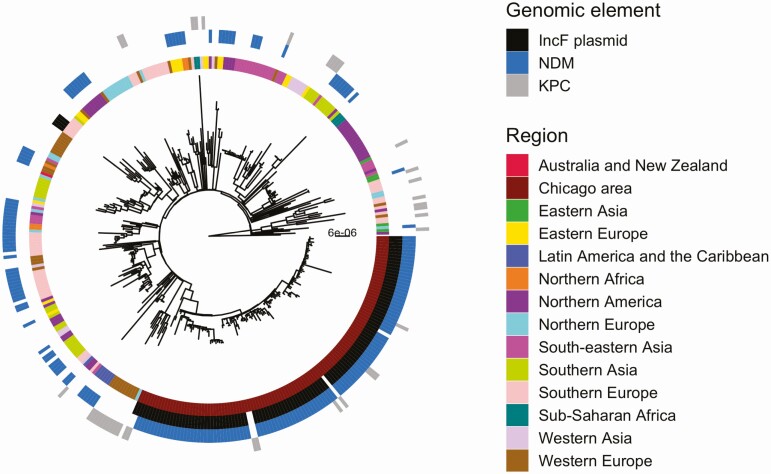
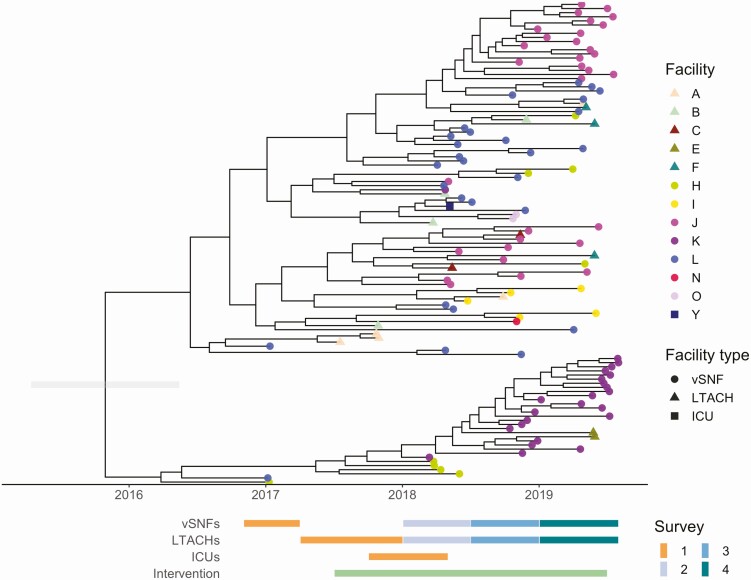
Genomic analyses revealed that the rise of NDM+ CRE was due to the clonal dissemination of an sequence type (ST) 147 Klebsiella pneumoniae strain harboring blaNDM-1 on an IncF plasmid. Dated phylogenetic reconstructions indicated that ST147 was introduced into the region around 2013 and likely acquired NDM around 2015. Analyzing the relatedness of strains within and between facilities supported initial increases in prevalence due to intrafacility transmission in certain vSNFs, with evidence of subsequent interfacility spread among LTACHs and vSNFs connected by patient transfer.
We identified a regional outbreak of blaNDM-1 ST147 that began in and disseminated across Chicago area post-acute care facilities. Our findings highlight the importance of performing genomic surveillance at post-acute care facilities to identify emerging threats.
携带 blaKPC 的碳青霉烯类耐药肠杆菌科 (CRE) 在芝加哥地区的医疗网络中流行已有十多年。在 2016 年至 2019 年期间,一系列区域性的时点患病率调查发现,在多家长期急性护理医院 (LTACH) 和有能力提供呼吸机的熟练护理设施 (vSNF) 中,blaNDM 耐药 CRE 的流行率不断上升。我们对产 blaNDM 的 CRE 进行了基因组流行病学调查,以了解其区域性的出现和传播情况。
我们对来自芝加哥地区 35 家医疗机构(LTACH、vSNF 和急性护理医院重症监护病房)的 4 次时点患病率调查中的blaNDM+CRE 分离株进行了全基因组测序,并对这些分离株的基因组相关性和随时间推移的传播动态进行了调查。
基因组分析显示,NDM+CRE 的增加是由于携带 blaNDM-1 的 ST147 型肺炎克雷伯菌克隆传播所致,该菌带有 IncF 质粒。定年系统发育重建表明,ST147 于 2013 年左右引入该地区,可能于 2015 年左右获得了 blaNDM。对设施内和设施间菌株的相关性分析支持了最初由于某些 vSNF 内的传播导致患病率增加,有证据表明随后在 LTACH 和 vSNF 之间发生了传播,这些设施通过患者转移相互连接。
我们发现了 blaNDM-1 ST147 在芝加哥地区的急性后护理设施中爆发和传播。我们的研究结果强调了在急性后护理设施进行基因组监测以识别新出现威胁的重要性。