Faculty of Medicine, Institute of Microbiology and Immunology, University of Ljubljana, Ljubljana, Slovenia.
Department of Medical Microbiology and Infection Prevention, University Medical Center Groningen, University of Groningen, Groningen, Netherlands.
PLoS One. 2020 Apr 13;15(4):e0231503. doi: 10.1371/journal.pone.0231503. eCollection 2020.
The first hospital outbreak of carbapenemase-producing Enterobacteriaceae in Slovenia occurred in 2014-2016. Whole genome sequencing was used to analyse the population of carbapenem-resistant Klebsiella pneumoniae collected in Slovenia in 2014-2017, including OXA-48 and/or NDM-1 producing strains from the outbreak.
A total of 32 K. pneumoniae isolates were analysed using short-read sequencing. Multi-locus sequence typing and core genome multi-locus sequence typing were used to infer genetic relatedness. Antimicrobial resistance markers, virulence factors, plasmid content and wzi types were determined. Long-read sequencing was used for six isolates for detailed analysis of plasmids and their possible transmission.
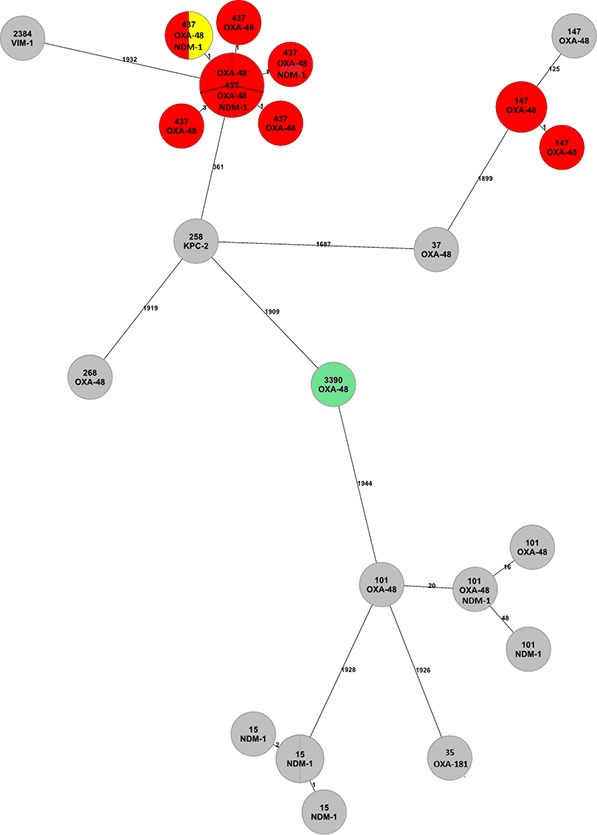
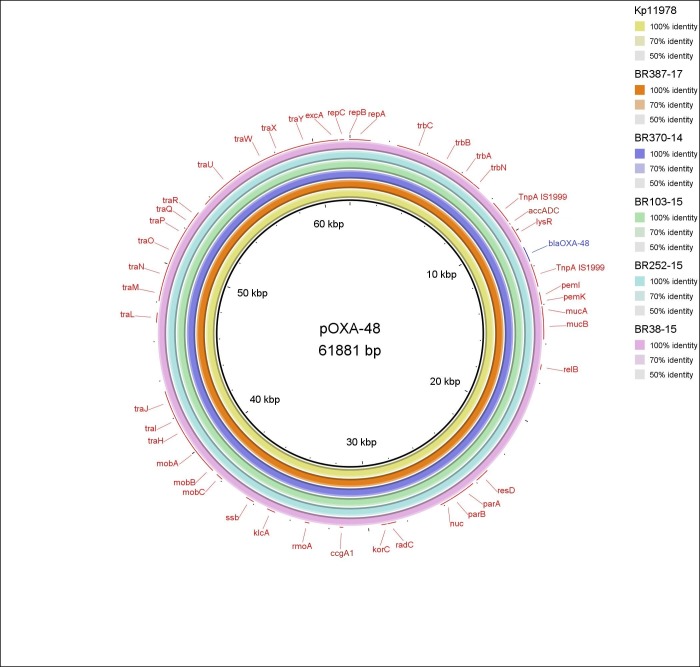
Overall, we detected 10 different sequence types (STs), the most common being ST437 (40.6%). Isolates from the initial outbreak belonged to ST437 (12/16) and ST147 (4/16). A second outbreak of four ST15 isolates was discovered. A new ST (ST3390) and two new wzi types (wzi-556, wzi-559) were identified. blaOXA-48 was found in 17 (53.1%) isolates, blaNDM-1 in five (15.6%), and a combination of blaOXA-48/NDM-1 in seven (21.9%) isolates. Identical plasmids carrying blaOXA-48 were found in outbreak isolates sequenced with long-read sequencing technology.
Whole genome sequencing of Slovenian carbapenem-resistant K. pneumoniae isolates revealed multiple clusters of STs, two of which were involved in the first hospital outbreak of carbapenem producing K. pneumoniae in Slovenia. Transmission of the plasmid carrying blaOXA-48 between two STs was likely to have occurred. A previously unidentified second outbreak was also discovered, highlighting the importance of whole genome sequencing in detection and/or characterization of hospital outbreaks and surveillance of drug-resistant bacterial clones.
斯洛文尼亚首次发生碳青霉烯酶产生肠杆菌科医院感染是在 2014-2016 年。本研究采用全基因组测序分析了 2014-2017 年斯洛文尼亚收集的碳青霉烯类耐药肺炎克雷伯菌,包括暴发期间产 OXA-48 和/或 NDM-1 的菌株。
对 32 株肺炎克雷伯菌进行短读长测序分析。多位点序列分型和核心基因组多位点序列分型用于推断遗传关系。测定了抗生素耐药标记物、毒力因子、质粒含量和 wzi 型。对 6 株分离株进行长读长测序,以详细分析质粒及其可能的传播。
共检测到 10 种不同的序列型(ST),最常见的是 ST437(40.6%)。初始暴发的分离株属于 ST437(12/16)和 ST147(4/16)。发现了 4 株 ST15 的第二次暴发。发现了一种新的 ST(ST3390)和两种新的 wzi 型(wzi-556,wzi-559)。17 株(53.1%)分离株携带 blaOXA-48,5 株(15.6%)携带 blaNDM-1,7 株(21.9%)携带 blaOXA-48/NDM-1。使用长读长测序技术对暴发分离株进行测序发现,blaOXA-48 携带的相同质粒。
对斯洛文尼亚碳青霉烯类耐药肺炎克雷伯菌分离株的全基因组测序揭示了多个 ST 簇,其中两个簇与斯洛文尼亚首次发生产碳青霉烯酶肺炎克雷伯菌医院感染有关。ST 之间 blaOXA-48 携带质粒的传播可能已经发生。还发现了以前未识别的第二次暴发,这突显了全基因组测序在检测和/或描述医院暴发以及监测耐药细菌克隆中的重要性。