Department of Plant and Environmental Sciences, New Mexico State University, NM, 88003, Las Cruces, USA.
Chile Pepper Institute, New Mexico State University, 88003, Las Cruces, NM, USA.
BMC Genomics. 2021 May 17;22(1):356. doi: 10.1186/s12864-021-07662-7.
Chile peppers (Capsicum spp.) are among the most important horticultural crops in the world due to their number of uses. They are considered a major cultural and economic crop in the state of New Mexico in the United States. Evaluating genetic diversity in current New Mexican germplasm would facilitate genetic improvement for different traits. This study assessed genetic diversity, population structure, and linkage disequilibrium (LD) among 165 chile pepper genotypes using single nucleotide polymorphism (SNP) markers derived from genotyping-by-sequencing (GBS).
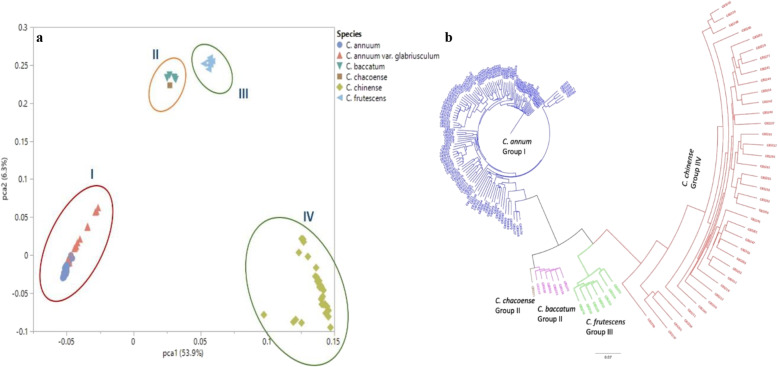
A GBS approach identified 66,750 high-quality SNP markers with known map positions distributed across the 12 chromosomes of Capsicum. Principal components analysis revealed four distinct clusters based on species. Neighbor-joining phylogenetic analysis among New Mexico State University (NMSU) chile pepper cultivars showed two main clusters, where the C. annuum genotypes grouped together based on fruit or pod type. A Bayesian clustering approach for the Capsicum population inferred K = 2 as the optimal number of clusters, where the C. chinense and C. frutescens grouped in a single cluster. Analysis of molecular variance revealed majority of variation to be between the Capsicum species (76.08 %). Extensive LD decay (~ 5.59 Mb) across the whole Capsicum population was observed, demonstrating that a lower number of markers would be required for implementing genome wide association studies for different traits in New Mexican type chile peppers. Tajima's D values demonstrated positive selection, population bottleneck, and balancing selection for the New Mexico Capsicum population. Genetic diversity for the New Mexican chile peppers was relatively low, indicating the need to introduce new alleles in the breeding program to broaden the genetic base of current germplasm.
Genetic diversity among New Mexican chile peppers was evaluated using GBS-derived SNP markers and genetic relatedness on the species level was observed. Introducing novel alleles from other breeding programs or from wild species could help increase diversity in current germplasm. We present valuable information for future association mapping and genomic selection for different traits for New Mexican chile peppers for genetic improvement through marker-assisted breeding.
智利辣椒(Capsicum spp.)因其用途广泛而成为世界上最重要的园艺作物之一。它们被认为是美国新墨西哥州的主要文化和经济作物。评估当前新墨西哥州种质资源的遗传多样性将有助于不同性状的遗传改良。本研究利用基于测序的基因型(GBS)获得的单核苷酸多态性(SNP)标记评估了 165 个智利辣椒基因型的遗传多样性、群体结构和连锁不平衡(LD)。
GBS 方法鉴定了 66750 个具有已知图谱位置的高质量 SNP 标记,这些标记分布在辣椒的 12 条染色体上。主成分分析根据物种显示了四个不同的聚类。新墨西哥州立大学(NMSU)智利辣椒品种的邻接聚类分析显示,有两个主要聚类,其中根据果实或豆荚类型将 C. annuum 基因型聚为一类。Capsicum 群体的贝叶斯聚类分析推断 K=2 为最佳聚类数,其中 C. chinense 和 C. frutescens 聚为一类。基于分子方差的分析表明,大部分变异来自于辣椒种间(76.08%)。在整个 Capsicum 群体中观察到广泛的 LD 衰减(~5.59 Mb),表明对于新墨西哥型智利辣椒的不同性状,实施全基因组关联研究所需的标记数量较少。Tajima's D 值表明新墨西哥州 Capsicum 群体存在正选择、种群瓶颈和平衡选择。新墨西哥州智利辣椒的遗传多样性相对较低,表明需要在育种计划中引入新的等位基因,以扩大当前种质的遗传基础。
本研究利用 GBS 衍生的 SNP 标记评估了新墨西哥州智利辣椒的遗传多样性,并观察到种间的遗传关系。从其他育种计划或野生种中引入新的等位基因可以帮助增加当前种质的多样性。我们为未来新墨西哥州智利辣椒的不同性状的关联作图和基因组选择提供了有价值的信息,以通过标记辅助选择进行遗传改良。