Department of Physical Therapy, Assuta Medical Center, Tel Aviv, Israel.
Department of Physical Therapy, Recanati School for Community Health Professions, Faculty of Health Sciences, Ben-Gurion University of the Negev, Beer Sheva, Israel.
Sci Rep. 2021 May 17;11(1):10432. doi: 10.1038/s41598-021-89908-8.
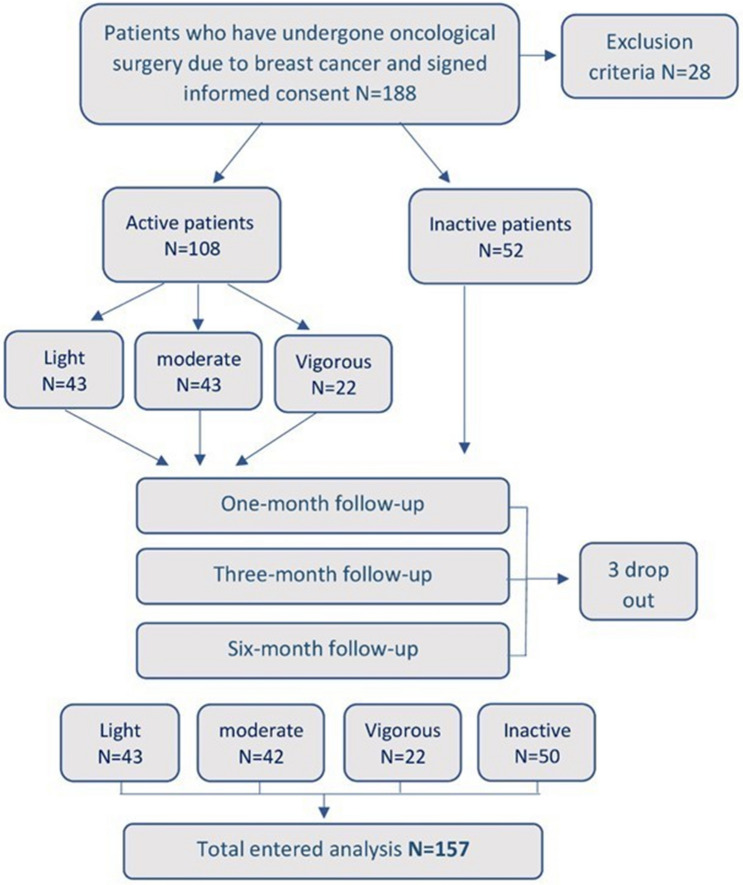
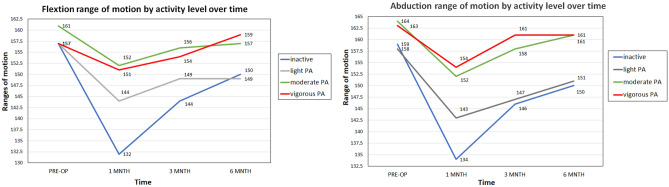
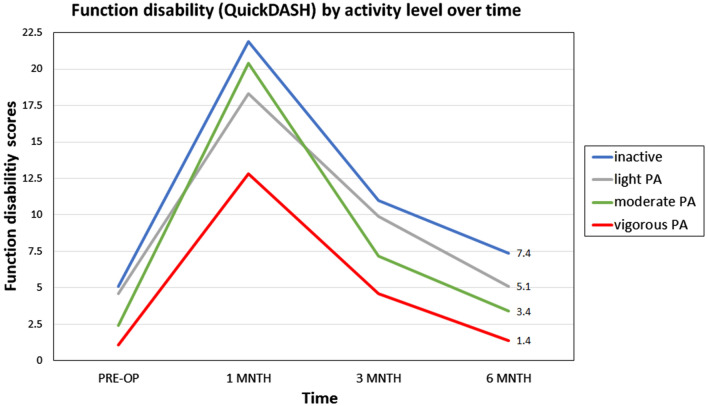
After breast cancer (BC) surgery, women may experience a physical decline. The effect of physical activity (PA) on the course of recovery after BC surgery has not yet been thoroughly examined. To analyze the impact of physical activity performed by women undergoing breast cancer surgery on measures of function, range of motion, and self-efficacy. A prospective study was carried out in 157 patients who underwent surgery for BC between October 2018 and April 2019, divided into four groups according to the intensity of PA with 6 months follow-up. 50 sedentary patients and 107 active patients were enrolled; the mean age was 52.6. Women who performed physical activity, moderate to vigorous, demonstrated lower function disabilities (QuickDASH 2.22) compared with inactivity or light physical activity (QuickDASH 7.0, p < 0.001), with better shoulder flexion (159.0° vs. 150.7°, p = 0.007) and abduction (159.5° vs. 152.2°, p = 0.008). Higher PA levels, displayed in higher self-efficacy reports (9.5 vs. 8.8, p = 0.002), and return to prior job status (0.005). The PA level does not influence pain at one, three and 6 months postoperatively (p = 0.278, p = 0.304 and p = 0.304 respectively). High PA levels increase the risk of axillary web syndrome (p = 0.041), although, it reduces the incidence of chronic pain (p = 0.007). Women who practice physical activity recover better from BC surgery than sedentary women. The higher the intensity and frequency of training, the better the results. Vigorous activity cause axillary web syndrome, despite, it has a beneficial effect on lowering the rate of chronic pain.
乳腺癌(BC)手术后,女性可能会出现身体机能下降。身体活动(PA)对 BC 手术后康复过程的影响尚未得到彻底研究。分析乳腺癌手术后女性进行身体活动对功能、运动范围和自我效能的影响。这是一项前瞻性研究,共纳入了 157 名 2018 年 10 月至 2019 年 4 月间接受 BC 手术的患者,根据 PA 强度分为四组,随访 6 个月。共纳入了 50 名久坐不动的患者和 107 名积极运动的患者,平均年龄为 52.6 岁。与不活动或低强度身体活动(QuickDASH 7.0)相比,进行适度至剧烈身体活动的女性功能障碍(QuickDASH 2.22)较低(p<0.001),且肩部屈曲(159.0° vs. 150.7°,p=0.007)和外展(159.5° vs. 152.2°,p=0.008)更好。更高的 PA 水平表现为更高的自我效能报告(9.5 分 vs. 8.8 分,p=0.002)和恢复到先前的工作状态(0.005)。PA 水平不会影响术后 1、3 和 6 个月的疼痛(p=0.278、p=0.304 和 p=0.304)。高水平的 PA 增加腋网综合征的风险(p=0.041),尽管它降低了慢性疼痛的发生率(p=0.007)。与久坐不动的女性相比,进行身体活动的女性从 BC 手术中恢复得更好。训练的强度和频率越高,结果越好。剧烈活动会导致腋网综合征,但它对降低慢性疼痛的发生率有有益的影响。