Department of Neurobiology, Care Sciences and Society, Karolinska Institutet, Stockholm, Sweden.
Cancer Theme, Karolinska University Hospital, Stockholm, Sweden.
J Cancer Surviv. 2019 Apr;13(2):244-256. doi: 10.1007/s11764-019-00747-z. Epub 2019 Mar 25.
Whether the benefits of exercise during chemotherapy continue into survivorship is not well-known. Here, the aim was to examine the effects of two exercise interventions on self-reported health-related and objectively measured physiological outcomes 12 months following commencement of chemotherapy.
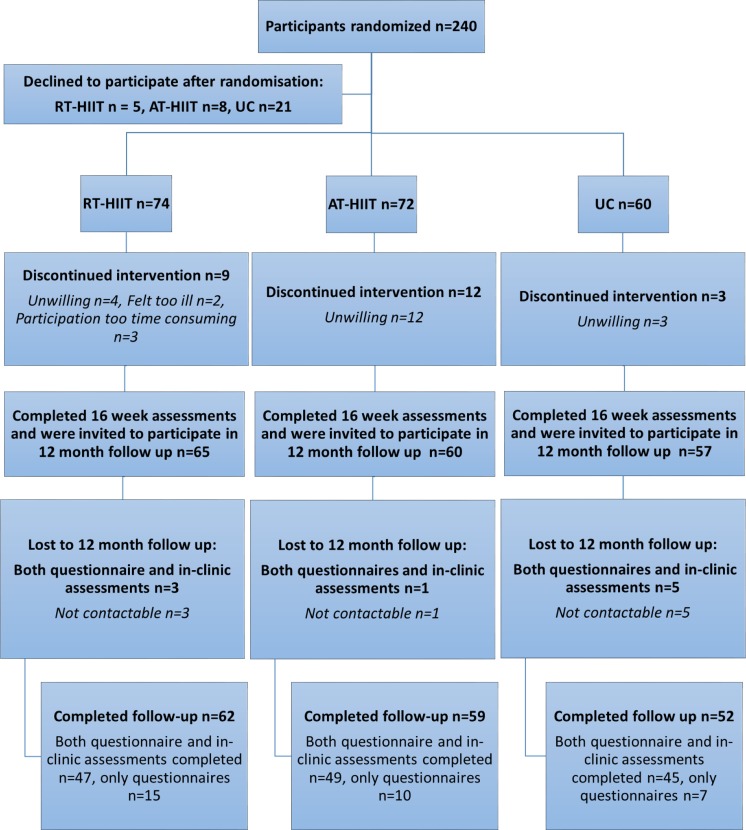
Two hundred and forty women with breast cancer stage I-IIIa were randomized to 16 weeks of high-intensity aerobic interval training combined with either resistance training (RT-HIIT), or moderate-intensity aerobic training (AT-HIIT), or to usual care (UC).
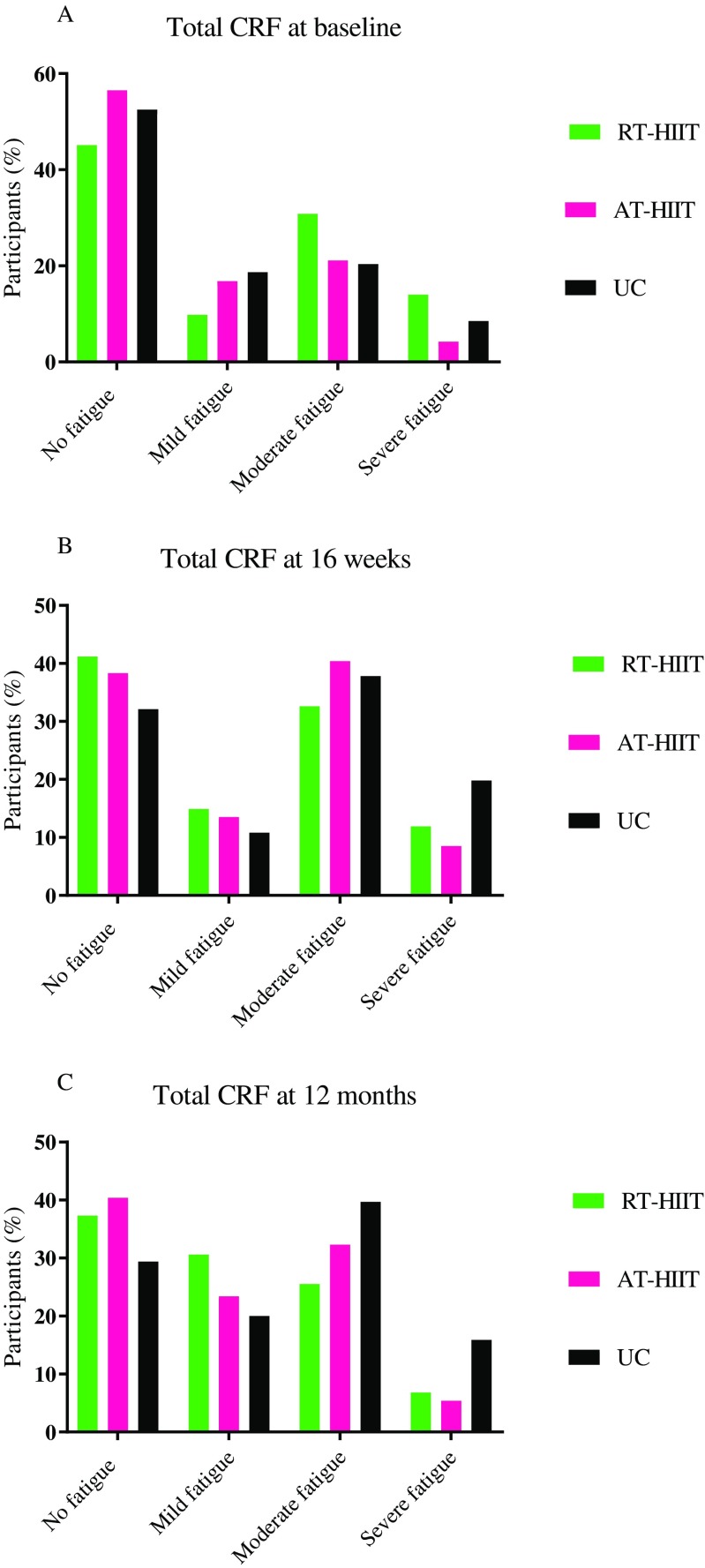
cancer-related fatigue (CRF); secondary outcomes: quality of life (QoL), symptom burden, muscle strength, cardiorespiratory-fitness, body mass, and return to work.
Compared to UC, both RT-HIIT and AT-HIIT significantly counteracted increases in total CRF (ES = - 0.34; ES = - 0.10), daily life CRF (ES=-0.76; ES=-0.50, and affective CRF (ES=-0.60; ES=-0.39). Both RT-HIIT and AT-HIIT reported significantly lower total symptoms (ES = - 0.46, ES = - 0.46), and displayed gains in lower limb (ES = 0.73; ES = 1.03) and handgrip muscle strength (surgery side ES = 0.70, ES = 0.71; non-surgery side ES = 0.57, ES = 0.59). AT-HIIT displayed significant reductions in body mass (ES = - 0.24), improved QoL: role (ES = 0.33) and emotional functioning (ES = 0.40), and a larger proportion had returned to work (p = 0.02) vs UC.
These findings emphasize the beneficial effects of supervised high-intensity exercise during chemotherapy to improve the health and to reduce societal costs associated with prolonged sick leave for patients with breast cancer several months following chemotherapy.
These findings provide important information with substantial positive consequences for breast cancer survivorship. High-intensity exercise programs during chemotherapy and support to maintain physical activity can be a powerful strategy to manage or prevent many of the short- and long-term adverse effects of treatment for the increasing cohort of cancer survivors.
化疗期间运动的益处是否会持续到生存阶段尚不清楚。在这里,目的是研究两种运动干预措施对化疗开始后 12 个月自我报告的与健康相关的和客观测量的生理结果的影响。
240 名乳腺癌 I-IIIa 期患者被随机分为 16 周的高强度间歇有氧训练加阻力训练(RT-HIIT)、中强度间歇有氧训练(AT-HIIT)或常规护理(UC)。
癌症相关疲劳(CRF);次要结果:生活质量(QoL)、症状负担、肌肉力量、心肺适应能力、体重和重返工作岗位。
与 UC 相比,RT-HIIT 和 AT-HIIT 均显著阻止了总 CRF(ES=-0.34;ES=-0.10)、日常生活 CRF(ES=-0.76;ES=-0.50)和情感 CRF(ES=-0.60;ES=-0.39)的增加。RT-HIIT 和 AT-HIIT 报告的总症状明显较低(ES=-0.46,ES=-0.46),下肢(ES=0.73;ES=1.03)和握力肌肉力量(手术侧 ES=0.70,ES=0.71;非手术侧 ES=0.57,ES=0.59)均有改善。AT-HIIT 显示体重显著下降(ES=-0.24),改善了生活质量:角色(ES=0.33)和情绪功能(ES=0.40),并且有更多的人重返工作岗位(p=0.02)与 UC 相比。
这些发现强调了在化疗期间进行监督性高强度运动的有益效果,可改善健康状况,并降低乳腺癌患者化疗后数月因长期病假而产生的社会成本。
这些发现为乳腺癌幸存者提供了重要信息,具有实质性的积极影响。化疗期间的高强度运动计划和维持身体活动的支持可以成为管理或预防治疗的许多短期和长期不良后果的有力策略,这些治疗方法适用于越来越多的癌症幸存者。