Department of Internal Medicine, Liver Center, Pusan National University School of Medicine, Pusan National University Yangsan Hospital, 20 Geumo-ro, Gyeongnam, 50612, Yangsan, South Korea.
BMC Cancer. 2021 May 18;21(1):569. doi: 10.1186/s12885-021-08124-9.
Regorafenib has shown promising results as a second-line therapy for patients with hepatocellular carcinoma (HCC) who progressed on sorafenib. Although there have been several data regarding the efficacy of sequential therapy with sorafenib and that of regorafenib in real-life, specific inflammation markers for predicting the prognosis have not been studied. This study aimed to investigate prognostic value of systemic inflammatory markers in patients with HCC who received sorafenib-regorafenib sequential therapy.
We retrospectively analyzed medical data of patients who received regorafenib for the treatment of HCC after sorafenib failure. Progression free survival (PFS) and overall survival (OS) were assessed using the Kaplan-Meier survival curves. Univariate and multivariate analyses were performed to analyze the factors associated with survival.
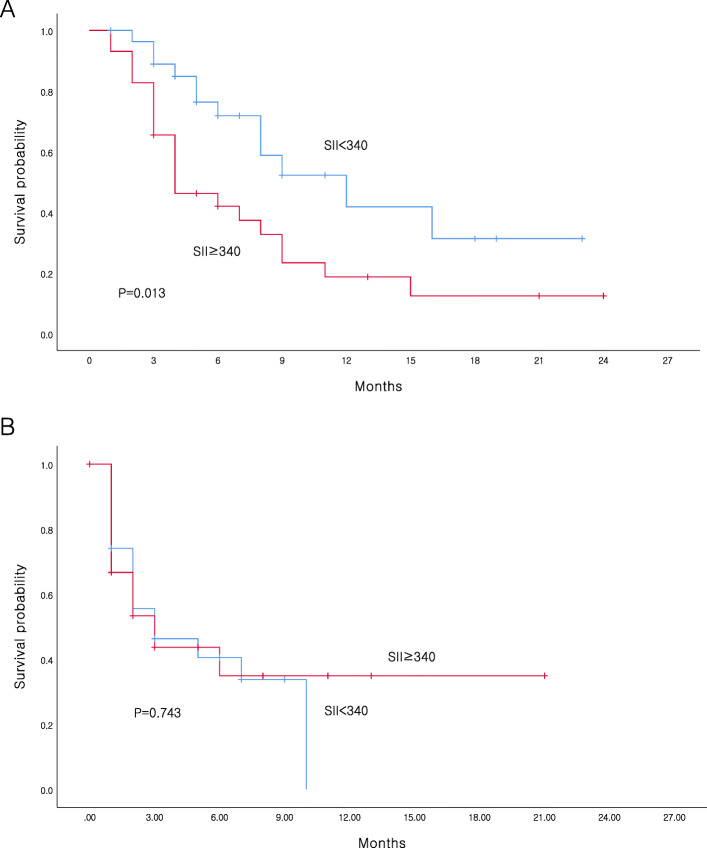
A total of 58 patients who received at least one dose of regroafenib and fulfilled the eligibility criteria, good performance status (Eastern Cooperative Oncology Group [ECOG] 0-1) and preserved liver function (Child-Pugh-A), were included in the analysis. The median PFS was 3 months (95% confidence interval [CI] = 0.981-5.019) and the median OS was 8 months (95% CI = 5.761-10.239). Elevated systemic immune-inflammation index (SII ≥340) was independently associated with poor OS. In multivariate analysis, the SII (hazard ratio [HR] = 2.211, 95% CI = 1.089-4.489, P = 0.028) and alpha-fetoprotein (AFP) (HR = 2.750, 95% CI = 1.259-6.010, P = 0.011) were independent predictors of OS.
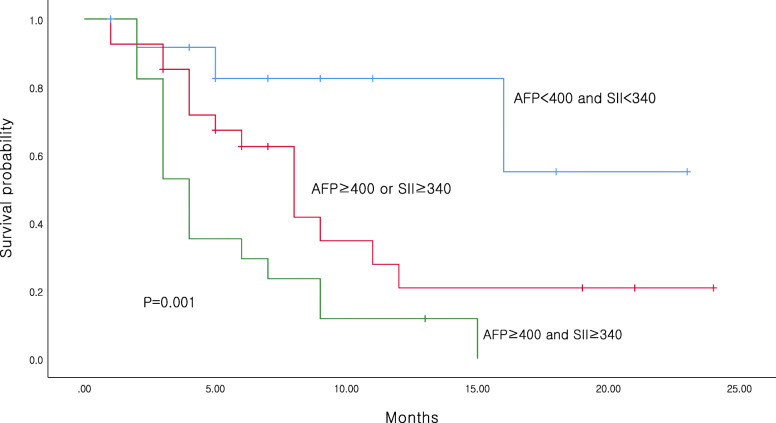
Elevated SII is associated with poor OS in patients with HCC who received sequential therapy with sorafenib and regorafenib. In addition, when selecting a treatment strategy, the SII can be used in combination with the AFP level as a promising prognostic tool for HCC.
regorafenib 作为索拉非尼治疗后进展的肝细胞癌(HCC)患者的二线治疗方法显示出良好的效果。尽管已经有许多关于索拉非尼和regorafenib 序贯治疗的真实数据,但尚未研究预测预后的特定炎症标志物。本研究旨在探讨索拉非尼-regorafenib 序贯治疗后 HCC 患者的全身炎症标志物对预后的预测价值。
我们回顾性分析了接受regorafenib 治疗索拉非尼治疗失败的 HCC 患者的医疗数据。使用 Kaplan-Meier 生存曲线评估无进展生存期(PFS)和总生存期(OS)。进行单因素和多因素分析以分析与生存相关的因素。
共纳入 58 例至少接受一剂 regroafenib 且符合纳入标准、良好的体能状态(东部合作肿瘤学组[ECOG]0-1)和保留肝功能(Child-Pugh-A)的患者进行分析。中位 PFS 为 3 个月(95%置信区间[CI] = 0.981-5.019),中位 OS 为 8 个月(95%CI = 5.761-10.239)。全身性免疫炎症指数(SII≥340)升高与较差的 OS 独立相关。多因素分析显示,SII(风险比[HR] = 2.211,95%CI = 1.089-4.489,P = 0.028)和甲胎蛋白(AFP)(HR = 2.750,95%CI = 1.259-6.010,P = 0.011)是 OS 的独立预测因子。
升高的 SII 与接受索拉非尼和regorafenib 序贯治疗的 HCC 患者的 OS 较差相关。此外,在选择治疗策略时,SII 可以与 AFP 水平联合使用,作为 HCC 有前途的预后工具。