Yao Ying, Ge Likun, Yu Qian, Du Xiaohong, Zhang Xiangyang, Taylor-Piliae Ruth, Wei Gao-Xia
Key Laboratory of Mental Health, Institute of Psychology, Chinese Academy of Sciences, Beijing, China.
Department of Psychology, University of Chinese Academy of Sciences, Beijing, China.
Evid Based Complement Alternat Med. 2021 Apr 30;2021:5549006. doi: 10.1155/2021/5549006. eCollection 2021.
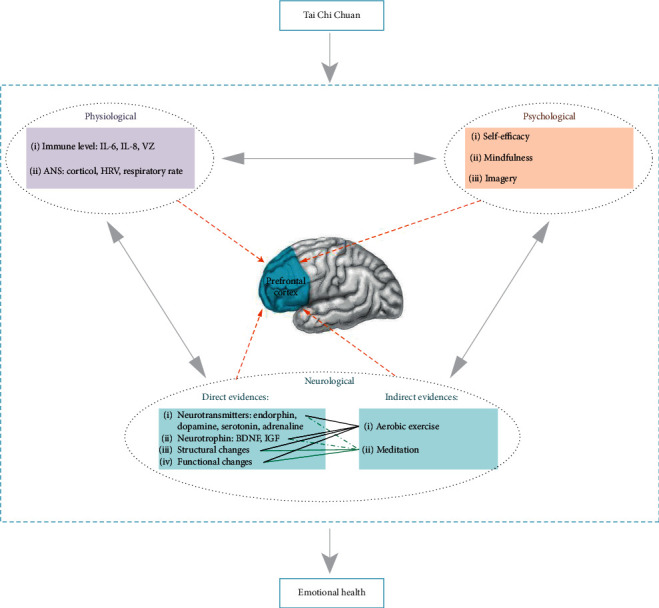
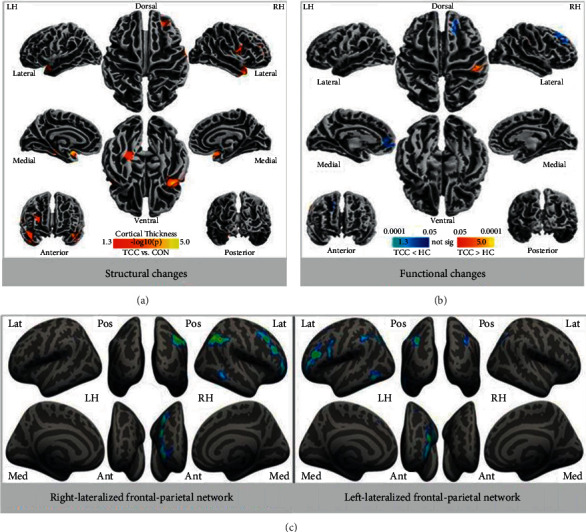
Deep involvement in the negative mood over long periods of time likely results in emotional disturbances/disorders and poor mental health. Tai Chi Chuan (TCC) is regarded as a typical mind-body practice combining aerobic exercise and meditation to prevent and treat negative mood. Although there are an increasing number of TCC studies examining anxiety, depression, and mental stress, the mechanisms underlying these negative emotions are not fully understood. This review study examined TCC studies related to emotional health from both clinical patients and healthy individuals. Next, several potential mechanisms from physiological, psychological, and neurological perspectives were evaluated based on direct and indirect research evidence. We reviewed recent functional magnetic resonance imaging studies, which demonstrated changes in brain anatomy and function, mainly in the prefrontal cortex, following TCC practice. Finally, the effects of TCC on emotion/mental health is depicted with a prefrontal cortex hypothesis that proposed "an immune system of the mind" indicating the role of the prefrontal cortex as a flexible hub in regulating an individual's mental health. The prefrontal cortex is likely a key biomarker among the multiple complex neural correlates to help an individual manage negative emotions/mental health. Future research is needed to examine TCC effects on mental health by examining the relationship between the executive control system (mainly prefrontal cortex) and limbic network (including amygdala, insula, and hippocampal gyrus).
长期深陷负面情绪可能会导致情绪障碍以及心理健康不佳。太极拳被视为一种典型的身心锻炼方式,它将有氧运动与冥想相结合,用于预防和治疗负面情绪。尽管有越来越多关于太极拳的研究探讨焦虑、抑郁和精神压力,但这些负面情绪背后的机制尚未完全明晰。本综述研究考察了来自临床患者和健康个体的与情绪健康相关的太极拳研究。接下来,基于直接和间接研究证据,从生理、心理和神经学角度评估了几种潜在机制。我们回顾了近期的功能磁共振成像研究,这些研究表明,练习太极拳后大脑的解剖结构和功能发生了变化,主要是前额叶皮层。最后,用一个前额叶皮层假说描述了太极拳对情绪/心理健康的影响,该假说提出“心灵的免疫系统”,表明前额叶皮层在调节个体心理健康方面作为一个灵活枢纽的作用。前额叶皮层可能是多个复杂神经关联中的关键生物标志物,有助于个体管理负面情绪/心理健康。未来的研究需要通过考察执行控制系统(主要是前额叶皮层)和边缘系统网络(包括杏仁核、脑岛和海马回)之间的关系,来研究太极拳对心理健康的影响。