Lu Fang Ying, Chen Rong, Zhou Min, Guo Yi
Department of Respiratory and Critical Care Medicine, Shanghai Rui Jin Hospital, School of Medicine, Shanghai Jiao Tong University, Shanghai 200025, P.R. China.
Institute of Respiratory Diseases, School of Medicine, Shanghai Jiao Tong University, Shanghai 200025, P.R. China.
Exp Ther Med. 2021 Jul;22(1):729. doi: 10.3892/etm.2021.10161. Epub 2021 May 4.
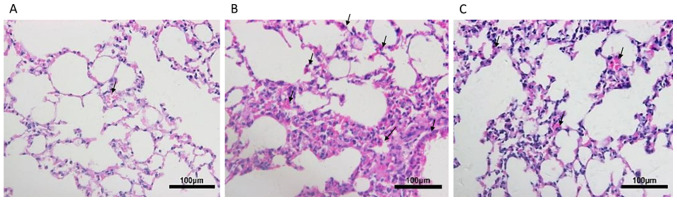
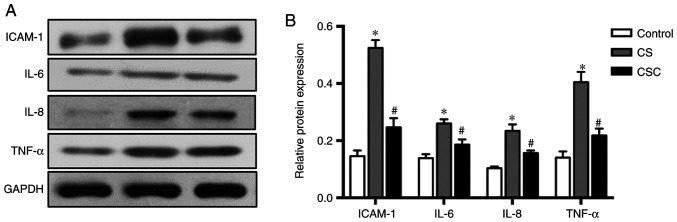
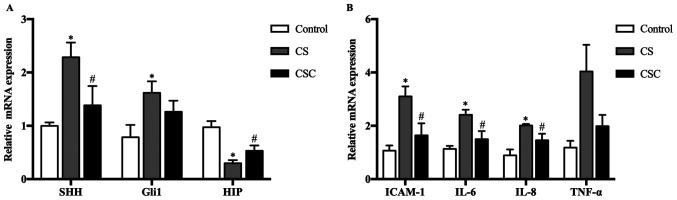
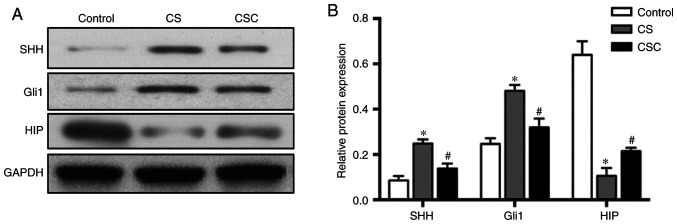
Hedgehog (Hh) signaling is involved in early embryogenesis and maintains quiescence in the adult lungs. The interruption of Hh signaling may lead to the development of chronic obstructive pulmonary disease (COPD). The current study aimed to assess whether the Hh pathway affects cigarette-induced emphysema and airway inflammation by regulating inflammatory cytokines. C57BL/6J mice were randomized into control, cigarette smoke (CS) or CS + cyclopamine (CSC) groups. Control mice were exposed to normal room air, CS mice were exposed to tobacco smoke and CSC mice were exposed to CS and received cyclopamine treatment. Histopathological examination of lung tissues was performed, and the expression of sonic hedgehog (HH), glioma-associated oncogene homolog 1 (Gli1), hedgehog-interacting protein (HIP) and several inflammatory mediators (intracellular adhesion molecule-1, IL-6, IL-8 and TNF-α) were compared using reverse transcription-quantitative PCR and western blotting. The emphysema of lung tissues by histopathological examination demonstrated partial amelioration in the CSC group compared with that in the CS group. Additionally, expression levels of SHH, Gli1 and inflammatory mediators were significantly higher in the CS group compared with the control group but were significantly decreased in the CSC group. The expression of HIP was decreased in the CS group, but significantly increased in the CSC group. Hh signaling may serve an important role in cigarette-induced emphysema and airway inflammation by regulating inflammatory cytokines in animal models. Therefore, diminishing the activation of the Hh signal may serve as a novel therapeutic strategy for patients suffering from smoking-related COPD.
刺猬信号通路(Hh)参与早期胚胎发育,并维持成年肺的静止状态。Hh信号通路的中断可能导致慢性阻塞性肺疾病(COPD)的发生。本研究旨在评估Hh信号通路是否通过调节炎症细胞因子影响香烟诱导的肺气肿和气道炎症。将C57BL/6J小鼠随机分为对照组、香烟烟雾(CS)组或CS + 环杷明(CSC)组。对照组小鼠暴露于正常室内空气,CS组小鼠暴露于烟草烟雾,CSC组小鼠暴露于CS并接受环杷明治疗。对肺组织进行组织病理学检查,并使用逆转录定量PCR和蛋白质印迹法比较音猬因子(HH)、胶质瘤相关癌基因同源物1(Gli1)、刺猬信号相互作用蛋白(HIP)和几种炎症介质(细胞间黏附分子-1、IL-6、IL-8和TNF-α)的表达。组织病理学检查显示,与CS组相比,CSC组肺组织的肺气肿有所改善。此外,与对照组相比,CS组中SHH、Gli1和炎症介质的表达水平显著升高,但在CSC组中显著降低。CS组中HIP的表达降低,但在CSC组中显著增加。在动物模型中,Hh信号通路可能通过调节炎症细胞因子在香烟诱导的肺气肿和气道炎症中发挥重要作用。因此,减少Hh信号的激活可能为患有吸烟相关COPD的患者提供一种新的治疗策略。