Brightman Andrew O, Coffee R Lane, Garcia Kara, Lottes Aaron E, Sors Thomas G, Moe Sharon M, Wodicka George R
Weldon School of Biomedical Engineering and Indiana CTSI Medical Technology Advance Program, Purdue University, West Lafayette, IN, USA.
Department of Emergency and Indiana CTSI Translational Research Development Program, Indiana University School of Medicine, Indianapolis, IN, USA.
J Clin Transl Sci. 2021 Jan 19;5(1):e79. doi: 10.1017/cts.2021.1.
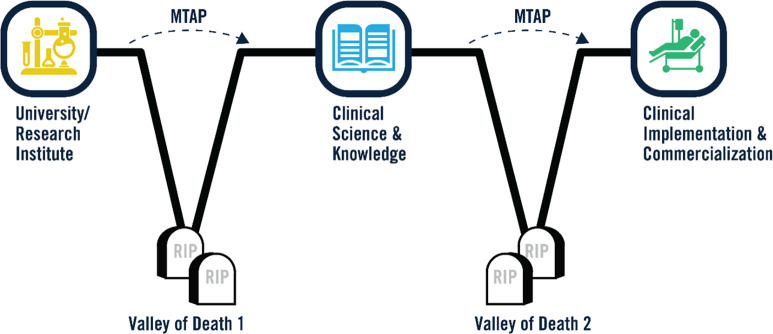
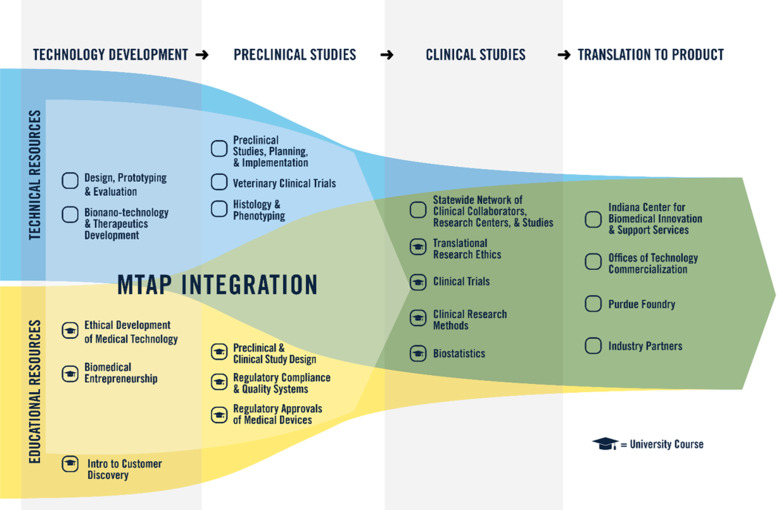
The success rate for translation of newly engineered medical technologies into clinical practice is low. Traversing the "translational valleys of death" requires a high level of knowledge of the complex landscape of technical, ethical, regulatory, and commercialization challenges along a multi-agency path of approvals. The Indiana Clinical and Translational Sciences Institute developed a program targeted at increasing that success rate through comprehensive training, education, and resourcing. The Medical Technology Advance Program (MTAP) provides technical, educational, and consultative assistance to investigators that leverages partnerships with experts in the health products industry to speed progress toward clinical implementation. The training, resourcing, and guidance are integrated through the entire journey of medical technology translation. Investigators are supported through a set of courses that cover bioethics, ethical engineering, preclinical and clinical study design, regulatory submissions, entrepreneurship, and commercialization. In addition to the integrated technical and educational resources, program experts provide direct consultation for planning each phase along the life cycle of translation. Since 2008, nearly 200 investigators have gained assistance from MTAP resulting in over 100 publications and patents. This support via medicine-engineering-industry partnership provides a unique and novel opportunity to expedite new medical technologies into clinical and product implementation.
新设计的医疗技术转化为临床实践的成功率很低。跨越“转化死亡谷”需要对多机构审批过程中复杂的技术、伦理、监管和商业化挑战有深入了解。印第安纳临床与转化科学研究所制定了一项计划,旨在通过全面的培训、教育和资源配置提高成功率。医学技术推进计划(MTAP)为研究人员提供技术、教育和咨询援助,利用与健康产品行业专家的合作关系,加快临床应用的进程。培训、资源配置和指导贯穿于医疗技术转化的全过程。通过一系列涵盖生物伦理学、伦理工程、临床前和临床研究设计、监管申报、创业和商业化的课程,为研究人员提供支持。除了整合的技术和教育资源外,该计划的专家还为翻译生命周期的每个阶段的规划提供直接咨询。自2008年以来,近200名研究人员获得了MTAP的帮助,产生了100多篇出版物和专利。这种通过医学-工程-行业合作提供的支持为加速新医疗技术进入临床和产品应用提供了独特而新颖的机会。