Department of Internal Medicine, School of Medicine, Teikyo University, Kaga 2-11-1, Itabashi ward, 173-8605, Tokyo, Japan.
Department of Breast and Endocrine Surgery, School of Medicine, Tokai University, Isehara, Kanagawa, Japan.
Support Care Cancer. 2021 Nov;29(11):6831-6839. doi: 10.1007/s00520-021-06277-8. Epub 2021 May 18.
The Japanese Society of Medical Oncology published a guideline (GL) on febrile neutropenia (FN) in 2017. The study's purpose is to reveal how widely GL penetrated among physicians and surgeons providing chemotherapy.
A questionnaire survey was conducted with SurveyMonkey™ for members of the Japanese Association of Supportive Care in Cancer and relevant academic organizations. Each question had four options (always do, do in more than half of patients, do in less than half, do not at all) and a free description form. Responses were analyzed with statistical text-analytics.
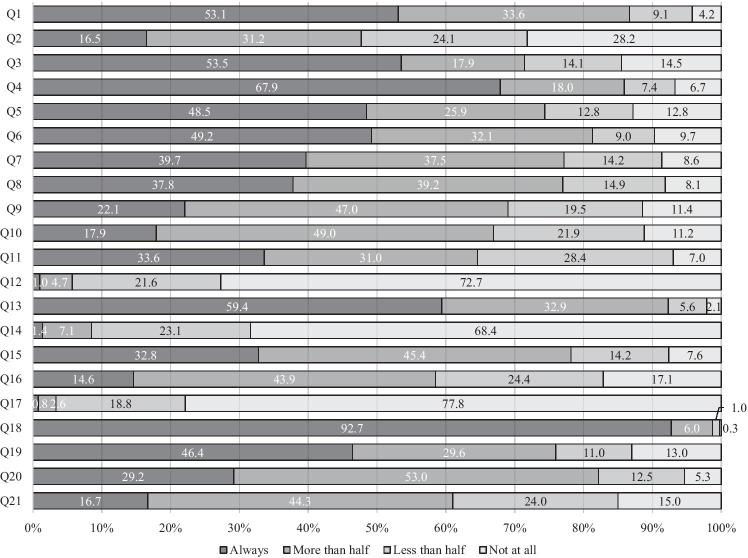
A total of 800 responses were retrieved. Major respondents were experts with more than 10-year experience, physicians 54%, and surgeons 46%. Eighty-seven percent of respondents knew and used GL. Forty-eight percent assessed FN with Multinational Association of Supportive Care in Cancer (MASCC) score "always" or "more than half." Eighty-one percent chose beta-lactam monotherapy as primary treatment in high-risk patients. Seventy-seven percent did oral antibacterial therapy in low-risk patients ambulatorily. Seventy-eight percent administered primary prophylactic G-CSF (ppG-CSF) in FN frequency ≥ 20% regimen. Fifty-nine percent did ppG-CSF for high-risk patients in FN frequency 10-20% regimen. Ninety-seven percent did not use ppG-CSF in FN frequency < 10% regimen. The medians of complete and complete plus partial compliance rates were 46.4% (range 7.0-92.8) and 77.8% (range 35.4-98.7). The complete compliance rates were less than 30% in seven recommendations, including the MASCC score assessment.
GL is estimated to be widely utilized, but some recommendations were not followed, presumably due to a mismatch with actual clinical practices in Japan.
日本肿瘤内科学会于 2017 年发布了发热性中性粒细胞减少症(FN)指南(GL)。本研究旨在揭示 GL 在提供化疗的肿瘤内科医生和外科医生中的普及程度。
使用 SurveyMonkey™ 对日本癌症支持治疗协会和相关学术组织的成员进行问卷调查。每个问题都有四个选项(总是、超过一半患者、不到一半患者、从不)和自由描述形式。通过统计文本分析对回答进行分析。
共回收 800 份回复。主要回复者为有 10 年以上经验的专家、医生 54%、外科医生 46%。87%的受访者知道并使用 GL。48%的人总是或超过一半使用多国癌症支持治疗协会(MASCC)评分评估 FN。81%的人选择β-内酰胺单药治疗高危患者。77%的人在门诊低危患者中进行口服抗菌治疗。78%的人在 FN 频率≥20%的方案中使用初级预防性 G-CSF(ppG-CSF)。59%的人在 FN 频率为 10-20%的高危患者中使用 ppG-CSF。97%的人在 FN 频率<10%的方案中不使用 ppG-CSF。完全和完全加部分依从率的中位数分别为 46.4%(范围为 7.0-92.8)和 77.8%(范围为 35.4-98.7)。在七个建议中,完全依从率低于 30%,包括 MASCC 评分评估。
GL 估计得到了广泛应用,但有些建议并未得到遵循,这可能是由于与日本实际临床实践不匹配所致。