Department of Clinical Pharmacy and Toxicology, Leiden University Medical Center, Albinusdreef 2, 2333ZA, Leiden, The Netherlands.
Department of Medical Oncology, Leiden University Medical Center, Leiden, The Netherlands.
Support Care Cancer. 2022 Nov;30(11):9181-9189. doi: 10.1007/s00520-022-07343-5. Epub 2022 Aug 31.
Chemotherapy-induced febrile neutropenia (FN) is a life-threatening and chemotherapy dose-limiting adverse event. FN can be prevented with granulocyte-colony stimulating factors (G-CSFs). Guidelines recommend primary G-CSF use for patients receiving either high (> 20%) FN risk (HR) chemotherapy, or intermediate (10-20%) FN risk (IR) chemotherapy if the overall risk with additional patient-related risk factors exceeds 20%. In this study, we applied an EHR text-mining tool for real-world G-CSF treatment evaluation in breast cancer patients.
Breast cancer patients receiving IR or HR chemotherapy treatments between January 2015 and February 2021 at LUMC, the Netherlands, were included. We retrospectively collected data from EHR with a text-mining tool and assessed G-CSF use, risk factors, and the FN and neutropenia (grades 3-4) and incidence.
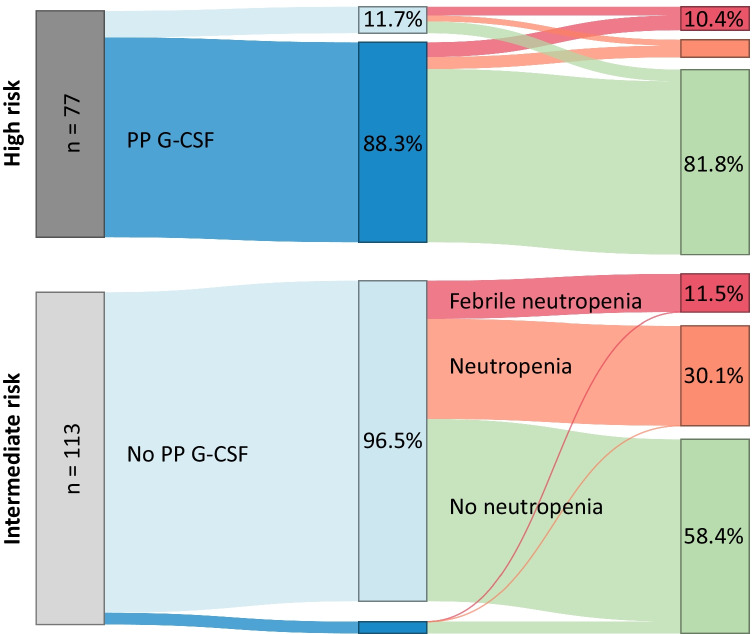
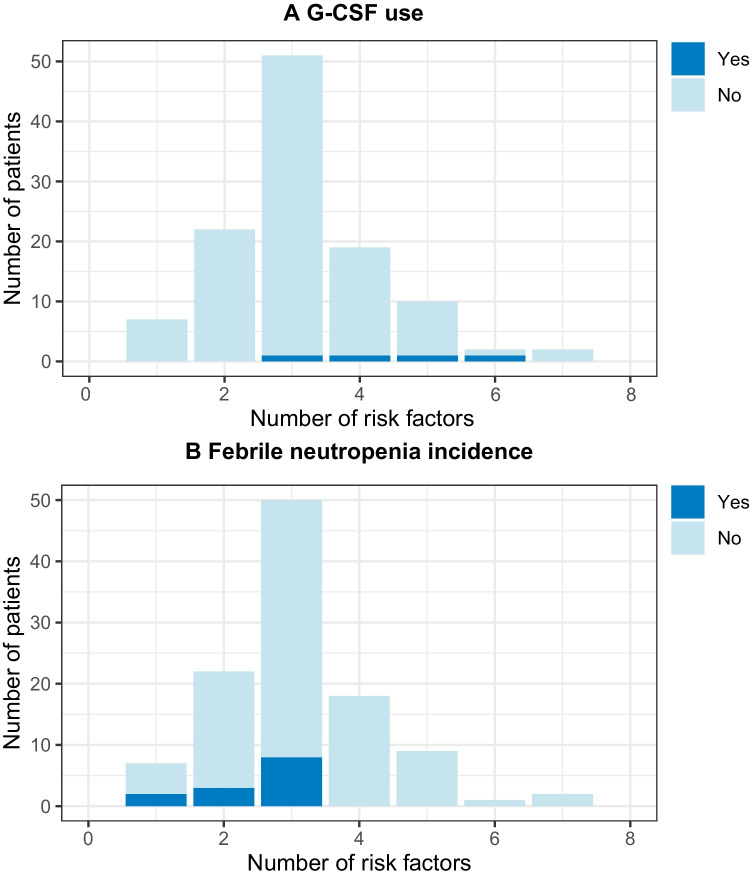
A total of 190 female patients were included, who received 77 HR and 113 IR treatments. In 88.3% of the HR regimens, G-CSF was administered; 7.3% of these patients developed FN vs. 33.3% without G-CSF. Although most IR regimen patients had ≥ 2 risk factors, only 4% received G-CSF, of which none developed neutropenia. However, without G-CSF, 11.9% developed FN and 31.2% severe neutropenia.
Our text-mining study shows high G-CSF use among HR regimen patients, and low use among IR regimen patients, although most had ≥ 2 risk factors. Therefore, current practice is not completely in accordance with the guidelines. This shows the need for increased awareness and clarity regarding risk factors. Also, text-mining can effectively be implemented for the evaluation of patient care.
化疗引起的发热性中性粒细胞减少症(FN)是一种危及生命且限制化疗剂量的不良事件。使用粒细胞集落刺激因子(G-CSF)可预防 FN。指南建议对接受高(>20%)FN 风险(HR)化疗的患者或接受中(10-20%)FN 风险(IR)化疗的患者(如果存在其他与患者相关的危险因素,总体风险超过 20%),首选 G-CSF 治疗。在这项研究中,我们应用电子病历(EHR)文本挖掘工具来评估真实世界中乳腺癌患者的 G-CSF 治疗情况。
本研究纳入了 2015 年 1 月至 2021 年 2 月在荷兰莱顿大学医学中心(LUMC)接受 IR 或 HR 化疗治疗的乳腺癌患者。我们使用 EHR 中的文本挖掘工具回顾性地收集数据,并评估了 G-CSF 的使用、风险因素以及 FN 和中性粒细胞减少症(3-4 级)的发生率。
共纳入 190 名女性患者,接受 77 例 HR 方案和 113 例 IR 方案治疗。在 88.3%的 HR 方案中,给予了 G-CSF;其中 7.3%的患者发生 FN,而未使用 G-CSF 的患者中 FN 发生率为 33.3%。尽管大多数 IR 方案患者存在≥2 个危险因素,但仅有 4%的患者接受了 G-CSF 治疗,其中无一例发生中性粒细胞减少症。然而,未使用 G-CSF 的患者中,11.9%发生 FN,31.2%发生严重中性粒细胞减少症。
我们的文本挖掘研究表明,HR 方案患者中 G-CSF 的使用率较高,而 IR 方案患者的使用率较低,尽管大多数患者存在≥2 个危险因素。因此,目前的实践并不完全符合指南。这表明需要提高对危险因素的认识和清晰度。此外,文本挖掘可有效地用于评估患者的护理情况。