Sobrado Carlos Walter, Sobrado Lucas Faraco, Nahas Sergio Carlos, Cecconello Ivan
Digestive and Colorectal Surgery Division, Department of Gastroenterology, Hospital das Clínicas, University of São Paulo School of Medicine, São Paulo, Brazil.
Arq Bras Cir Dig. 2021 May 14;34(1):e1560. doi: 10.1590/0102-672020210001e1560. eCollection 2021.
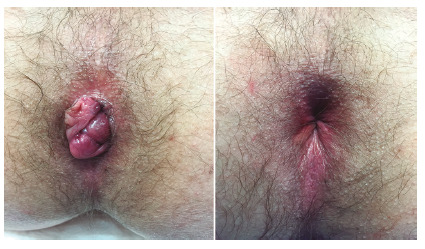
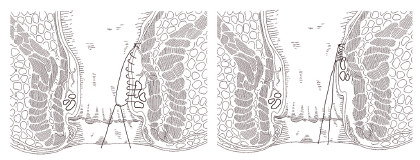
The surgical procedure: three dearterializations and three mucopexies.Transanal hemorrhoidal dearterialization (THD) is safe and effective minimally invasive treatment for hemorrhoidal disease, but reports regarding recurrence and postoperative complications (pain and tenesmus) vary significantly.
To evaluate if selective dearterialization and mucopexy at the symptomatic hemorrhoid only, without Doppler guidance, achieves adequate control of the prolapse and bleeding and if postoperative morbidity is reduced with this technique.
Twenty consecutive patients with grade II and III hemorrhoids were treated with this new approach and were evaluated for postoperative complications and recurrence.
Control of prolapse and bleeding was achieved in all patients (n=20). Postoperative complications were tenesmus (n=2), external hemorrhoidal thrombosis (n=2) and urinary retention (n=2). After a mean follow-up of 13 months no recurrences were diagnosed.
Selective dearterialization and mucopexy is safe and achieves adequate control of prolapse and bleeding and, by minimizing sutures in the anal canal, postoperative morbidity is diminished. Doppler probe is unnecessary for this procedure, which makes it also more interesting from an economic perspective.
手术方法:三次去动脉化和三次黏膜固定术。经肛门痔动脉结扎术(THD)是治疗痔病的一种安全有效的微创治疗方法,但关于复发及术后并发症(疼痛和里急后重)的报道差异很大。
评估仅对有症状的痔进行选择性去动脉化和黏膜固定术,不使用多普勒引导,是否能充分控制脱垂和出血,以及该技术是否能降低术后发病率。
连续20例Ⅱ度和Ⅲ度痔患者采用这种新方法治疗,并对术后并发症和复发情况进行评估。
所有患者(n = 20)的脱垂和出血均得到控制。术后并发症包括里急后重(n = 2)、外痔血栓形成(n = 2)和尿潴留(n = 2)。平均随访13个月后,未诊断出复发。
选择性去动脉化和黏膜固定术是安全的,能充分控制脱垂和出血,并且通过减少肛管内的缝合,降低了术后发病率。该手术无需多普勒探头,从经济角度来看也更具吸引力。