Clinic Bois Cerf/Hirslanden, Lausanne, Switzerland.
University Center for Primary Care and Public Health Biostatistics, Lausanne, Switzerland.
J Bone Miner Res. 2021 Sep;36(9):1717-1728. doi: 10.1002/jbmr.4335. Epub 2021 May 19.
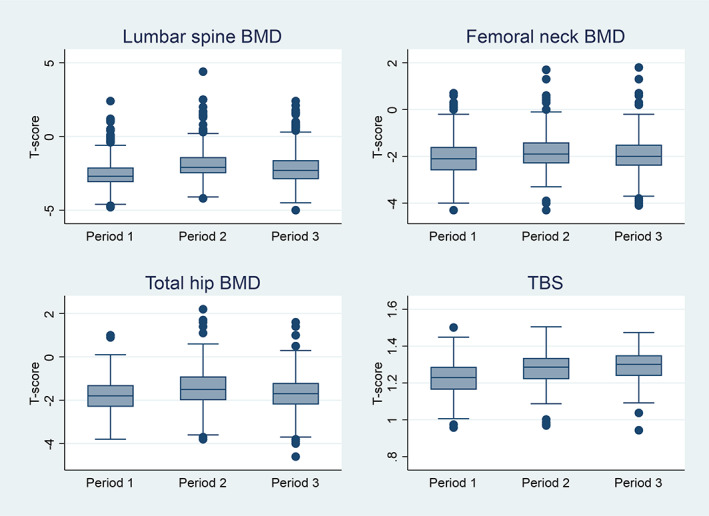
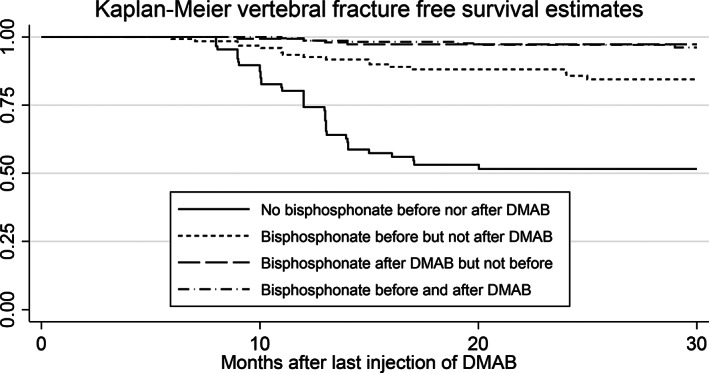
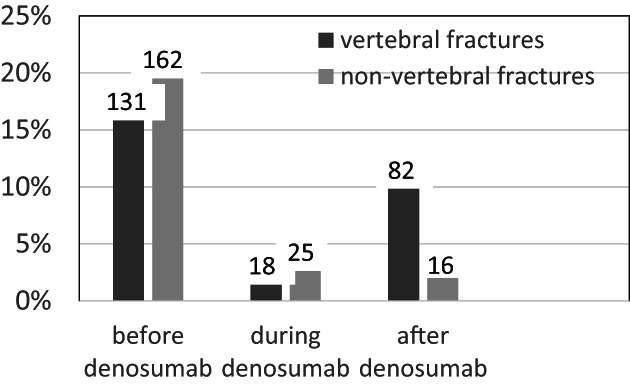
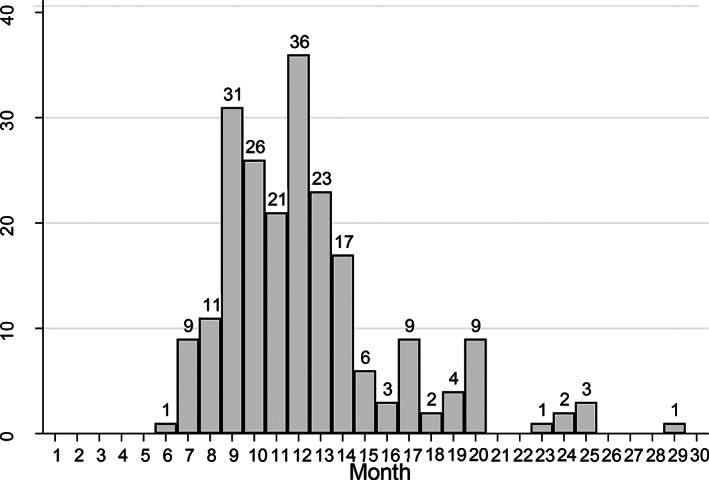
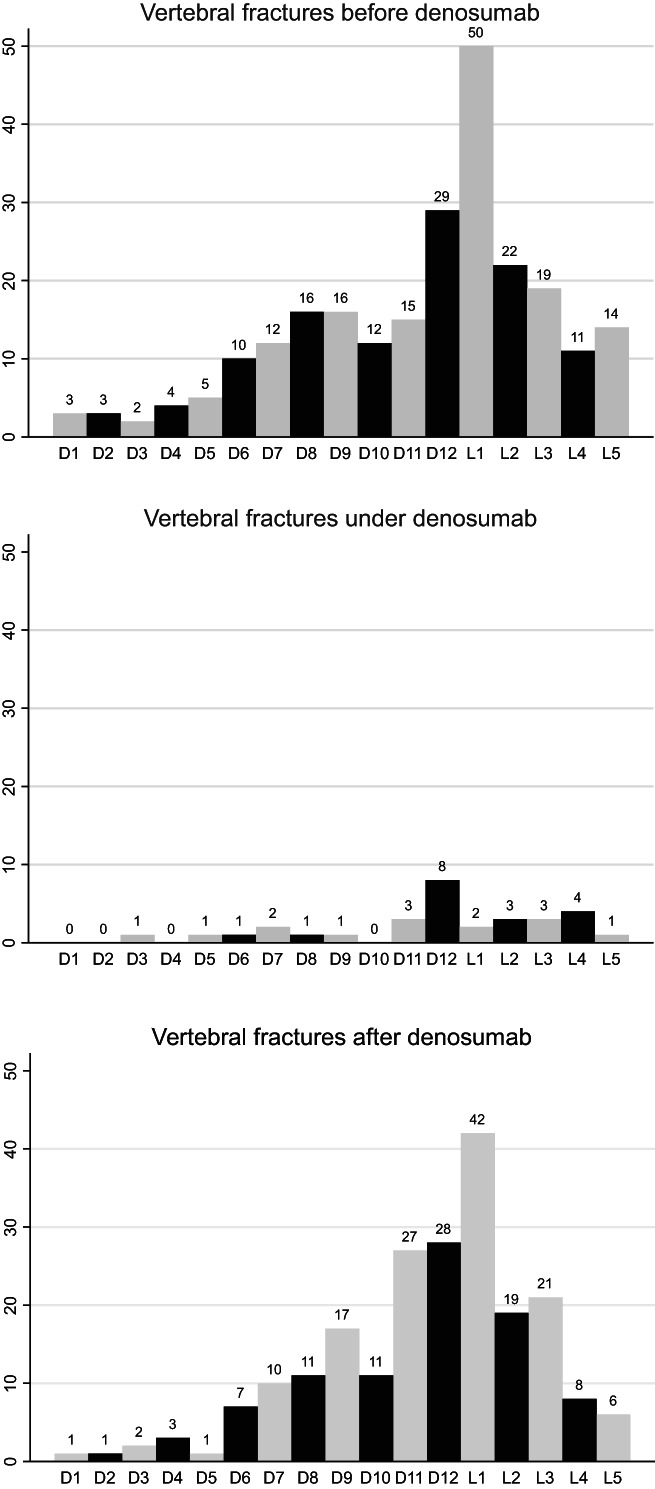
A rebound of osteoclast activity during the 2 years after a treatment or prevention of osteoporosis with denosumab (Dmab) leads to an increased risk of vertebral fractures (VFs). We attempted to identify the risk factors for these VF and to examine the protective role of bisphosphonates. For that, 22 specialists in Switzerland provided data of unselected patients, treated with denosumab for osteoporosis or breast cancer without metastases under aromatase inhibitors, who have received at least two injections of Dmab, with at least 1 year of follow-up after discontinuation. The questionnaire covered separately the periods before, during, and after Dmab treatment, and registered clinical, radiological, and lab data. For the analysis of the risk factors, the main outcomes were the time to the first VF after the treatment, the presence of multiple VFs (MVFs), and the number of VFs. The incidence of VF was 16.4% before, 2.2% during, and 10.3% after the treatment with Dmab. The risk of VF after Dmab discontinuation was associated with an increased risk of non-vertebral fractures. The pretreatment predictors of the post-treatment fracture risk were a parental hip fracture and previous VFs. Further risk factors appeared later, such as low total hip bone mineral density (BMD) during and after denosumab, increased bone resorption markers, and the loss of total hip BMD after the denosumab. Treatment with bisphosphonates, especially after Dmab, had a protective effect. Bisphosphonates given before Dmab did not further decrease the risk of VF in cases who got bisphosphonates after Dmab. This study shows that the risk of VF is poorly predictable before the prescription of denosumab. But during and after the treatment, bone resorption markers and BMD have a significant predictive value. Bisphosphonates after the treatment with denosumab are protective against VFs. © 2021 The Authors. Journal of Bone and Mineral Research published by Wiley Periodicals LLC on behalf of American Society for Bone and Mineral Research (ASBMR).
在使用地舒单抗(Dmab)治疗或预防骨质疏松症后的 2 年内,破骨细胞活性的反弹会导致椎体骨折(VF)的风险增加。我们试图确定这些 VF 的风险因素,并研究双膦酸盐的保护作用。为此,瑞士的 22 名专家提供了数据,这些数据来自未选择的患者,他们在芳香化酶抑制剂下接受地舒单抗治疗骨质疏松症或乳腺癌且无转移,至少接受了 2 次 Dmab 注射,并在停药后至少有 1 年的随访。问卷分别涵盖了 Dmab 治疗前、治疗中和治疗后的时期,并记录了临床、放射学和实验室数据。为了分析风险因素,主要结果是治疗后首次 VF 的时间、多发 VF(MVF)的存在和 VF 的数量。在使用地舒单抗治疗之前、期间和之后,VF 的发生率分别为 16.4%、2.2%和 10.3%。Dmab 停药后 VF 的风险与非椎体骨折的风险增加相关。治疗后骨折风险的预处理预测因子是父母髋部骨折和先前的 VF。后来出现了其他风险因素,例如在使用地舒单抗期间和之后的全髋骨密度(BMD)较低、骨吸收标志物增加以及在使用地舒单抗后全髋 BMD 丢失。双膦酸盐治疗,特别是在使用地舒单抗之后,具有保护作用。在使用地舒单抗之前使用双膦酸盐并不能进一步降低在使用地舒单抗之后使用双膦酸盐的患者发生 VF 的风险。这项研究表明,在开用地舒单抗之前,VF 的风险难以预测。但是在治疗期间和之后,骨吸收标志物和 BMD 具有重要的预测价值。使用地舒单抗治疗后使用双膦酸盐可预防 VF。
© 2021 作者。《骨与矿物研究杂志》由 Wiley 期刊出版公司代表美国骨与矿物研究协会(ASBMR)出版。