Instituto D'Or de Pesquisa e Ensino (IDOR), Rio de Janeiro, Brazil.
Oncoclínicas, Salvador, Brazil.
JCO Glob Oncol. 2021 May;7:726-733. doi: 10.1200/GO.20.00622.
Lung cancer is a global health problem, with more than 220,000 new cases and 150,000 deaths per year in the United States. Likewise, in Brazil, lung cancer is the most lethal cancer with 30,200 new cases expected in 2020. Regarding treatment types, radiation therapy (RT) represents an important approach, since 60%-70% of the patients will receive this modality of treatment during the course of their disease. However, access to RT remains challenging because of the socioeconomic inequalities in the Brazilian population, where approximately 100,000 patients/year die without access to RT. This work provides an overview on the availability of high technology RT in Brazil.
A retrospective study was performed using the Brazilian Radiotherapy Census, local public and private databases, and the current literature published in 2019.
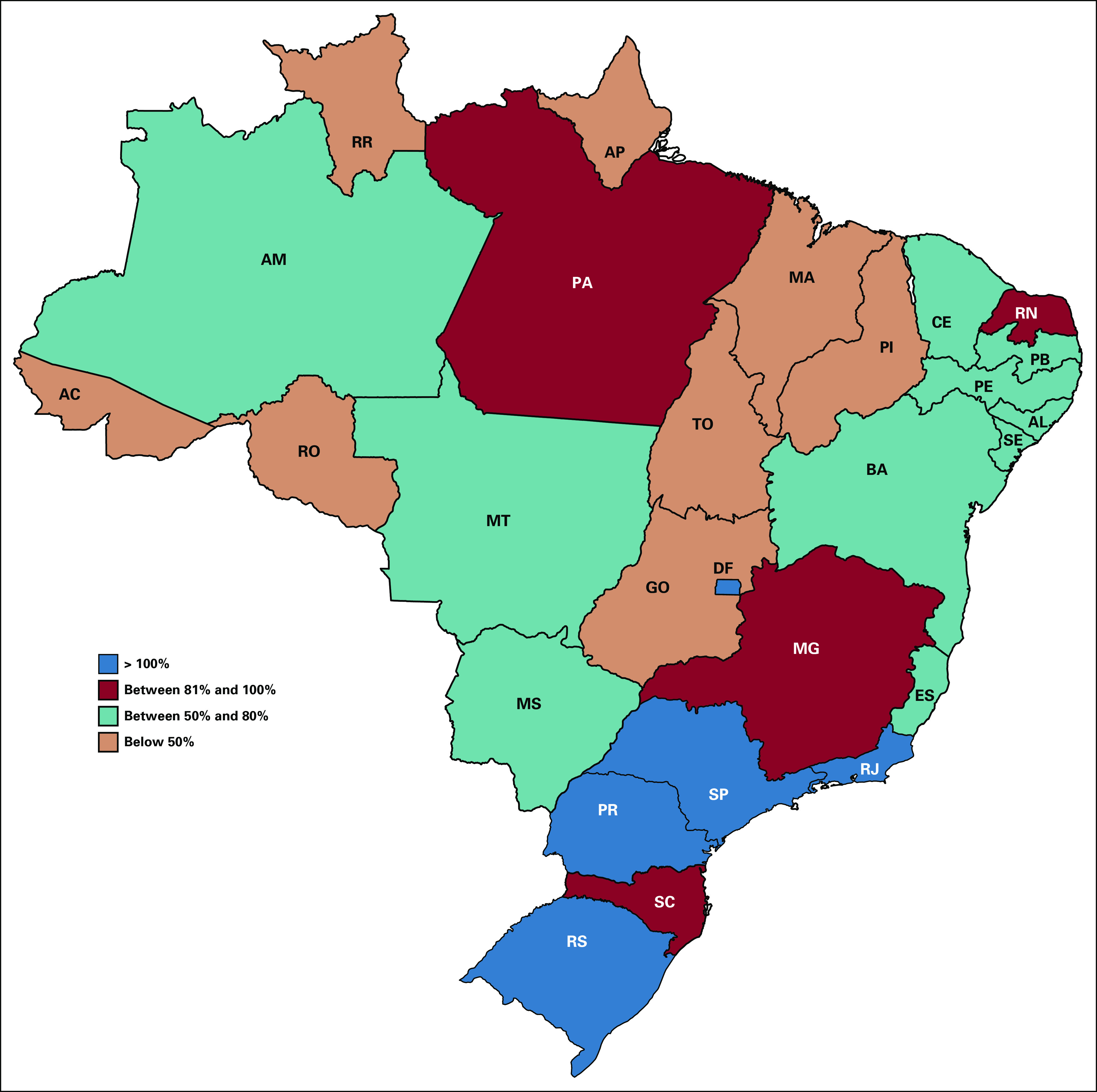
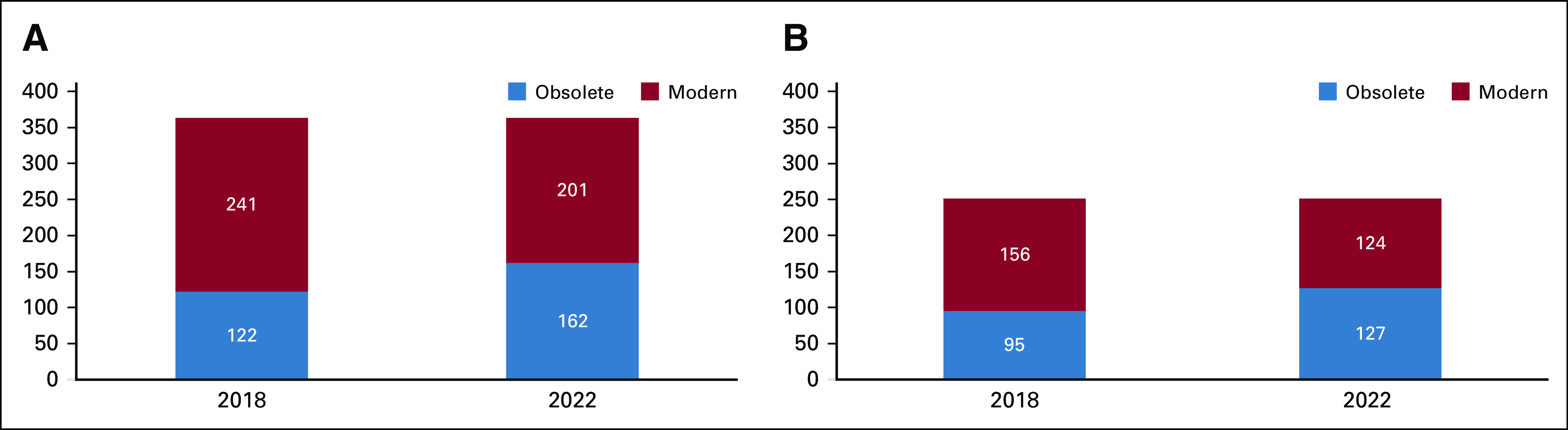
The Brazilian radiotherapy network relies on approximately 363 linear accelerators and 20 cobalt machines that remain operational. Most of these machines are installed at public health facilities. Regarding high technology, intensity-modulated RT is available in 53.7% (n = 130) and volumetric modulated arc therapy in 28.5% (n = 69) of the institutions, although only 19.8% (n = 48) of those facilities are capable of performing image-guided RT using cone beam computed tomography. Considering only the public health care system, the scenario is more restricted, with 40.1% (n = 65) of the institutions offering intensity-modulated RT, 21% (n = 34) volumetric modulated arc therapy, and 14.8% (n = 24) using cone beam computed tomography. Because of these scare resources, only 16% of Radiation Departments offer stereotactic body RT.
Brazil still needs to improve and provide high and safer RT technologies to patients with lung cancer across all Brazilian regions to attend the population needs and obtain better patient outcomes.
肺癌是一个全球性的健康问题,仅在美国,每年就有超过 22 万例新发病例和 15 万人死于肺癌。同样,在巴西,肺癌也是最致命的癌症,预计 2020 年将有 30200 例新发病例。关于治疗类型,放射治疗(RT)是一种重要的治疗方法,因为 60%-70%的患者在疾病过程中会接受这种治疗方式。然而,由于巴西人口的社会经济不平等,RT 的应用仍然具有挑战性,每年约有 10 万名患者因无法接受 RT 而死亡。本文概述了巴西提供高科技 RT 的情况。
使用巴西放射治疗普查、当地公共和私人数据库以及 2019 年发表的当前文献进行回顾性研究。
巴西的放射治疗网络依赖于大约 363 台线性加速器和 20 台钴机,这些机器仍在运行。这些机器大多安装在公共卫生机构。关于高科技 RT,53.7%(n = 130)的机构提供强度调制 RT,28.5%(n = 69)的机构提供容积调制弧形治疗,尽管只有 19.8%(n = 48)的机构能够使用锥形束 CT 进行图像引导 RT。仅考虑公共医疗保健系统,情况更为受限,40.1%(n = 65)的机构提供强度调制 RT,21%(n = 34)提供容积调制弧形治疗,14.8%(n = 24)使用锥形束 CT。由于资源匮乏,只有 16%的放射治疗部门提供立体定向体部 RT。
巴西仍需要改善并为所有巴西地区的肺癌患者提供更高、更安全的 RT 技术,以满足人群需求并获得更好的患者治疗效果。