Vassiliadi Dimitra Argyro, Ilias Ioannis, Pratikaki Maria, Jahaj Edison, Vassiliou Alice G, Detsika Maria, Ampelakiotou Kleio, Koulenti Marina, Manolopoulos Konstantinos N, Tsipilis Stamatis, Gavrielatou Evdokia, Diamantopoulos Aristidis, Zacharis Alexandros, Athanasiou Nicolaos, Orfanos Stylianos, Kotanidou Anastasia, Tsagarakis Stylianos, Dimopoulou Ioanna
Department of Endocrinology Diabetes and Metabolism, National Expertise Center for Rare Endocrine Diseases, Evangelismos Hospital, Athens, Greece.
Department of Endocrinology Diabetes and Metabolism, Elena Venizelou Hospital, Elena Venizelou Square, Athens, Greece.
Endocr Connect. 2021 Jun 17;10(6):646-655. doi: 10.1530/EC-21-0029.
Following the evolution of COVID-19 pandemic, reports pointed on a high prevalence of thyroiditis-related thyrotoxicosis. Interpretation of thyroid tests during illness, however, is hampered by changes occurring in the context of non-thyroidal illness syndrome (NTIS). In order to elucidate these findings, we studied thyroid function in carefully selected cohorts of COVID-19 positive and negative patients.
Cohort observational study.
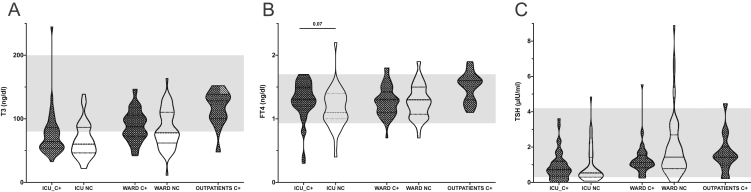
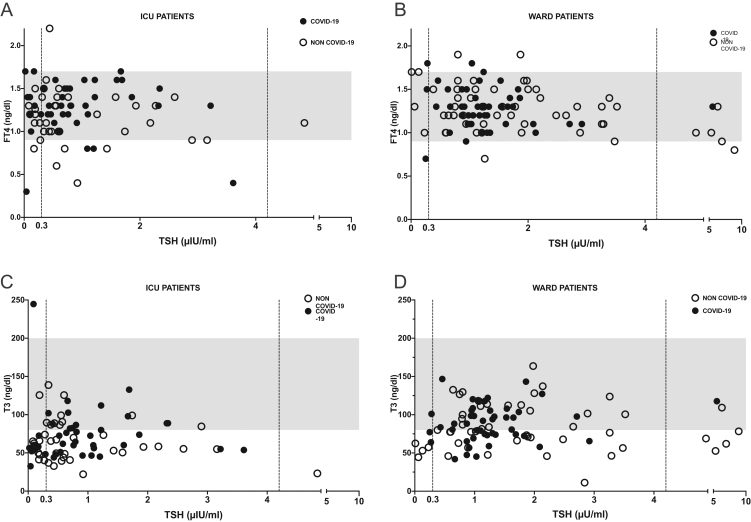
We measured TSH, FT4, T3 within 24 h of admission in 196 patients without thyroid disease and/or confounding medications. In this study, 102 patients were SARS-CoV-2 positive; 41 admitted in the ICU, 46 in the ward and 15 outpatients. Controls consisted of 94 SARS-CoV-2 negative patients; 39 in the ICU and 55 in the ward. We designated the thyroid hormone patterns as consistent with NTIS, thyrotoxicosis and hypothyroidism.
A NTIS pattern was encountered in 60% of ICU and 36% of ward patients, with similar frequencies between SARS-CoV-2 positive and negative patients (46.0% vs 46.8%, P = NS). A thyrotoxicosis pattern was observed in 14.6% SARS-CoV-2 ICU patients vs 7.7% in ICU negative (P = NS) and, overall in 8.8% of SARS-CoV-2 positive vs 7.4% of negative patients. In these patients, thyroglobulin levels were similar to those with normal thyroid function or NTIS. The hypothyroidism pattern was rare.
NTIS pattern is common and relates to the severity of disease rather than SARS-CoV-2 infection. A thyrotoxicosis pattern is less frequently observed with similar frequency between patients with and without COVID-19. It is suggested that thyroid hormone monitoring in COVID-19 should not differ from other critically ill patients.
随着新冠疫情的演变,报告指出甲状腺炎相关甲状腺毒症的患病率很高。然而,疾病期间甲状腺检查结果的解读受到非甲状腺疾病综合征(NTIS)背景下发生的变化的阻碍。为了阐明这些发现,我们在精心挑选的新冠阳性和阴性患者队列中研究了甲状腺功能。
队列观察性研究。
我们在196例无甲状腺疾病和/或无混淆用药的患者入院后24小时内测量了促甲状腺激素(TSH)、游离甲状腺素(FT4)和三碘甲状腺原氨酸(T3)。在本研究中,102例患者新冠病毒检测呈阳性;41例入住重症监护病房(ICU),46例在病房,15例为门诊患者。对照组由94例新冠病毒检测呈阴性的患者组成;39例在ICU,55例在病房。我们将甲状腺激素模式分为与NTIS、甲状腺毒症和甲状腺功能减退一致的模式。
60%的ICU患者和36%的病房患者出现NTIS模式,新冠病毒阳性和阴性患者的频率相似(46.0%对46.8%,P=无显著性差异)。14.6%的新冠病毒ICU患者出现甲状腺毒症模式,而ICU阴性患者为7.7%(P=无显著性差异),总体而言,8.8%的新冠病毒阳性患者和7.4%的阴性患者出现该模式。在这些患者中,甲状腺球蛋白水平与甲状腺功能正常或NTIS患者相似。甲状腺功能减退模式罕见。
NTIS模式常见,与疾病严重程度有关,而非新冠病毒感染。甲状腺毒症模式较少见,新冠病毒感染患者和未感染患者的频率相似。建议新冠患者的甲状腺激素监测与其他重症患者无异。