Department of Pediatrics, Showa University School of Medicine.
Department of Endocrinology and Metabolism, Tokyo Metropolitan Children's Medical Center.
J Atheroscler Thromb. 2022 May 1;29(5):667-677. doi: 10.5551/jat.62807. Epub 2021 May 20.
This study aimed to elucidate the gene and lipid profiles of children clinically diagnosed with familial hypercholesterolemia (FH).
A total of 21 dyslipidemia-related Mendelian genes, including FH causative genes (LDLR, APOB, and PCSK9) and LDL-altering genes (APOE, LDLRAP1, and ABCG5/8), were sequenced in 33 Japanese children (mean age, 9.7±4.2 years) with FH from 29 families.
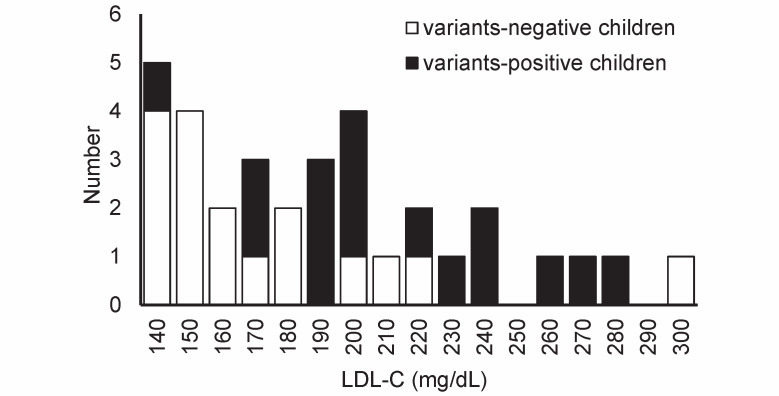
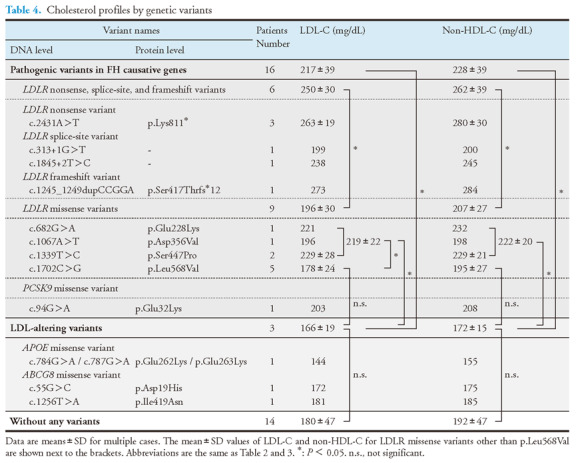
Fifteen children (45.5%) with pathogenic variants in LDLR (eight different heterozygous variants) and one child (3.0%) with the PCSK9 variant were found. Among 17 patients without FH causative gene variants, 3 children had variants in LDL-altering genes, an APOE variant and two ABCG8 variants. The mean serum total cholesterol (280 vs 246 mg/dL), LDL-cholesterol (LDL-C, 217 vs 177 mg/dL), and non-HDL cholesterol (228 vs 188 mg/dL) levels were significantly higher in the pathogenic variant-positive group than in the variant-negative group. In the variant-positive group, 81.3% of patients had LDL-C levels ≥ 180 mg/dL but 35.3% in the variant-negative group. The mean LDL-C level was significantly lower in children with missense variants, especially with the p.Leu568Val variant, than in children with other variants in LDLR, whereas the LDL-altering variants had similar effects on the increase in serum LDL-C to LDLR p.Leu568Val.
Approximately half of the children clinically diagnosed with FH had pathogenic variants in FH causative genes. The serum LDL-C levels tend to be high in FH children with pathogenic variations, and the levels are by the types of variants. Genetic analysis is useful; however, further study on FH without any variants is required.
本研究旨在阐明临床诊断为家族性高胆固醇血症(FH)的儿童的基因和脂质谱。
对 29 个家族的 33 名 FH 日本儿童(平均年龄 9.7±4.2 岁)进行了 21 个与血脂异常相关的孟德尔基因(包括 FH 致病基因(LDLR、APOB 和 PCSK9)和 LDL 改变基因(APOE、LDLRAP1 和 ABCG5/8))测序。
发现 15 名儿童(45.5%)存在 LDLR 致病性变异(8 种不同的杂合变异),1 名儿童(3.0%)存在 PCSK9 变异。在 17 名无 FH 致病基因变异的患者中,3 名患者存在 LDL 改变基因变异,即 APOE 变异和 2 种 ABCG8 变异。阳性组患儿的血清总胆固醇(280 比 246mg/dL)、LDL-胆固醇(LDL-C,217 比 177mg/dL)和非 HDL 胆固醇(228 比 188mg/dL)水平显著高于阴性组。在阳性组中,81.3%的患者 LDL-C 水平≥180mg/dL,但阴性组中仅 35.3%。LDLR 中错义变异患儿的 LDL-C 水平明显低于其他变异患儿,尤其是 p.Leu568Val 变异,而 LDL 改变变异对 LDL-C 水平的升高与 LDLR p.Leu568Val 具有相似的影响。
大约一半临床诊断为 FH 的儿童存在 FH 致病基因的致病性变异。携带致病性变异的 FH 儿童血清 LDL-C 水平较高,且 LDL-C 水平与变异类型有关。基因分析是有用的,但需要进一步研究无任何变异的 FH。