Tada Hayato, Kojima Nobuko, Yamagami Kan, Nomura Akihiro, Nohara Atsushi, Usui Soichiro, Sakata Kenji, Fujino Noboru, Takamura Masayuki, Kawashiri Masa-Aki
Department of Cardiovascular Medicine, Graduate School of Medical Sciences, Kanazawa University, Kanazawa, Japan.
Department of Clinical Genetics, Ishikawa Prefectural Central Hospital, Kanazawa, Japan.
Front Genet. 2022 Apr 11;13:872056. doi: 10.3389/fgene.2022.872056. eCollection 2022.
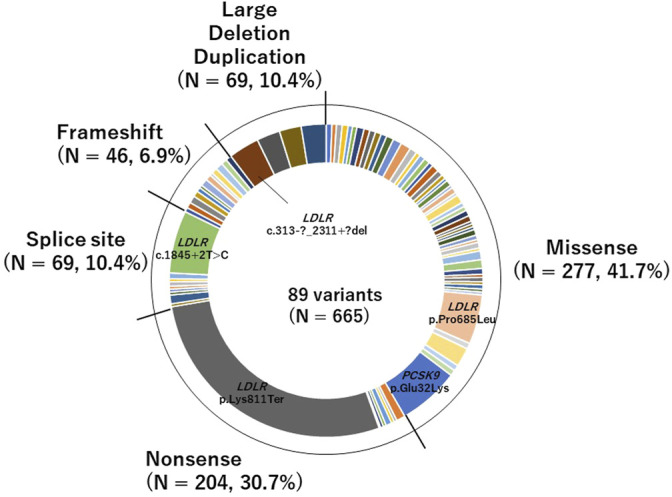
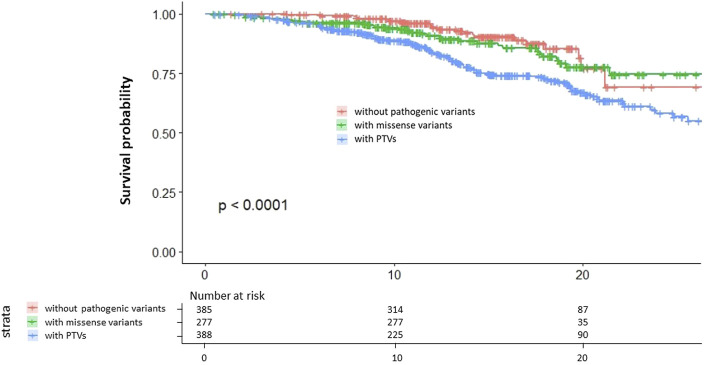
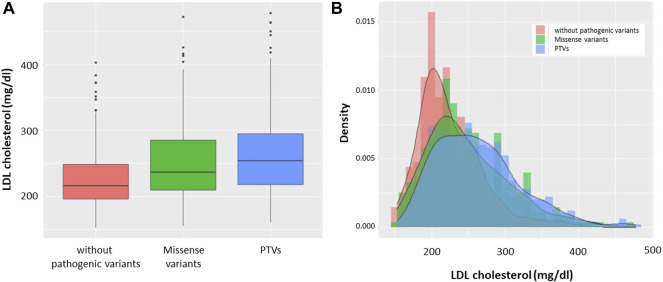
It has been shown that pathogenic variants are associated with poor clinical outcomes in patients with familial hypercholesterolemia (FH). However, data on the effect of different types of pathogenic variants on FH phenotype is limited. We retrospectively investigated the associations between genotypes and phenotypes, including low-density lipoprotein (LDL) cholesterol level and the occurrence of major adverse cardiac events (MACEs), defined as cardiovascular death, myocardial infarction, unstable angina, or coronary artery revascularization, in patients with FH (N = 1,050, male/female = 490/560). Based on genotype, the patients were divided into the following three groups: patients without pathogenic variants, patients with missense variants, and patients with protein-truncating variants (PTVs). Cox proportional hazard model was used to identify the factors associated with MACEs. The median follow-up duration was 12.6 years (interquartile range = 9.5-17.9 years). There were 665 patients with FH-mutation (277 patients with missense variants and 388 patients with PTVs) and 385 patients without FH-mutation. Over the follow-up duration, 175 MACEs were observed. We identified 89 different pathogenic variants in the 665 patients with FH. LDL cholesterol level was found to be significantly higher in patients with PTVs (256 mg/dl) than in patients with missense variants (236 mg/dl) and patients without pathogenic variants (216 mg/dl). It was also found that PTVs and missense variants are significantly associated with MACEs (hazard ratio [HR] = 1.58, 95% confidence interval [CI] = 1.08-2.08, = 0.0033 and HR = 3.24, 95% CI = 2.12-4.40, = 3.9 × 10, respectively), independent of classical risk factors. Pathogenic variants, especially PTVs, are significantly associated with poor outcomes in patients with FH. Genetic testing is useful for the diagnosis and risk stratification of patients with FH.
研究表明,致病性变异与家族性高胆固醇血症(FH)患者的不良临床结局相关。然而,关于不同类型致病性变异对FH表型影响的数据有限。我们回顾性研究了FH患者(N = 1050,男/女 = 490/560)的基因型与表型之间的关联,包括低密度脂蛋白(LDL)胆固醇水平以及主要不良心脏事件(MACE)的发生情况,MACE定义为心血管死亡、心肌梗死、不稳定型心绞痛或冠状动脉血运重建。根据基因型,患者被分为以下三组:无致病性变异的患者、有错义变异的患者和有蛋白质截短变异(PTV)的患者。采用Cox比例风险模型来确定与MACE相关的因素。中位随访时间为12.6年(四分位间距 = 9.5 - 17.9年)。有665例FH突变患者(277例有错义变异,388例有PTV)和385例无FH突变患者。在随访期间,观察到175例MACE。我们在665例FH患者中鉴定出89种不同的致病性变异。发现有PTV的患者的LDL胆固醇水平(256mg/dl)显著高于有错义变异的患者(236mg/dl)和无致病性变异的患者(216mg/dl)。还发现PTV和错义变异与MACE显著相关(风险比[HR] = 1.58,95%置信区间[CI] = 1.08 - 2.08,P = 0.0033;HR = 3.24,95%CI = 2.12 - 4.40,P = 3.9×10⁻⁶),且独立于经典危险因素。致病性变异,尤其是PTV,与FH患者的不良结局显著相关。基因检测对FH患者的诊断和风险分层有用。