Zhang Xuanze, Wang Ying-Ping, Rayner Peter J, Ciais Philippe, Huang Kun, Luo Yiqi, Piao Shilong, Wang Zhonglei, Xia Jianyang, Zhao Wei, Zheng Xiaogu, Tian Jing, Zhang Yongqiang
Key Laboratory of Water Cycle and Related Land Surface Processes, Institute of Geographic Sciences and Natural Resources Research, Chinese Academy of Sciences, Beijing, China.
Research Center for Global Change and Ecological Forecasting, School of Ecological and Environmental Science, East China Normal University, Shanghai, China.
Nat Commun. 2021 May 19;12(1):2952. doi: 10.1038/s41467-021-22392-w.
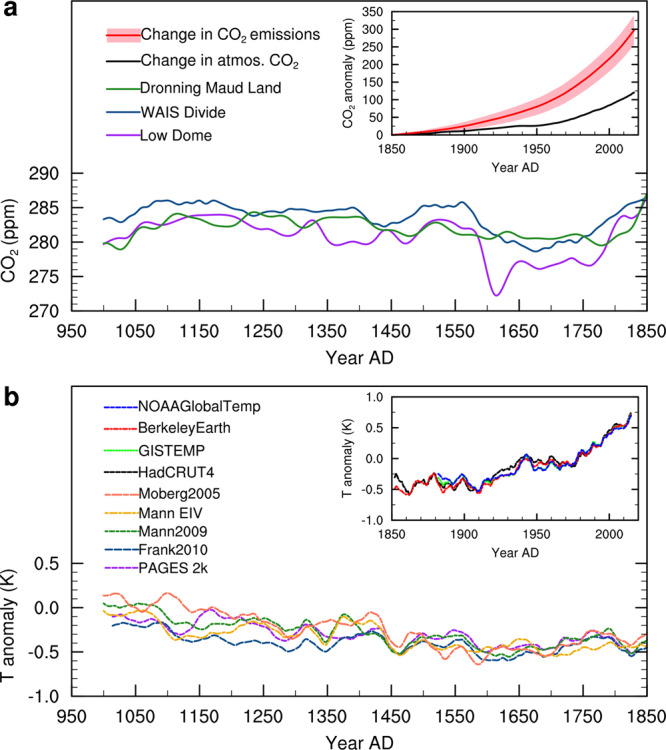
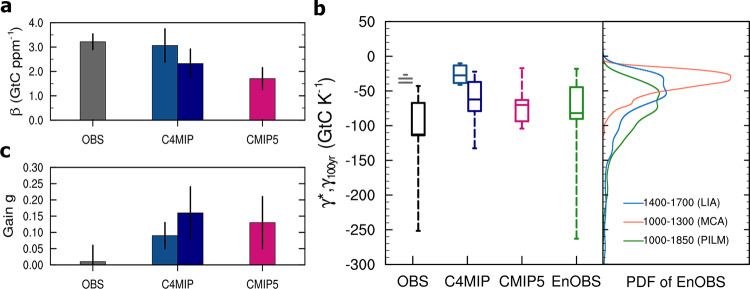
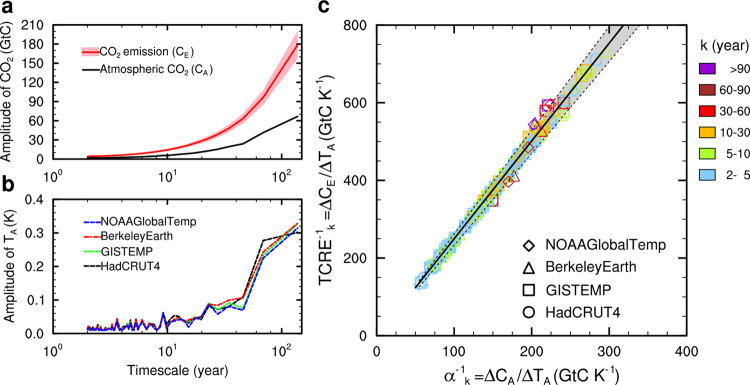
The climate-carbon cycle feedback is one of the most important climate-amplifying feedbacks of the Earth system, and is quantified as a function of carbon-concentration feedback parameter (β) and carbon-climate feedback parameter (γ). However, the global climate-amplifying effect from this feedback loop (determined by the gain factor, g) has not been quantified from observations. Here we apply a Fourier analysis-based carbon cycle feedback framework to the reconstructed records from 1850 to 2017 and 1000 to 1850 to estimate β and γ. We show that the β-feedback varies by less than 10% with an average of 3.22 ± 0.32 GtC ppm for 1880-2017, whereas the γ-feedback increases from -33 ± 14 GtC K on a decadal scale to -122 ± 60 GtC K on a centennial scale for 1000-1850. Feedback analysis further reveals that the current amplification effect from the carbon cycle feedback is small (g is 0.01 ± 0.05), which is much lower than the estimates by the advanced Earth system models (g is 0.09 ± 0.04 for the historical period and is 0.15 ± 0.08 for the RCP8.5 scenario), implying that the future allowable CO emissions could be 9 ± 7% more. Therefore, our findings provide new insights about the strength of climate-carbon cycle feedback and about observational constraints on models for projecting future climate.
气候 - 碳循环反馈是地球系统中最重要的气候放大反馈之一,它被量化为碳浓度反馈参数(β)和碳 - 气候反馈参数(γ)的函数。然而,尚未从观测中量化该反馈回路产生的全球气候放大效应(由增益因子g确定)。在此,我们将基于傅里叶分析的碳循环反馈框架应用于1850年至2017年以及1000年至1850年的重建记录,以估算β和γ。我们表明,对于1880 - 2017年,β反馈的变化小于10%,平均为3.22±0.32 GtC ppm,而对于1000 - 1850年,γ反馈在年代际尺度上从 - 33±14 GtC K增加到百年尺度上的 - 122±60 GtC K。反馈分析进一步揭示,当前碳循环反馈的放大效应较小(g为0.01±0.05),远低于先进地球系统模型的估计值(历史时期g为0.09±0.04,RCP8.5情景下为0.15±0.08),这意味着未来允许的二氧化碳排放量可能会多9±7%。因此,我们的研究结果为气候 - 碳循环反馈的强度以及对预测未来气候的模型的观测约束提供了新的见解。