
犬细小病毒及其非结构基因1作为溶瘤剂:作用机制及抗肿瘤免疫反应的诱导
Canine Parvovirus and Its Non-Structural Gene 1 as Oncolytic Agents: Mechanism of Action and Induction of Anti-Tumor Immune Response.
作者信息
Arora Richa, Malla Waseem Akram, Tyagi Arpit, Mahajan Sonalika, Sajjanar Basavaraj, Tiwari Ashok Kumar
机构信息
Division of Veterinary Biotechnology, ICAR-Indian Veterinary Research Institute, Izatnagar, India.
GB Pant University of Agriculture and Technology, Pantnagar, India.
出版信息
Front Oncol. 2021 May 3;11:648873. doi: 10.3389/fonc.2021.648873. eCollection 2021.
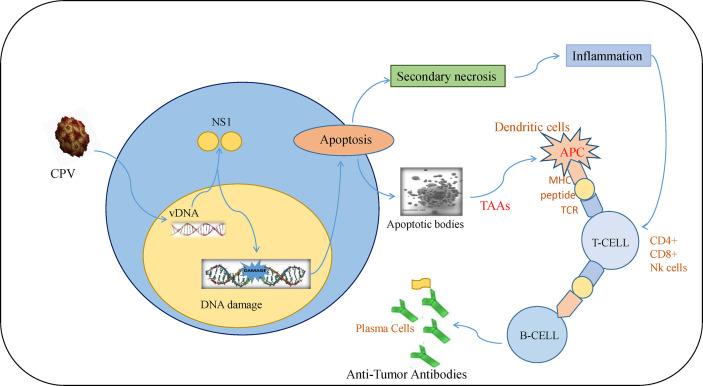
The exploration into the strategies for the prevention and treatment of cancer is far from complete. Apart from humans, cancer has gained considerable importance in animals because of increased awareness towards animal health and welfare. Current cancer treatment regimens are less specific towards tumor cells and end up harming normal healthy cells. Thus, a highly specific therapeutic strategy with minimal side effects is the need of the hour. Oncolytic viral gene therapy is one such specific approach to target cancer cells without affecting the normal cells of the body. Canine parvovirus (CPV) is an oncolytic virus that specifically targets and kills cancer cells by causing DNA damage, caspase activation, and mitochondrial damage. Non-structural gene 1 (NS1) of CPV, involved in viral DNA replication is a key mediator of cytotoxicity of CPV and can selectively cause tumor cell lysis. In this review, we discuss the oncolytic properties of Canine Parvovirus (CPV or CPV2), the structure of the NS1 protein, the mechanism of oncolytic action as well as role in inducing an antitumor immune response in different tumor models.
对癌症防治策略的探索远未完成。除了人类,由于对动物健康和福利的关注度提高,癌症在动物中也变得相当重要。当前的癌症治疗方案对肿瘤细胞的特异性较低,最终会损害正常健康细胞。因此,当下迫切需要一种副作用最小的高度特异性治疗策略。溶瘤病毒基因疗法就是一种这样的特异性方法,可靶向癌细胞而不影响身体的正常细胞。犬细小病毒(CPV)是一种溶瘤病毒,它通过引起DNA损伤、半胱天冬酶激活和线粒体损伤来特异性地靶向并杀死癌细胞。参与病毒DNA复制的CPV非结构基因1(NS1)是CPV细胞毒性的关键介质,可选择性地导致肿瘤细胞裂解。在这篇综述中,我们讨论了犬细小病毒(CPV或CPV2)的溶瘤特性、NS1蛋白的结构、溶瘤作用机制以及在不同肿瘤模型中诱导抗肿瘤免疫反应的作用。


 Zotero 插件