Kim Sang-Hoon, Ko Young Jun, Baek Seung-Soo
Department of Sport & Health Sciences, College of Art & Culture, Sangmyung University, Seoul, Korea.
Department of Physiology, College of Medicine, Kyung Hee University, Seoul, Korea.
J Exerc Rehabil. 2021 Apr 27;17(2):81-87. doi: 10.12965/jer.2142188.094. eCollection 2021 Apr.
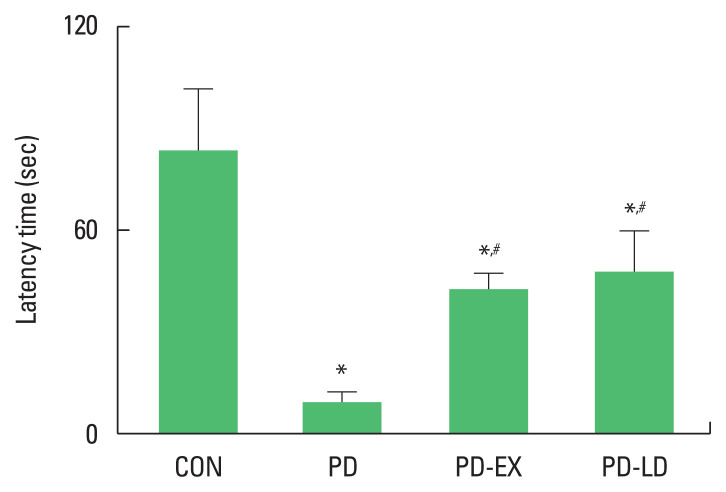
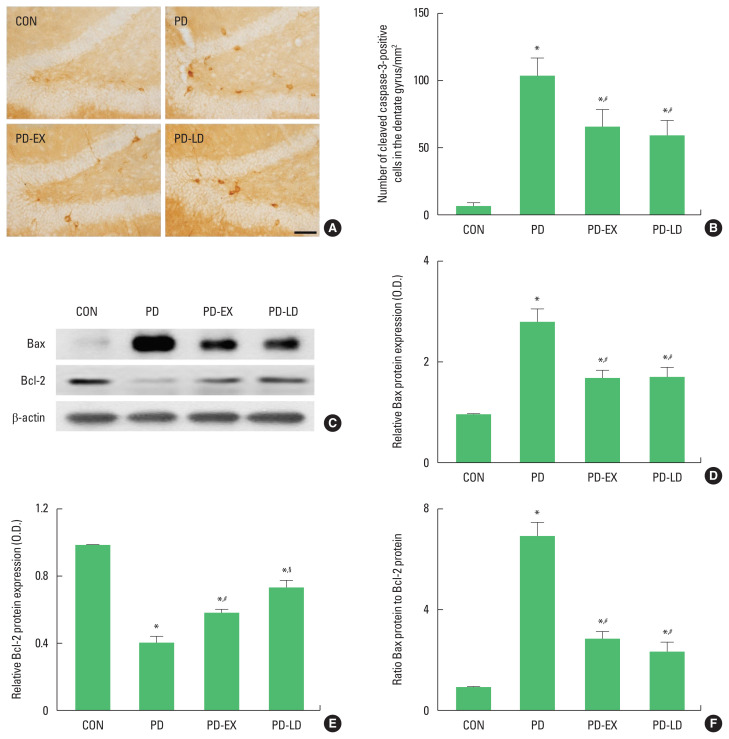
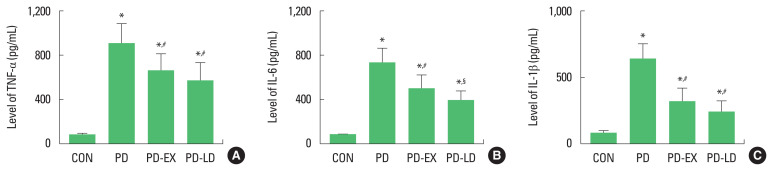
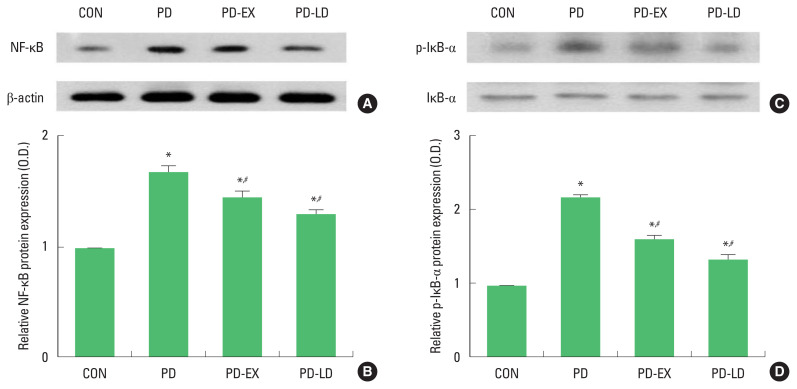
Dysfunctions of Parkinson disease (PD) are classified into motor dysfunction, autonomic nervous system dysfunction, and nonmotor dysfunction, and clinical symptoms such as muscle stiffness, tremors, speech disorders, balance disorders, and slow movements appear. Resistance exercise is a main compartment of exercise programs for PD patient. The effect of resistant exercise on short-term memory in PD mice was studied in relation to the activation of nuclear factor (NF)-κB pathway. PD was induced by subcutaneous injection of 1-methyl-4-phenyl-1,2,3,6-tetrahydropyridine. For resistance exercise, mice performed ladder climbing 5 days per week for 5 weeks. Step-down avoidance test for short-term memory, enzyme-linked immunoassay for tumor necrosis factor (TNF)-α, interleukin (IL)-6, and IL-1β, Western bot for NF-κB, NF-κB inhibitor (IκB)-α, B-cell lymphoma 2 (Bcl-2)-associated X protein (Bax), and Bcl-2, and immunohistochemistry for cleaved caspase-3 were done. Latency time was shortened, TNF-α, IL-6, and IL-1β concentration was increased, NF-κB expression and IκB-α phosphorylation were increased, cleaved caspase-3 and Bax expression was enhanced, and Bcl-2 expression was suppressed by PD induction. Latency time was lengthened, TNF-α, IL-6, and IL-1β concentration was decreased, NF-κB expression and IκB-α phosphorylation were suppressed, cleaved caspase-3 and Bax expression was decreased, and Bcl-2 expression was increased in PD mice by resistance exercise or levodopa treatment. Resistance exercise improved short-term memory by inhibiting secretion of proinflammatory cytokines and apoptosis through inactivation of NF-κB. These effects of resistance exercise were similar to levodopa treatment.
帕金森病(PD)的功能障碍分为运动功能障碍、自主神经系统功能障碍和非运动功能障碍,并出现肌肉僵硬、震颤、言语障碍、平衡障碍和运动迟缓等临床症状。抗阻运动是PD患者运动方案的主要组成部分。研究了抗阻运动对PD小鼠短期记忆的影响及其与核因子(NF)-κB通路激活的关系。通过皮下注射1-甲基-4-苯基-1,2,3,6-四氢吡啶诱导PD。对于抗阻运动,小鼠每周进行5天爬梯训练,持续5周。进行了短期记忆的跳台回避试验、肿瘤坏死因子(TNF)-α、白细胞介素(IL)-6和IL-1β的酶联免疫分析、NF-κB、NF-κB抑制剂(IκB)-α、B细胞淋巴瘤2(Bcl-2)相关X蛋白(Bax)和Bcl-2的蛋白质免疫印迹分析以及裂解的半胱天冬酶-3的免疫组织化学分析。PD诱导后,潜伏期缩短,TNF-α、IL-6和IL-1β浓度升高,NF-κB表达和IκB-α磷酸化增加,裂解的半胱天冬酶-3和Bax表达增强,Bcl-2表达受到抑制。通过抗阻运动或左旋多巴治疗,PD小鼠的潜伏期延长,TNF-α、IL-6和IL-1β浓度降低,NF-κB表达和IκB-α磷酸化受到抑制,裂解的半胱天冬酶-3和Bax表达降低,Bcl-2表达增加。抗阻运动通过抑制促炎细胞因子的分泌和NF-κB失活诱导的细胞凋亡来改善短期记忆。抗阻运动的这些作用与左旋多巴治疗相似。