Sainoh Takeshi, Orita Sumihisa, Miyagi Masayuki, Suzuki-Narita Miyako, Sakuma Yoshihiro, Oikawa Yasuhiro, Kubota Go, Sato Jun, Shiga Yasuhiro, Fujimoto Kazuki, Eguchi Yawara, Koda Masao, Aoki Yasuchika, Akazawa Tsutomu, Furuya Takeo, Nakamura Junichi, Takahashi Hiroshi, Maki Satoshi, Inoue Masahiro, Kinoshita Hideyuki, Norimoto Masaki, Sato Takashi, Sato Masashi, Suzuki Masahiro, Enomoto Keigo, Takaoka Hiromitsu, Mizuki Norichika, Hozumi Takashi, Tsuchiya Ryuto, Kim Geundong, Otagiri Takuma, Mukaihata Tomohito, Hishiya Takahisa, Ohtori Seiji, Inage Kazuhide
Department of Orthopaedic Surgery, Sainou Hospital, Toyama, Japan.
Department of Orthopaedic Surgery, Graduate School of Medicine, Chiba University, Chiba, Japan.
Asian Spine J. 2022 Feb;16(1):99-106. doi: 10.31616/asj.2020.0283. Epub 2021 May 21.
Prospective cohort study (open-label, single-arm, and non-blinded).
This study aims to determine the effects of systemic administration of tocilizumab, an anti-interleukin-6 (IL-6) receptor antibody on refractory low back pain and leg symptoms.
IL-6 overexpression is associated with neuropathic pain pathogenesis, which is potentially followed by chronic low back pain, including leg pain and numbness. This finding suggest that inhibition of IL-6 at the site of pain or in the transmission pathway could provide novel therapeutic targets for chronic low back pain.
This prospective, single-arm study included 11 patients (eight men; mean age, 62.7 years) with ≥3-months' chronic pain history due to lumbar disease. Subcutaneous TCZ injections were administered twice, at a 2-week interval. We evaluated low back pain, leg pain, and leg numbness using numeric rating scales and the Oswestry Disability Index (ODI; baseline and 6 months postinjection); serum IL-6 and tumor necrosis factor-α levels (baseline and 1 month postinjection); and clinical adverse events.
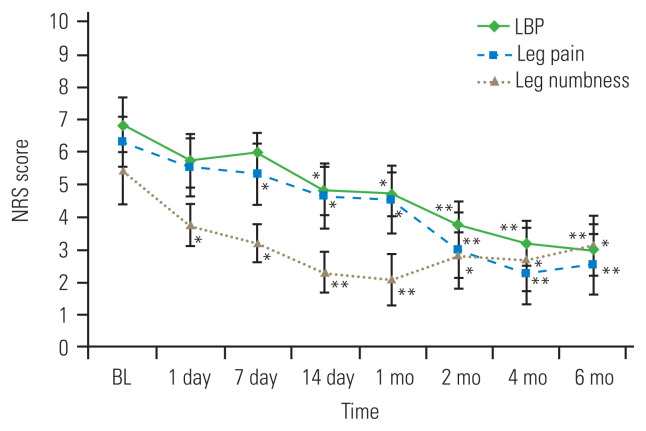
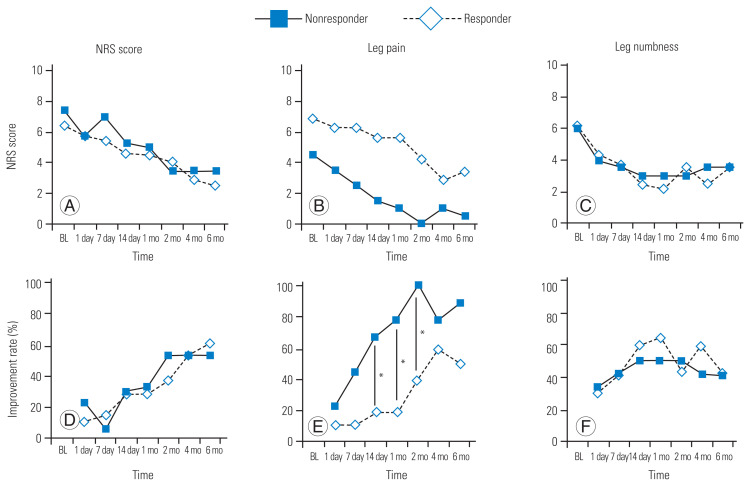
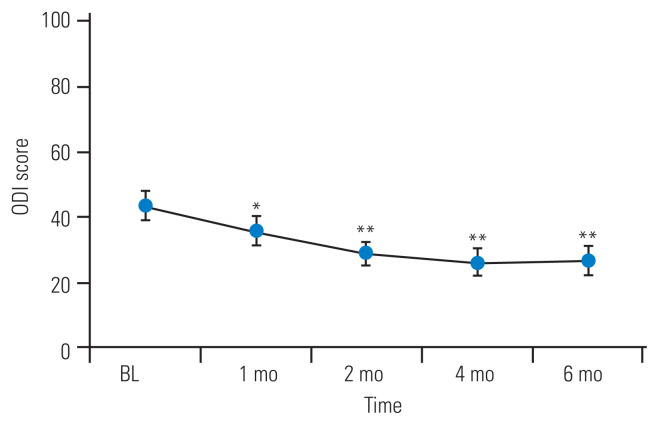
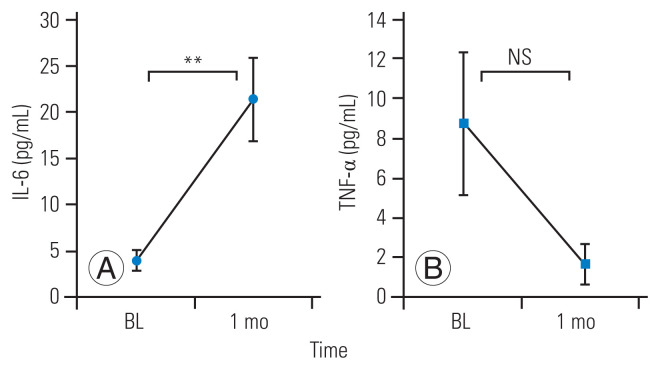
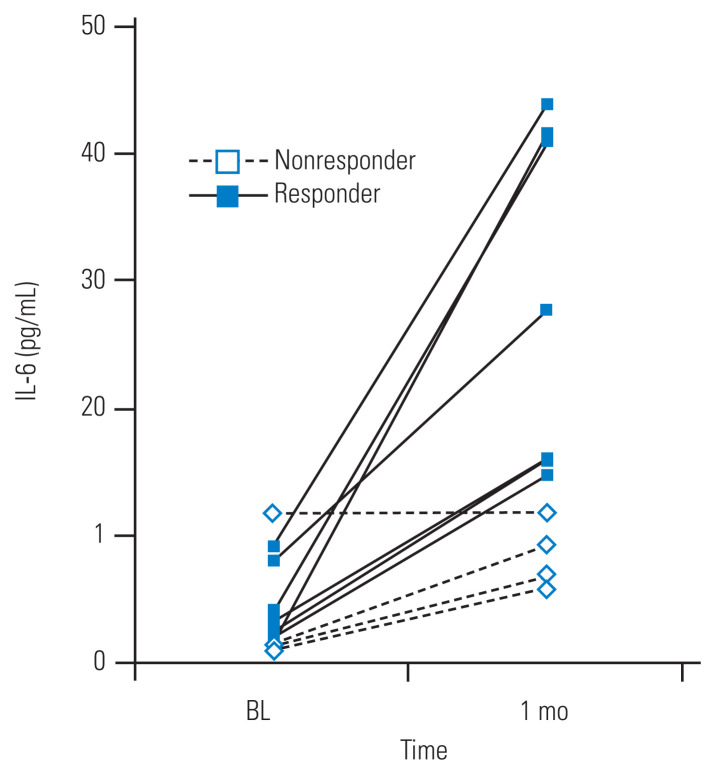
Intractable symptoms reduced after TCZ administration. Low back pain improved for 6 months. Improvements in leg pain and numbness peaked at 4 and 1 month, respectively. Improvements in ODI were significant at 1 month and peaked at 4 months. Serum IL-6 was increased at 1 month. IL-6 responders (i.e., patients with IL-6 increases >10 pg/mL) showed particularly significant improvements in leg pain at 2 weeks, 1 month, and 2 months compared with nonresponders. We observed no apparent adverse events.
Systemic TCZ administration improved symptoms effectively for 6 months, with peak improvements at 1-4 months and no adverse events. Changing serum IL-6 levels correlated with leg pain improvements; further studies are warranted to elucidate the mechanistic connections between lumbar disorders and inflammatory cytokines.
前瞻性队列研究(开放标签、单臂且非盲法)。
本研究旨在确定抗白细胞介素 -6(IL-6)受体抗体托珠单抗全身给药对难治性腰背痛和腿部症状的影响。
IL-6 过表达与神经性疼痛发病机制相关,这可能继而导致慢性腰背痛,包括腿痛和麻木。这一发现表明,在疼痛部位或传导途径抑制 IL-6 可为慢性腰背痛提供新的治疗靶点。
这项前瞻性单臂研究纳入了 11 例因腰椎疾病有≥3 个月慢性疼痛病史的患者(8 名男性;平均年龄 62.7 岁)。皮下注射托珠单抗,每 2 周注射一次,共注射两次。我们使用数字评分量表和奥斯威斯功能障碍指数(ODI;基线及注射后 6 个月)评估腰背痛、腿痛和腿部麻木情况;检测血清 IL-6 和肿瘤坏死因子 -α 水平(基线及注射后 1 个月);并记录临床不良事件。
托珠单抗给药后难治性症状减轻。腰背痛改善持续 6 个月。腿痛和麻木的改善分别在第 4 个月和第 1 个月达到峰值。ODI 在第 1 个月有显著改善,并在第 4 个月达到峰值。血清 IL-6 在第 1 个月升高。与无反应者相比,IL-6 反应者(即 IL-6 升高>10 pg/mL 的患者)在第 2 周、第 1 个月和第 2 个月时腿痛改善尤为显著。我们未观察到明显的不良事件。
全身给予托珠单抗可有效改善症状达 6 个月,在 1 - 4 个月时改善最为明显,且无不良事件。血清 IL-6 水平的变化与腿痛改善相关;有必要进一步研究以阐明腰椎疾病与炎性细胞因子之间的机制联系。