Bao Linlin, Deng Wei, Qi Feifei, Lv Qi, Song Zhiqi, Liu Jiangning, Gao Hong, Wei Qiang, Yu Pin, Xu Yanfeng, Qu Yajin, Li Fengdi, Xue Jing, Gong Shuran, Liu Mingya, Wang Guanpeng, Wang Shunyi, Zhao Binbin, Cong Bin, Qin Chuan
Beijing Key Laboratory for Animal Models of Emerging and Remerging Infectious Diseases, NHC Key Laboratory of Human Disease Comparative Medicine, Institute of Laboratory Animal Science, Chinese Academy of Medical Sciences and Comparative Medicine Center, Peking Union Medical College, Beijing, China.
Hebei Medical University, Shijiazhuang, China.
Signal Transduct Target Ther. 2021 May 20;6(1):200. doi: 10.1038/s41392-021-00618-z.
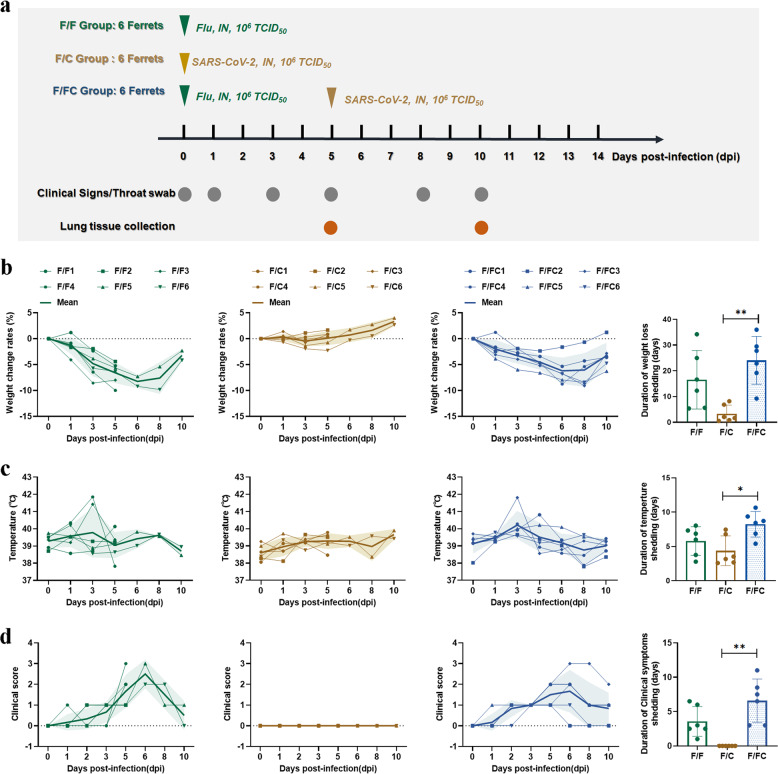
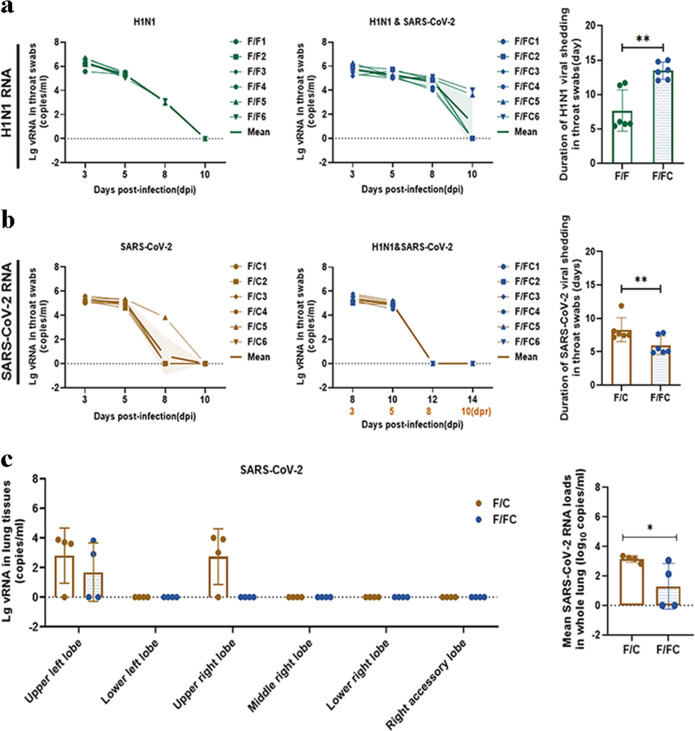
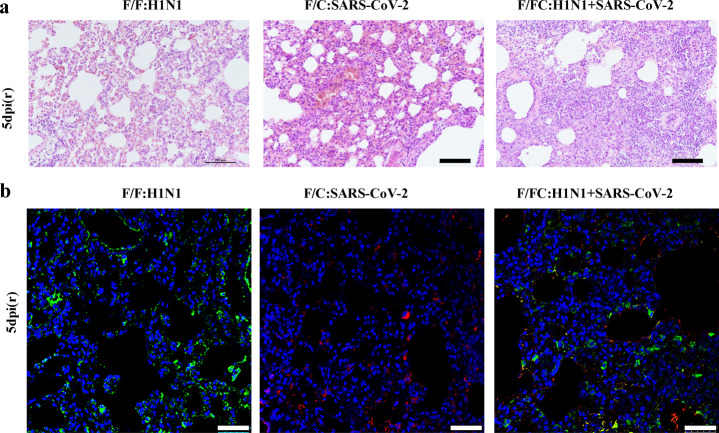
Influenza A virus may circulate simultaneously with the SARS-CoV-2 virus, leading to more serious respiratory diseases during this winter. However, the influence of these viruses on disease outcome when both influenza A and SARS-CoV-2 are present in the host remains unclear. Using a mammalian model, sequential infection was performed in ferrets and in K18-hACE2 mice, with SARS-CoV-2 infection following H1N1. We found that co-infection with H1N1 and SARS-CoV-2 extended the duration of clinical manifestation of COVID-19, and enhanced pulmonary damage, but reduced viral shedding of throat swabs and viral loads in the lungs of ferrets. Moreover, mortality was increased in sequentially infected mice compared with single-infection mice. Compared with single-vaccine inoculation, co-inoculation of PiCoVacc (a SARS-CoV-2 vaccine) and the flu vaccine showed no significant differences in neutralizing antibody titers or virus-specific immune responses. Combined immunization effectively protected K18-hACE2 mice against both H1N1 and SARS-CoV-2 infection. Our findings indicated the development of systematic models of co-infection of H1N1 and SARS-CoV-2, which together notably enhanced pneumonia in ferrets and mice, as well as demonstrated that simultaneous vaccination against H1N1 and SARS-CoV-2 may be an effective prevention strategy for the coming winter.
甲型流感病毒可能与严重急性呼吸综合征冠状病毒2(SARS-CoV-2)病毒同时传播,导致今年冬季出现更严重的呼吸道疾病。然而,当甲型流感和SARS-CoV-2同时存在于宿主体内时,这些病毒对疾病结局的影响仍不清楚。利用哺乳动物模型,在雪貂和K18-hACE2小鼠中进行了序贯感染,H1N1感染后再感染SARS-CoV-2。我们发现,H1N1和SARS-CoV-2共同感染延长了新冠病毒病(COVID-19)的临床表现持续时间,并加重了肺部损伤,但减少了雪貂咽喉拭子的病毒脱落和肺部的病毒载量。此外,与单次感染小鼠相比,序贯感染小鼠的死亡率增加。与单疫苗接种相比,PiCoVacc(一种SARS-CoV-2疫苗)和流感疫苗联合接种在中和抗体滴度或病毒特异性免疫反应方面没有显著差异。联合免疫有效地保护了K18-hACE2小鼠免受H1N1和SARS-CoV-2感染。我们的研究结果表明,建立了H1N1和SARS-CoV-2共同感染的系统模型,该模型显著加重了雪貂和小鼠的肺炎,同时也证明了同时接种H1N1和SARS-CoV-2疫苗可能是应对即将到来的冬季的有效预防策略。