Wiendl Maximilian, Becker Emily, Müller Tanja M, Voskens Caroline J, Neurath Markus F, Zundler Sebastian
Department of Medicine 1, Deutsches Zentrum Immuntherapie (DZI), University Hospital Erlangen, Friedrich-Alexander-Universität Erlangen-Nürnberg, Erlangen, Germany.
Department of Dermatology, University Hospital Erlangen, Friedrich-Alexander-Universität Erlangen-Nürnberg, Erlangen, Germany.
Front Immunol. 2021 May 4;12:656452. doi: 10.3389/fimmu.2021.656452. eCollection 2021.
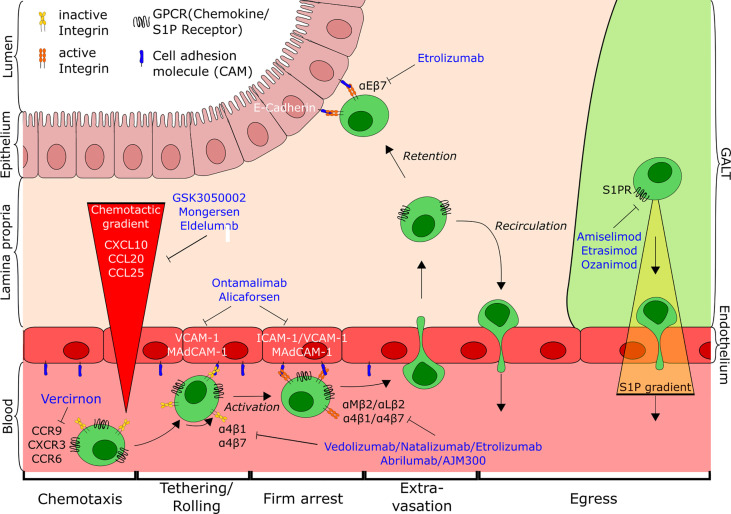
Inflammatory bowel diseases (IBDs), including Crohn's disease (CD) and ulcerative colitis (UC) are multifactorial diseases with still unknown aetiology and an increasing prevalence and incidence worldwide. Despite plentiful therapeutic options for IBDs, the lack or loss of response in certain patients demands the development of further treatments to tackle this unmet medical need. In recent years, the success of the anti-α4β7 antibody vedolizumab highlighted the potential of targeting the homing of immune cells, which is now an important pillar of IBD therapy. Due to its complexity, leukocyte trafficking and the involved molecules offer a largely untapped resource for a plethora of potential therapeutic interventions. In this review, we aim to summarise current and future directions of specifically interfering with immune cell trafficking. We will comment on concepts of homing, retention and recirculation and particularly focus on the role of tissue-derived chemokines. Moreover, we will give an overview of the mode of action of drugs currently in use or still in the pipeline, highlighting their mechanisms and potential to reduce disease burden.
炎症性肠病(IBD),包括克罗恩病(CD)和溃疡性结肠炎(UC),是多因素疾病,其病因仍不明,且在全球范围内患病率和发病率不断上升。尽管IBD有多种治疗选择,但某些患者缺乏反应或反应丧失,这就需要开发更多治疗方法来满足这一未被满足的医疗需求。近年来,抗α4β7抗体维多珠单抗的成功突出了靶向免疫细胞归巢的潜力,这现已成为IBD治疗的一个重要支柱。由于其复杂性,白细胞运输及相关分子为大量潜在治疗干预提供了一个很大程度上未被开发的资源。在本综述中,我们旨在总结特异性干扰免疫细胞运输的当前及未来方向。我们将对归巢、滞留和再循环的概念进行评论,并特别关注组织衍生趋化因子的作用。此外,我们将概述目前正在使用或仍在研发中的药物的作用方式,突出其作用机制及减轻疾病负担的潜力。