Brabson John P, Leesang Tiffany, Mohammad Sofia, Cimmino Luisa
Department of Biochemistry and Molecular Biology, Miller School of Medicine, University of Miami, Miami, FL, United States.
Sylvester Comprehensive Cancer Center, Miller School of Medicine, University of Miami, Miami, FL, United States.
Front Genet. 2021 May 4;12:675780. doi: 10.3389/fgene.2021.675780. eCollection 2021.
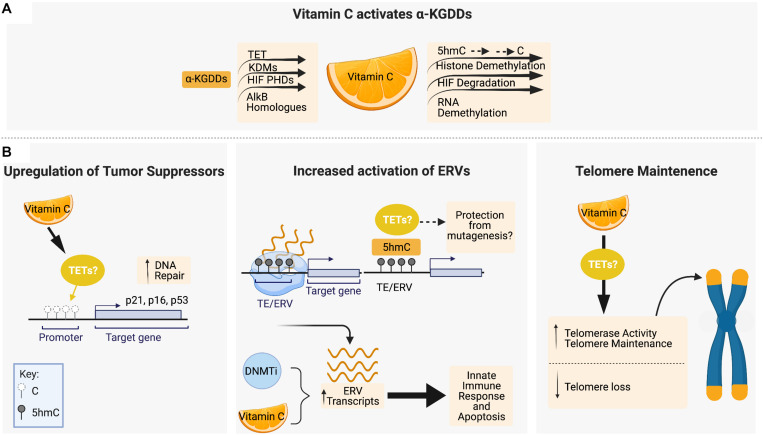
DNA methylation plays an important role in the maintenance of genomic stability. Ten-eleven translocation proteins (TETs) are a family of iron (Fe) and α-KG -dependent dioxygenases that regulate DNA methylation levels by oxidizing 5-methylcystosine (5mC) to generate 5-hydroxymethylcytosine (5hmC), 5-formylcytosine (5fC), and 5-carboxylcytosine (5caC). These oxidized methylcytosines promote passive demethylation upon DNA replication, or active DNA demethylation, by triggering base excision repair and replacement of 5fC and 5caC with an unmethylated cytosine. Several studies over the last decade have shown that loss of TET function leads to DNA hypermethylation and increased genomic instability. Vitamin C, a cofactor of TET enzymes, increases 5hmC formation and promotes DNA demethylation, suggesting that this essential vitamin, in addition to its antioxidant properties, can also directly influence genomic stability. This review will highlight the functional role of DNA methylation, TET activity and vitamin C, in the crosstalk between DNA methylation and DNA repair.
DNA甲基化在维持基因组稳定性方面发挥着重要作用。10-11易位蛋白(TETs)是一类依赖铁(Fe)和α-酮戊二酸的双加氧酶,通过将5-甲基胞嘧啶(5mC)氧化生成5-羟甲基胞嘧啶(5hmC)、5-甲酰基胞嘧啶(5fC)和5-羧基胞嘧啶(5caC)来调节DNA甲基化水平。这些氧化的甲基胞嘧啶在DNA复制时促进被动去甲基化,或通过触发碱基切除修复并用未甲基化的胞嘧啶取代5fC和5caC来促进主动DNA去甲基化。过去十年的多项研究表明,TET功能丧失会导致DNA高甲基化和基因组不稳定性增加。维生素C是TET酶的一种辅助因子,可增加5hmC的形成并促进DNA去甲基化,这表明这种必需维生素除了具有抗氧化特性外,还可直接影响基因组稳定性。本综述将重点介绍DNA甲基化、TET活性和维生素C在DNA甲基化与DNA修复相互作用中的功能作用。