Department of Translational Medicine and Physiology, Elson S. Floyd College of Medicine, Washington State University, Spokane, WA, 99202, USA.
Department of Translational Medicine and Physiology, Elson S. Floyd College of Medicine, Washington State University, Spokane, WA, 99202, USA; Department of Integrative Physiology and Neuroscience, College of Veterinary Medicine, Washington State University, Pullman, WA, 99164, USA; Sleep and Performance Research Center, Washington State University, Spokane, WA, 99202, USA; Steve Gleason Institute for Neuroscience, Washington State University, Spokane, WA, 99202, USA.
Redox Biol. 2024 Sep;75:103288. doi: 10.1016/j.redox.2024.103288. Epub 2024 Jul 26.
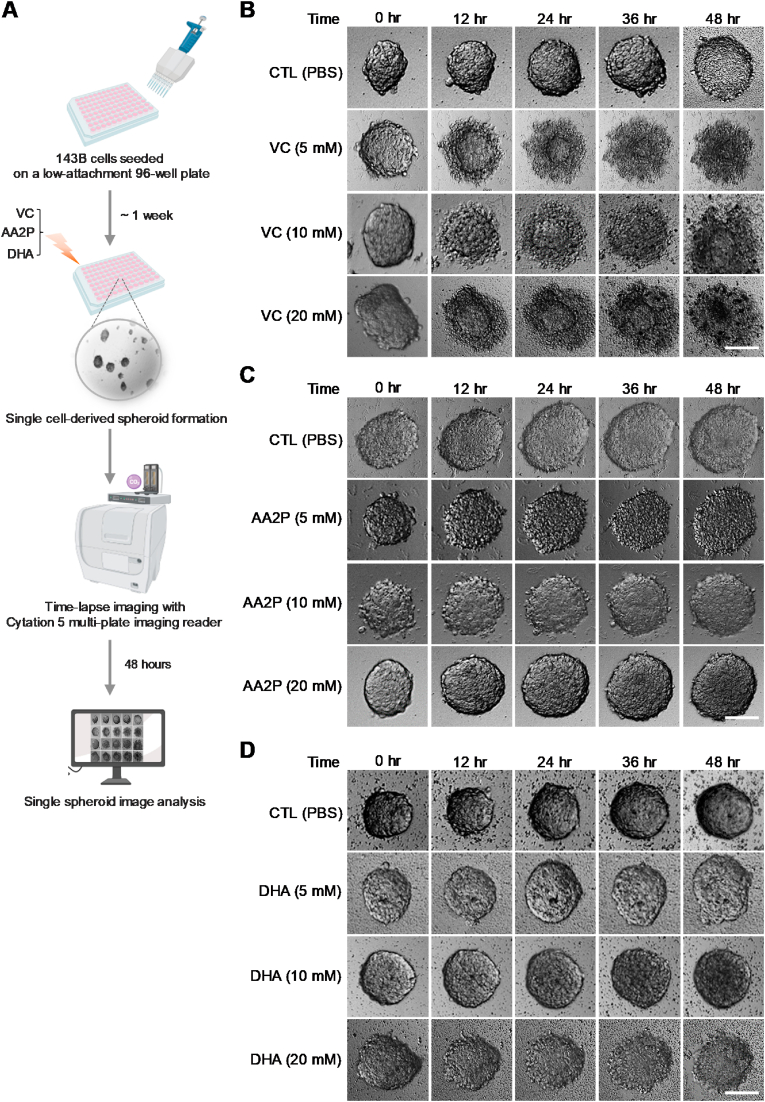
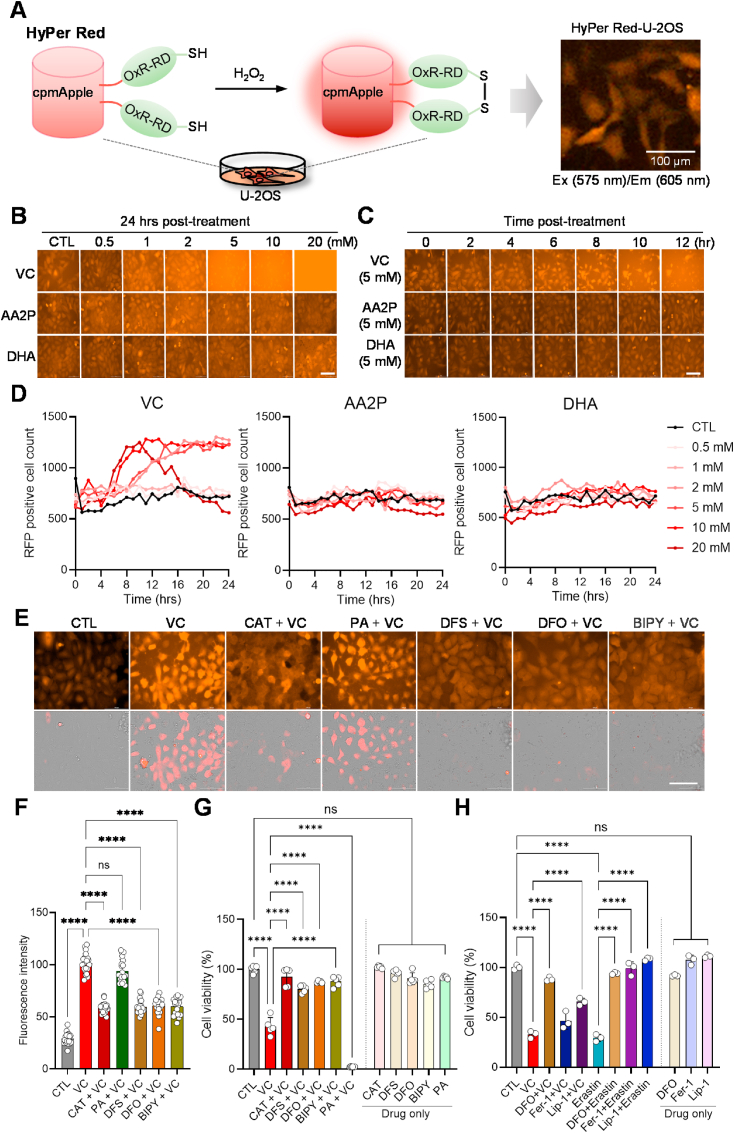
Pharmacological vitamin C (VC) has gained attention for its pro-oxidant characteristics and selective ability to induce cancer cell death. However, defining its role in cancer has been challenging due to its complex redox properties. In this study, using a human osteosarcoma (OS) model, we show that the redox-active property of VC is critical for inducing non-apoptotic cancer cell death via intracellular reactive oxygen species (ROS)-iron-calcium crosstalk and mitochondrial dysfunction. In both 2D and 3D OS cell culture models, only the oxidizable form of VC demonstrated potent dose-dependent cytotoxicity, while non-oxidizable and oxidized VC derivatives had minimal effects. Live-cell imaging showed that only oxidizable VC caused a surge in cytotoxic ROS, dependent on iron rather than copper. Inhibitors of ferroptosis, a form of iron-dependent cell death, along with classical apoptosis inhibitors, were unable to completely counteract the cytotoxic effects induced by VC. Further pharmacological and genetic inhibition analyses showed that VC triggers calcium release through inositol 1,4,5-trisphosphate receptors (IP3Rs), leading to mitochondrial ROS production and eventual cell death. RNA sequencing revealed down-regulation of genes involved in the mitochondrial electron transport chain and oxidative phosphorylation upon pharmacological VC treatment. Consistently, high-dose VC reduced mitochondrial membrane potential, oxidative phosphorylation, and ATP levels, with ATP reconstitution rescuing VC-induced cytotoxicity. In vivo OS xenograft studies demonstrated reduced tumor growth with high-dose VC administration, concomitant with the altered expression of mitochondrial ATP synthase (MT-ATP). These findings emphasize VC's potential clinical utility in osteosarcoma treatment by inducing mitochondrial metabolic dysfunction through a vicious intracellular ROS-iron-calcium cycle.
药理学维生素 C(VC)因其具有促氧化剂特性和选择性诱导癌细胞死亡的能力而受到关注。然而,由于其复杂的氧化还原特性,定义其在癌症中的作用一直具有挑战性。在这项研究中,我们使用人骨肉瘤(OS)模型表明,VC 的氧化还原活性对于通过细胞内活性氧(ROS)-铁-钙串扰和线粒体功能障碍诱导非凋亡性癌细胞死亡至关重要。在 2D 和 3D OS 细胞培养模型中,只有可氧化的 VC 形式表现出强大的剂量依赖性细胞毒性,而非可氧化和氧化的 VC 衍生物则几乎没有影响。活细胞成像显示,只有可氧化的 VC 会引起依赖铁而不是铜的细胞毒性 ROS 激增。铁死亡抑制剂(一种铁依赖性细胞死亡形式)和经典凋亡抑制剂都无法完全抵消 VC 诱导的细胞毒性作用。进一步的药理学和遗传抑制分析表明,VC 通过肌醇 1,4,5-三磷酸受体(IP3Rs)触发钙释放,导致线粒体 ROS 产生和最终细胞死亡。RNA 测序显示,药物处理后 VC 下调涉及线粒体电子传递链和氧化磷酸化的基因。一致地,高剂量 VC 降低了线粒体膜电位、氧化磷酸化和 ATP 水平,ATP 重建挽救了 VC 诱导的细胞毒性。体内 OS 异种移植研究表明,高剂量 VC 给药可降低肿瘤生长,同时改变线粒体 ATP 合酶(MT-ATP)的表达。这些发现强调了 VC 通过恶性细胞内 ROS-铁-钙循环诱导线粒体代谢功能障碍在骨肉瘤治疗中的潜在临床应用。