Kathe Niranjan J, Wani Rajvi J
Senior Manager, Complete HEOR Solutions, North Wales, PA, USA.
Real World Evidence Manager, Amgen Canada Inc, Mississauga, ON, Canada.
J Health Econ Outcomes Res. 2021 May 11;8(1):51-62. doi: 10.36469/jheor.2021.22978.
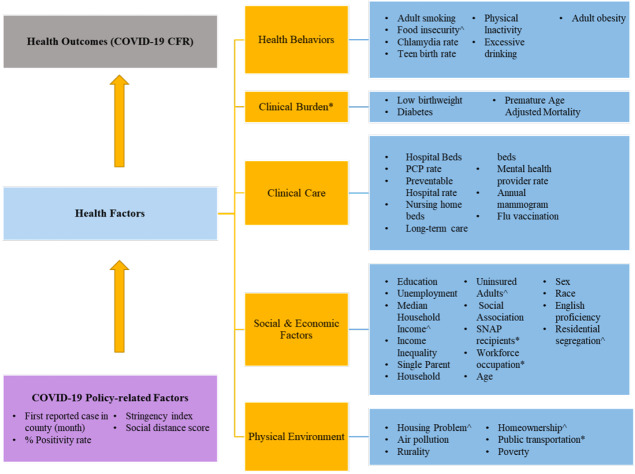
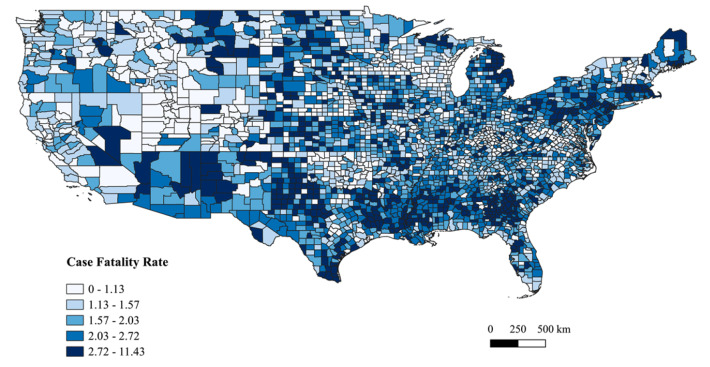
The United States continues to account for the highest proportion of the global Coronavirus Disease-2019 (COVID-19) cases and deaths. Currently, it is important to contextualize COVID-19 fatality to guide mitigation efforts. The objective of this study was to assess the ecological factors (policy, health behaviors, socio-economic, physical environment, and clinical care) associated with COVID-19 case fatality rate (CFR) in the United States. Data from the New York Times' COVID-19 repository and the Centers for Disease Control and Prevention Data (01/21/2020 - 02/27/2021) were used. County-level CFR was modeled using the Spatial Durbin model (SDM). The SDM estimates were decomposed into direct and indirect impacts. The study found percent positive for COVID-19 (0.057% point), stringency index (0.014% point), percent diabetic (0.011% point), long-term care beds (log) (0.010% point), premature age-adjusted mortality (log) (0.702 % point), income inequality ratio (0.078% point), social association rate (log) (0.014% point), percent 65 years old and over (0.055% point), and percent African Americans (0.016% point) in a given county were positively associated with its COVID-19 CFR. The study also found food insecurity, long-term beds (log), mental health-care provider (log), workforce in construction, social association rate (log), and percent diabetic of a given county as well as neighboring county were associated with given county's COVID-19 CFR, indicating significant externalities. The spatial models identified percent positive for COVID-19, stringency index, elderly, college education, race/ethnicity, residential segregation, premature mortality, income inequality, workforce composition, and rurality as important ecological determinants of the geographic disparities in COVID-19 CFR.
美国仍然是全球2019冠状病毒病(COVID-19)病例和死亡人数占比最高的国家。目前,结合背景情况来考量COVID-19死亡情况对于指导缓解措施很重要。本研究的目的是评估与美国COVID-19病例死亡率(CFR)相关的生态因素(政策、健康行为、社会经济、物理环境和临床护理)。使用了来自《纽约时报》COVID-19资料库和疾病控制与预防中心的数据(2020年1月21日至2021年2月27日)。县级CFR使用空间杜宾模型(SDM)进行建模。SDM估计值被分解为直接影响和间接影响。研究发现,某县的COVID-19阳性率(0.057个百分点)、严格指数(0.014个百分点)、糖尿病患病率(0.011个百分点)、长期护理床位(对数)(0.010个百分点)、过早年龄调整死亡率(对数)(0.702个百分点)、收入不平等比率(0.078个百分点)、社交关联率(对数)(0.014个百分点)、65岁及以上人口比例(0.055个百分点)和非裔美国人比例(0.016个百分点)与该县的COVID-19 CFR呈正相关。研究还发现,某县以及相邻县的粮食不安全状况、长期护理床位(对数)、精神卫生保健提供者(对数)、建筑行业劳动力、社交关联率(对数)和糖尿病患病率与该县的COVID-19 CFR相关,表明存在显著的外部效应。空间模型确定,COVID-19阳性率、严格指数、老年人、大学教育程度、种族/族裔、居住隔离、过早死亡率、收入不平等、劳动力构成和农村地区是COVID-19 CFR地理差异的重要生态决定因素。