Department of Otorhinolaryngology, Head and Neck Surgery, Friedrich Alexander University of Erlangen-Nuremberg, Waldstraße 1, 91054, Erlangen, Germany.
Department of Radiation Oncology, Friedrich Alexander University of Erlangen-Nuremberg, Erlangen, Germany.
HNO. 2021 Aug;69(Suppl 2):47-52. doi: 10.1007/s00106-021-01030-3. Epub 2021 May 21.
Recurrent and residual laryngeal cancer after organ-preserving radio- or radiochemotherapy is associated with a poor prognosis. Salvage surgery is the most important therapeutic option in these cases.
The study assessed rates of recurrence and residual tumor as well as survival and complication rates after salvage laryngectomy at the authors' academic cancer center.
A retrospective examination of all patients receiving laryngectomy between 2001 and 2019 due to tumor residuals or recurrence after primary radio- and radiochemotherapy was conducted.
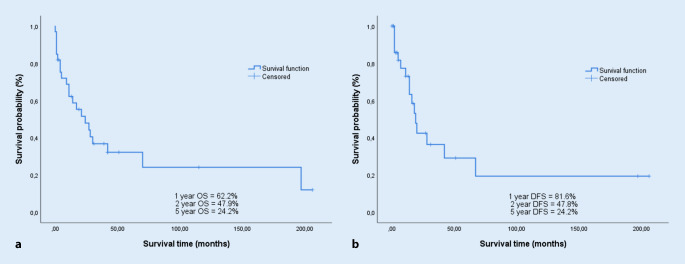
A total of 33 salvage procedures were performed. Defect reconstruction was performed by free flap surgery in 30.3% (n = 10) and regional flap surgery in 15.2% (n = 5) . One patient received regional flap surgery and free flap surgery simultaneously. Overall survival after 1, 2, and 5 years was 68.7, 47.9, and 24.2%, and disease-free survival was 81.6, 47.8, and 24.2%, respectively, with 48.5% (n = 16) postoperative tumor recurrences overall. Disease-free survival was significantly shorter for tumor extension into or onto the hypopharynx (p = 0.041). Postoperatively, 72.7% of patients developed a pharyngocutaneous fistula, of which 24.2% required surgical treatment. The hospital stay was 28.0 ± 16.1 days.
Salvage laryngectomy is associated with a high rate of treatable complications and high morbidity. Nevertheless, considering the advanced tumor stages treated, it allows for respectable oncological results.
保喉放疗或放化疗后复发和残留的喉癌预后较差。挽救性手术是这些情况下最重要的治疗选择。
本研究评估了作者所在学术癌症中心挽救性喉切除术的复发和残留肿瘤率以及生存和并发症发生率。
对 2001 年至 2019 年间因原发性放化疗后肿瘤残留或复发而行喉切除术的所有患者进行回顾性检查。
共进行了 33 例挽救性手术。游离皮瓣手术在 30.3%(n=10),区域性皮瓣手术在 15.2%(n=5)中进行缺损重建。1 例患者同时接受区域性皮瓣手术和游离皮瓣手术。1、2、5 年总生存率分别为 68.7%、47.9%和 24.2%,无病生存率分别为 81.6%、47.8%和 24.2%,总术后肿瘤复发率为 48.5%(n=16)。肿瘤侵犯或累及下咽与无病生存显著相关(p=0.041)。术后 72.7%的患者发生咽瘘,其中 24.2%需要手术治疗。住院时间为 28.0±16.1 天。
挽救性喉切除术与较高的并发症发生率和较高的发病率相关。然而,考虑到治疗的晚期肿瘤,它可以获得令人满意的肿瘤学结果。