Department of Population, Family and Reproductive Health, Johns Hopkins Bloomberg School of Public Health, Baltimore, MD, USA.
Department of Population, Family and Reproductive Health, Johns Hopkins Bloomberg School of Public Health, Baltimore, MD, USA.
Lancet Glob Health. 2021 Jun;9(6):e793-e801. doi: 10.1016/S2214-109X(21)00105-4.
Although hindrances to the sexual and reproductive health of women are expected because of COVID-19, the actual effect of the pandemic on contraceptive use and unintended pregnancy risk in women, particularly in sub-Saharan Africa, remains largely unknown. We aimed to examine population-level changes in the need for and use of contraception by women during the COVID-19 pandemic, determine if these changes differed by sociodemographic characteristics, and compare observed changes during the COVID-19 pandemic with trends in the 2 preceding years.
In this study, we used four rounds of Performance Monitoring for Action (PMA) population-based survey data collected in four geographies: two at the country level (Burkina Faso and Kenya) and two at the subnational level (Kinshasa, Democratic Republic of the Congo and Lagos, Nigeria). These geographies were selected for this study as they completed surveys immediately before the onset of COVID-19 and implemented a follow-up specific to COVID-19. The first round comprised the baseline PMA panel survey implemented between November, 2019, and February, 2020 (referred to as baseline). The second round comprised telephone-based follow-up surveys between May 28 and July 20, 2020 (referred to as COVID-19 follow-up). The third and fourth rounds comprised two previous cross-sectional survey rounds implemented in the same geographies between 2017 and 2019.
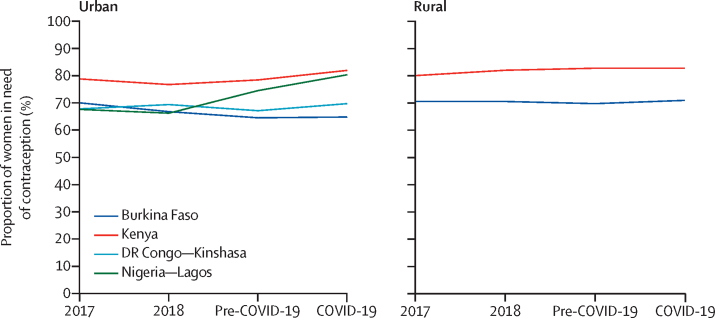
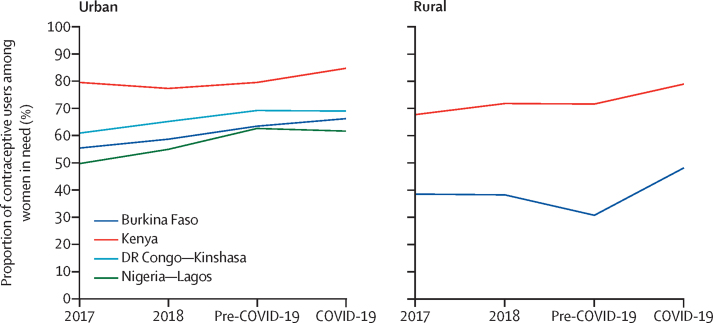
Our analyses were restricted to 7245 women in union (married or living with a partner, as if married) who were interviewed at baseline and COVID-19 follow-up. The proportion of women in need of contraception significantly increased in Lagos only, by 5·81 percentage points (from 74·5% to 80·3%). Contraceptive use among women in need increased significantly in the two rural geographies, with a 17·37 percentage point increase in rural Burkina Faso (30·7% to 48·1%) and a 7·35 percentage point increase in rural Kenya (71·6% to 78·9%). These overall trends mask several distinct patterns by sociodemographic group. Specifically, there was an increase in the need for contraception among nulliparous women across all geographies investigated.
Our findings do not support the anticipated deleterious effect of COVID-19 on access to and use of contraceptive services by women in the earliest stages of the pandemic. Although these results are largely encouraging, we warn that these trends might not be sustainable throughout prolonged economic hardship and service disruptions.
Bill & Melinda Gates Foundation.
For the French translation of the abstract see Supplementary Materials section.
尽管预计 COVID-19 会对女性的性健康和生殖健康造成阻碍,但该大流行对女性避孕措施使用和意外怀孕风险的实际影响,特别是在撒哈拉以南非洲,在很大程度上仍不清楚。我们旨在研究 COVID-19 大流行期间女性对避孕的需求和使用情况的人群水平变化,确定这些变化是否因社会人口特征而有所不同,并将观察到的 COVID-19 大流行期间的变化与前 2 年的趋势进行比较。
在这项研究中,我们使用了在四个地理区域收集的四轮 Performance Monitoring for Action(PMA)基于人群的调查数据:两个国家层面(布基纳法索和肯尼亚)和两个国家以下层面(刚果民主共和国的金沙萨和尼日利亚的拉各斯)。选择这些地理区域进行这项研究是因为它们在 COVID-19 爆发前完成了调查,并且针对 COVID-19 实施了后续调查。第一轮包括 2019 年 11 月至 2020 年 2 月之间实施的基线 PMA 面板调查(称为基线)。第二轮包括 2020 年 5 月 28 日至 7 月 20 日之间进行的基于电话的随访调查(称为 COVID-19 随访)。第三轮和第四轮包括在 2017 年至 2019 年期间在同一地理区域实施的两个先前的横断面调查轮次。
我们的分析仅限于 7245 名处于婚姻或伴侣关系(已婚或视同已婚)的女性,这些女性在基线和 COVID-19 随访时接受了采访。只有拉各斯的需要避孕的女性比例显著增加,增加了 5.81 个百分点(从 74.5%增加到 80.3%)。在两个农村地区,需要避孕的女性的避孕使用率显著增加,布基纳法索农村地区增加了 17.37 个百分点(从 30.7%增加到 48.1%),肯尼亚农村地区增加了 7.35 个百分点(从 71.6%增加到 78.9%)。这些总体趋势掩盖了按社会人口特征划分的几个明显模式。具体来说,所有调查地区的初产妇对避孕的需求都有所增加。
我们的研究结果并不支持 COVID-19 对女性在大流行早期获得和使用避孕服务的预期不利影响。尽管这些结果在很大程度上是令人鼓舞的,但我们警告说,这些趋势在经济困难和服务中断持续较长时间的情况下可能不会持续。
比尔及梅琳达·盖茨基金会。