Department of Population Family and Reproductive Health, Johns Hopkins Bloomberg School of Public Health, Baltimore, Maryland, United States of America.
Department of Health Behavior and Society, Johns Hopkins Bloomberg School of Public Health, Baltimore, Maryland, United States of America.
PLoS One. 2021 Dec 15;16(12):e0260823. doi: 10.1371/journal.pone.0260823. eCollection 2021.
While there has been considerable analysis of the health and economic effects of COVID-19 in the Global North, representative data on the distribution and depth of social and economic impacts in Africa has been more limited.
We analyze household data collected prior to the COVID-19 pandemic and during the first wave of COVID in four African countries. We evaluate the short-term changes to household economic status and assess women's access to health care during the first wave of COVID-19 in nationally representative samples of women aged 15-49 in Kenya and Burkina Faso, and in sub-nationally representative samples of women aged 15-49 in Kinshasa, Democratic Republic of Congo and Lagos, Nigeria. We examine prevalence and distribution of household income loss, food insecurity, and access to health care during the COVID-19 lockdowns across residence and pre-pandemic wealth categories. We then regress pre-pandemic individual and household sociodemographic characteristics on the three outcomes.
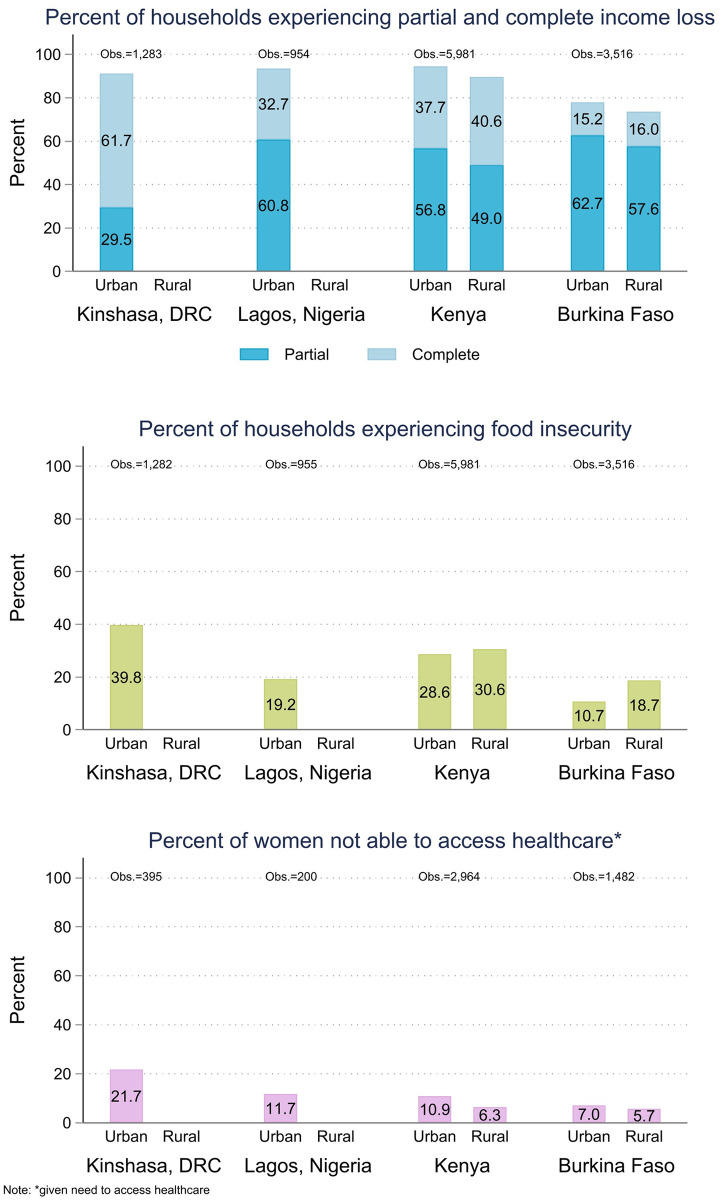
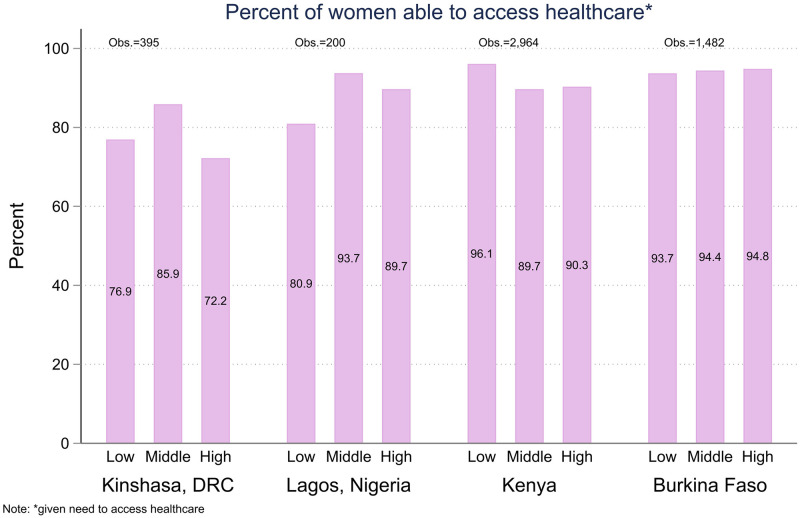
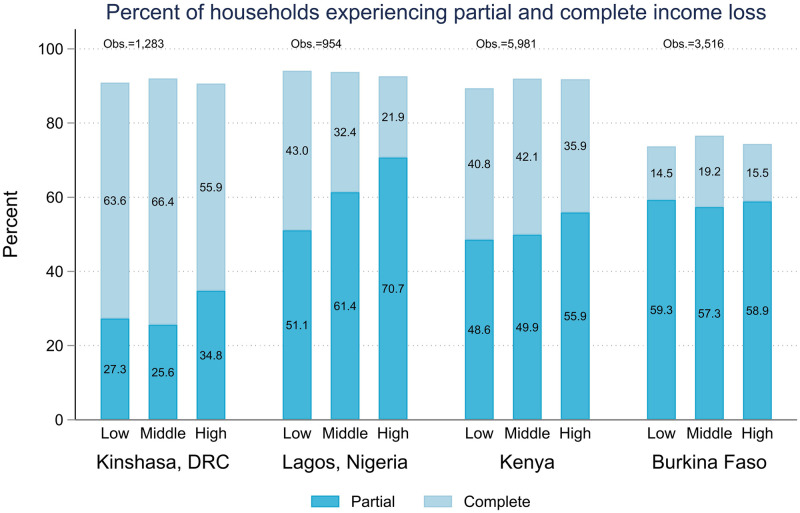
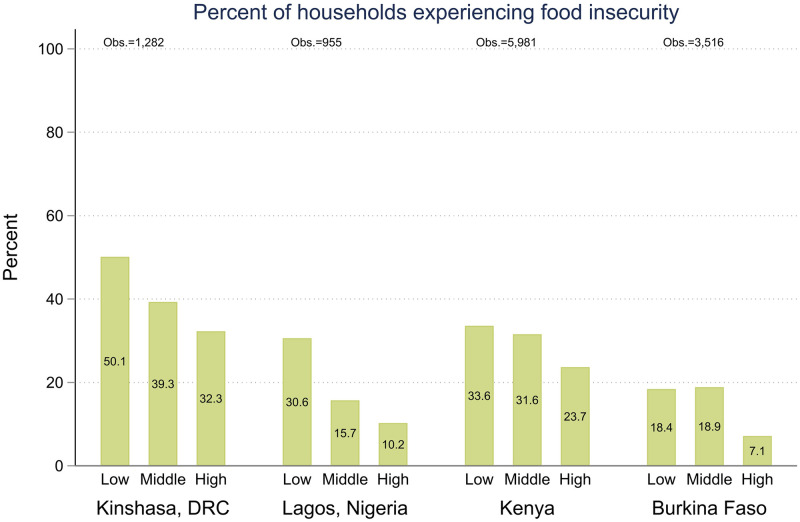
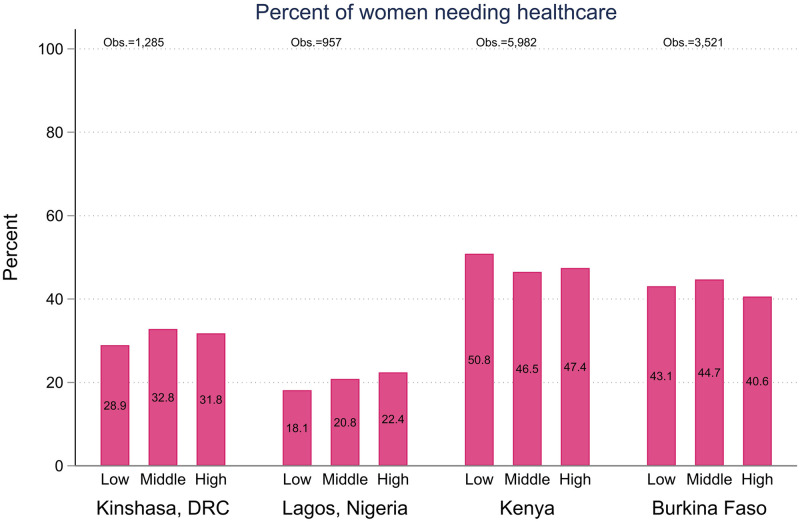
In three out of four samples, over 90% of women reported partial or complete loss of household income since the beginning of the coronavirus restrictions. Prevalence of food insecurity ranged from 17.0% (95% CI 13.6-20.9) to 39.8% (95% CI 36.0-43.7), and the majority of women in food insecure households reported increases in food insecurity during the COVID-19 restriction period. In contrast, we did not find significant barriers to accessing health care during COVID restrictions. Between 78·3% and 94·0% of women who needed health care were able successfully access it. When we examined pre-pandemic sociodemographic correlates of the outcomes, we found that the income shock of COVID-19 was substantial and distributed similarly across wealth groups, but food insecurity was concentrated among poorer households. Contrary to a-priori expectations, we find little evidence of women experiencing barriers to health care, but there is significant need for food support.
虽然已经有大量关于 COVID-19 在全球北方对健康和经济影响的分析,但在非洲,关于社会和经济影响的分布和深度的代表性数据则更为有限。
我们分析了在 COVID-19 大流行之前和在四个非洲国家的 COVID-19 第一波期间收集的家庭数据。我们评估了家庭经济状况的短期变化,并评估了在肯尼亚和布基纳法索的 15-49 岁女性的全国代表性样本中,以及在刚果民主共和国金沙萨和尼日利亚拉各斯的 15-49 岁女性的次国家代表性样本中,COVID-19 第一波期间妇女获得医疗保健的情况。我们检查了在 COVID-19 封锁期间,按居住地和大流行前财富类别划分的家庭收入损失、粮食不安全和获得医疗保健的情况的流行率和分布。然后,我们将大流行前个人和家庭社会人口统计学特征与这三个结果进行回归。
在四个样本中的三个样本中,超过 90%的女性报告自冠状病毒限制开始以来,家庭收入部分或全部损失。粮食不安全的发生率从 17.0%(95%可信区间 13.6-20.9)到 39.8%(95%可信区间 36.0-43.7)不等,大多数粮食不安全家庭的妇女报告在 COVID-19 限制期间粮食不安全程度增加。相比之下,我们没有发现 COVID 限制期间获得医疗保健的重大障碍。需要医疗保健的妇女中有 78.3%至 94.0%能够成功获得医疗保健。当我们检查这些结果的大流行前社会人口统计学相关性时,我们发现 COVID-19 的收入冲击是巨大的,并且在财富群体中分布相似,但粮食不安全主要集中在较贫穷的家庭中。与事先的预期相反,我们几乎没有发现妇女面临获得医疗保健的障碍的证据,但确实存在对粮食支持的巨大需求。