San Diego State University, University of California, San Diego Joint Doctoral Program in Clinical Psychology, 6363 Alvarado Court, Suite 103, San Diego, CA, 92120, United States.
Department of Psychology, San Diego State University, 5500 Campanile Drive, San Diego, CA, 92182, United States.
Dev Cogn Neurosci. 2021 Jun;49:100963. doi: 10.1016/j.dcn.2021.100963. Epub 2021 May 15.
Early life stress likely contributes to dysfunction in neural reward processing systems. However, studies to date have focused almost exclusively on adolescents and adults, measured early life stress retrospectively, and have often failed to control for concurrent levels of stress. The current study examined the contribution of prospectively measured cumulative life stress in preschool-age children on reward-related neural activation and connectivity in school-age children.
Children (N = 46) and caregivers reported children's exposure to early life stress between birth and preschool age (mean = 4.8 years, SD = 0.80). At follow-up (mean age = 7.52 years, SD = .78), participants performed a child-friendly monetary incentive delay task during functional magnetic resonance imaging.
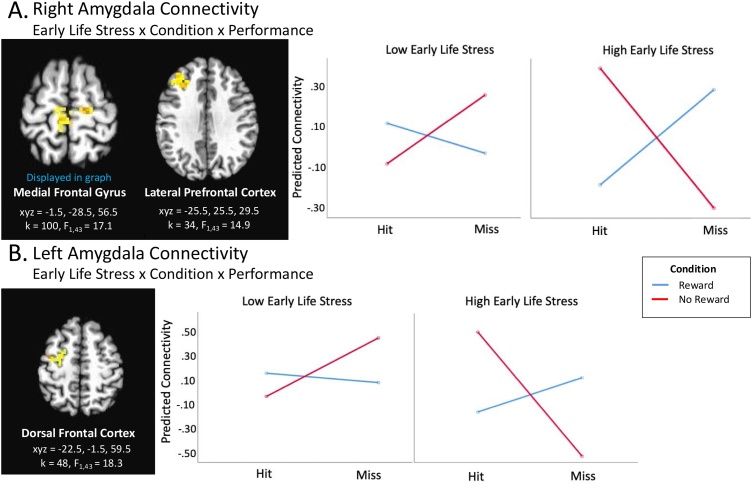
Children with higher levels of cumulative early life stress, controlling for concurrent stressful life events, exhibited aberrant patterns of neural activation and connectivity in reward- and emotion-related regions (e.g., prefrontal cortex, temporal pole, culmen), depending on the presence of a potential reward and whether or not the target was hit or missed.
Findings suggest that stress exposure during early childhood may impact neural reward processing systems earlier in development than has previously been demonstrated. Understanding how early life stress relates to alterations in reward processing could guide earlier, more mechanistic interventions.
早期生活压力可能导致神经奖励处理系统功能障碍。然而,迄今为止的研究几乎都集中在青少年和成年人身上,通过回顾性测量早期生活压力,并经常未能控制同期的压力水平。本研究探讨了在学龄前儿童中前瞻性测量的累积生活压力对学龄儿童奖励相关神经激活和连接的贡献。
儿童(N=46)及其照顾者报告了儿童在出生至学龄前期间(平均年龄为 4.8 岁,标准差为 0.80)的早期生活压力暴露情况。在随访时(平均年龄为 7.52 岁,标准差为 0.78),参与者在功能磁共振成像期间进行了儿童友好型货币奖励延迟任务。
在控制同期压力性生活事件的情况下,累积早期生活压力较高的儿童表现出奖励和情绪相关区域(例如,前额叶皮层、颞极、脑回)的神经激活和连接异常模式,具体取决于潜在奖励的存在以及目标是否击中或错过。
研究结果表明,儿童早期的压力暴露可能比以前显示的更早地影响神经奖励处理系统。了解早期生活压力如何与奖励处理的改变相关,可能有助于更早地进行更具机制性的干预。