School of Population and Public Health, Faculty of Medicine, University of British Columbia, Vancouver, Canada.
BC Children's Hospital Research Institute, Vancouver, Canada.
Clin Child Psychol Psychiatry. 2021 Oct;26(4):1035-1045. doi: 10.1177/13591045211017619. Epub 2021 May 21.
To evaluate clinical utility and feasibility of universal somatization screening in the pediatric emergency department (ED) using a standardized approach of (1) identifying potential somatizing symptoms within the ED, (2) introducing these patients and their caregivers to the concept of the 'mind-body connection', (3) corroborating the likelihood of a somatization diagnosis via brief psychiatric assessment, and (4) inviting families to a psychoeducational follow-up session.
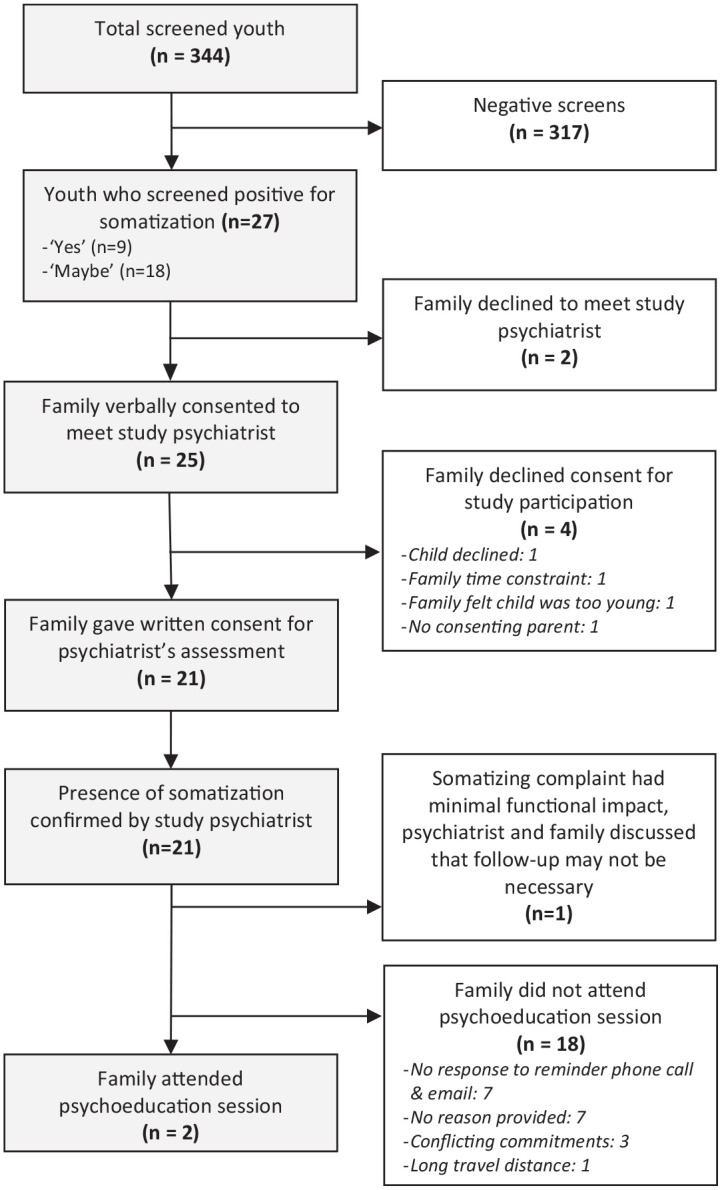
We conducted a cross-sectional study to carry out this approach with families visiting a pediatric ED. Our primary outcome of screening utility was measured as the proportion of youth who screened positive for somatization by the ED clinician. Our secondary outcome of screening feasibility was measured as the proportion of patients with positives who (1) agreed to meet with the study psychiatrist, (2) consented to an ED psychiatric assessment, (3) were assessed by the study psychiatrist as likely experiencing somatization, and (4) were invited for follow-up and attended.
Of the 344 screened patients, 27 (7.8%) screened positive for somatization. Of these, 25 (92.6%) families verbally consented to meet the study psychiatrist to learn about the mind-body connection, and 21 (77.8%) consented to further psychiatric assessment. Upon assessment, the somatization likelihood was supported for all 21 youth. Twenty families were invited to follow-up and ultimately two (10%) attended.
Somatization can be detected through ED-based universal screening. Few families attended psychoeducational follow-up. Further research is needed to determine appropriate ED-initiated pediatric somatization intervention.
通过标准化方法(1)在儿科急诊(ED)中识别潜在的躯体化症状,(2)向患者及其照顾者介绍“身心联系”的概念,(3)通过简短的精神病学评估证实躯体化诊断的可能性,(4)邀请家庭参加心理教育随访会议,评估在儿科 ED 中使用通用躯体化筛查的临床实用性和可行性。
我们进行了一项横断面研究,采用这种方法对就诊于儿科 ED 的家庭进行研究。我们将 ED 临床医生筛查出的躯体化阳性青年的比例作为筛查实用性的主要结局,将阳性患者(1)同意与研究精神科医生见面,(2)同意 ED 精神科评估,(3)经研究精神科医生评估为可能存在躯体化,(4)邀请参加随访并出席的比例作为筛查可行性的次要结局。
在 344 名筛查患者中,有 27 名(7.8%)筛查出躯体化阳性。在这些患者中,有 25 名(92.6%)家属口头同意与研究精神科医生会面以了解身心联系,有 21 名(77.8%)同意进一步进行精神病学评估。评估后,21 名青少年均被认为躯体化可能性较高。有 20 个家庭被邀请参加随访,最终有 2 个(10%)家庭出席。
可以通过 ED 进行的通用筛查来检测躯体化。很少有家庭参加心理教育随访。需要进一步研究以确定适合 ED 启动的儿科躯体化干预措施。