• 文献检索
  • 文档翻译
  • 深度研究
  • 学术资讯
  • Suppr Zotero 插件Zotero 插件
  • 邀请有礼
  • 套餐&价格
  • 历史记录
应用&插件
Suppr Zotero 插件Zotero 插件浏览器插件Mac 客户端Windows 客户端微信小程序
定价
高级版会员购买积分包购买API积分包
服务
文献检索文档翻译深度研究API 文档MCP 服务
关于我们
关于 Suppr公司介绍联系我们用户协议隐私条款
关注我们

Suppr 超能文献

核心技术专利:CN118964589B侵权必究
粤ICP备2023148730 号-1Suppr @ 2026

文献检索

告别复杂PubMed语法,用中文像聊天一样搜索,搜遍4000万医学文献。AI智能推荐,让科研检索更轻松。

立即免费搜索

文件翻译

保留排版,准确专业,支持PDF/Word/PPT等文件格式,支持 12+语言互译。

免费翻译文档

深度研究

AI帮你快速写综述,25分钟生成高质量综述,智能提取关键信息,辅助科研写作。

立即免费体验

英国儿科复发缓解型多发性硬化症中疾病修正疗法的应用。

Use of Disease-Modifying Therapies in Pediatric Relapsing-Remitting Multiple Sclerosis in the United Kingdom.

机构信息

From the Queen Square MS Centre (O.A.A., W.B., O.C., C.H., Y.H.), UCL Queen Square Institute of Neurology, Faculty of Brain Sciences, University College London; Department of Neurology (O.A.A., O.C., C.H., Y.H.), Great Ormond Street Hospital for Children, London; Children's Neurosciences (C.M.), Evelina London Children's Hospital, Guy's and St Thomas' NHS Foundation; Department of Paediatric Neurology (T.R., M.C.), Addenbrooke's Hospital, Cambridge; Department of Neurology (J.-C.S., R.K.), Alder Hey Children's NHS Foundation Trust, Liverpool, United Kingdom; Queen Square Institute of Neurology (C.T.), Faculty of Brain Sciences, University College London; Multiple Sclerosis Centre of Catalonia (Cemcat) (C.T.), Vall d'Hebron Institute of Research, Vall d'Hebron Barcelona Hospital Campus, Spain; Children's Neurosciences (S.B.), Evelina London Children's Hospital, Guy's and St Thomas' NHS Foundation Trust, King's Health Partners Academic Health Science Centre, London; Department of Clinical Neurosciences (A.C.), Addenbrooke's Hospital, Cambridge; Translational and Clinical Research Institute (R.F.), Newcastle University; Department of Neuroradiology (K.M.), Great Ormond Street Hospital for Children, London; Department of Neurology (D.R., S. West), Royal Manchester Children's Hospital, Manchester; Department of Neurology (S. Wright, E.W.), Birmingham Children's Hospital, Birmingham; Aston Neuroscience Institute (S. Wright, E.W.), College of Health and Life Sciences, Aston University, Birmingham, United Kingdom; Evelina London Children's Hospital (M.L.), Guy's and St Thomas' NHS Foundation Trust, King's Health Partners Academic Health Science Centre, London, United Kingdom; and NIHR University College London Hospitals Biomedical Research Centre (O.C.).

出版信息

Neurol Neuroimmunol Neuroinflamm. 2021 May 21;8(4). doi: 10.1212/NXI.0000000000001008. Print 2021 Jul.

DOI:10.1212/NXI.0000000000001008
PMID:34021056
原文链接:
https://pmc.ncbi.nlm.nih.gov/articles/PMC8143699/
Abstract

OBJECTIVES

To compare the real-world effectiveness of newer disease-modifying therapies (DMTs) vs injectables in children with relapsing-remitting multiple sclerosis (RRMS).

METHODS

In this retrospective, multicenter study, from the UK Childhood Inflammatory Demyelination Network, we identified children with RRMS receiving DMTs from January 2012 to December 2018. Clinical and paraclinical data were retrieved from the medical records. Annualized relapse rates (ARRs) before and on treatment, time to relapse, time to new MRI lesions, and change in Expanded Disability Status Scale (EDSS) score were calculated.

RESULTS

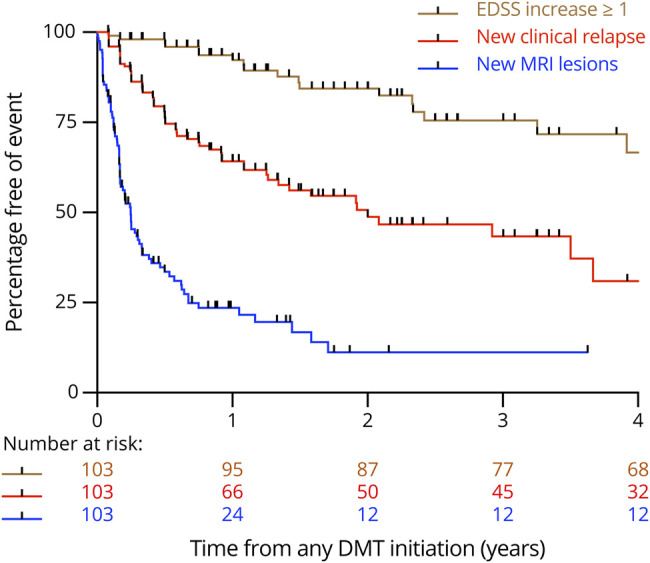
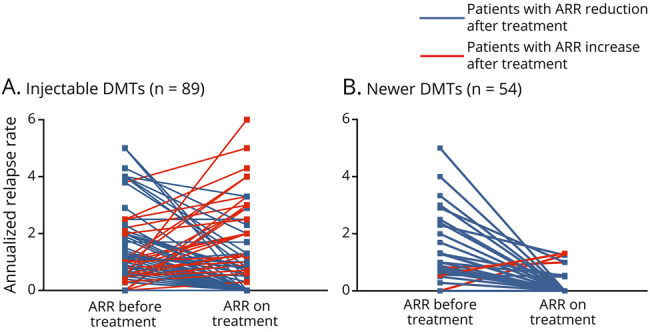
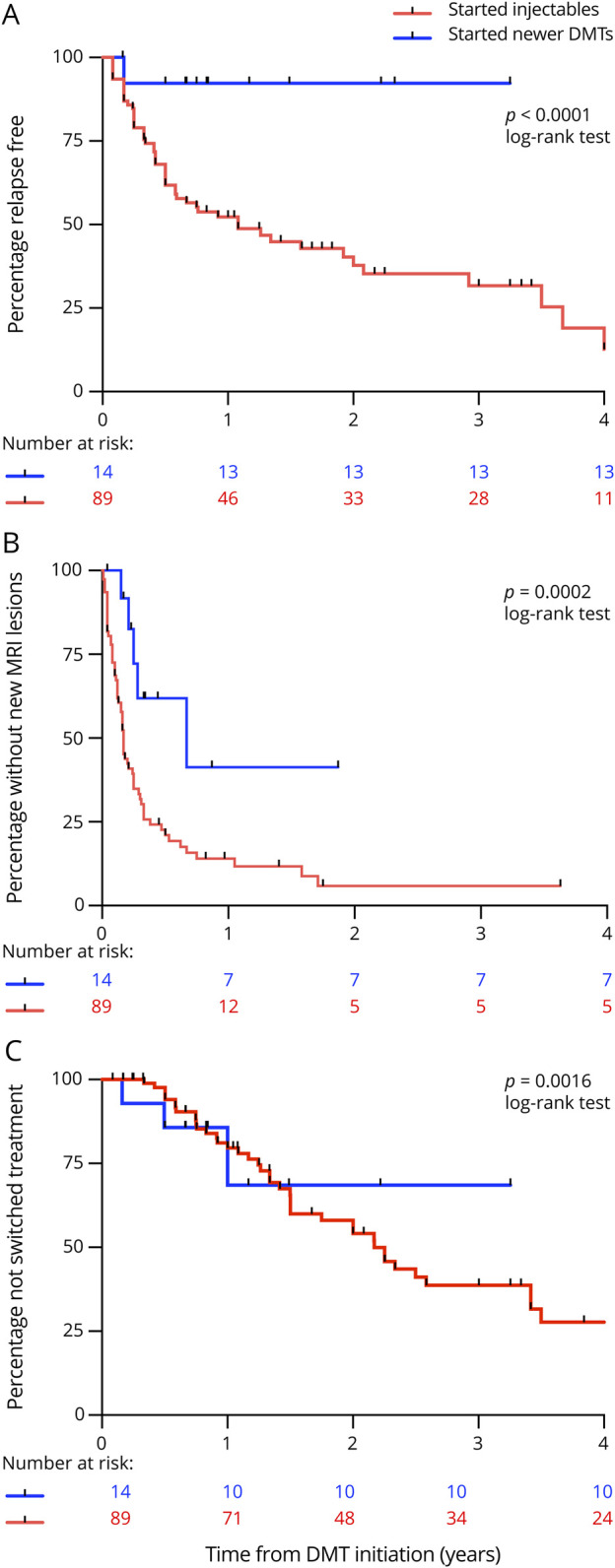
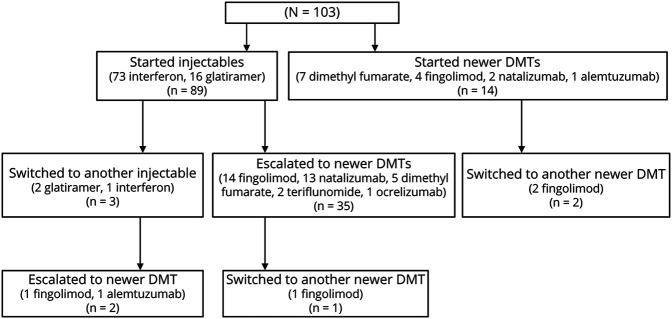
Of 103 children treated with DMTs, followed up for 3.8 years, relapses on treatment were recorded in 53/89 (59.5%) on injectables vs 8/54 (15%) on newer DMTs. The ARR was reduced from 1.9 to 1.1 on injectables ( < 0.001) vs 1.6 to 0.3 on newer DMTs ( = 0.002). New MRI lesions occurred in 77/89 (86.5%) of patients on injectables vs 26/54 (47%) on newer DMTs ( = 0.0001). Children on newer DMTs showed longer time to relapse, time to switch treatment, and time to new radiologic activity than patients on injectables (log-rank < 0.01). After adjustment for potential confounders, multivariable analysis showed that injectables were associated with 12-fold increased risk of clinical relapse (adjusted hazard ratio [HR] = 12.12, 95% CI = 1.64-89.87, = 0.015) and a 2-fold increased risk of new radiologic activity (adjusted HR = 2.78, 95% CI = 1.08-7.13, = 0.034) compared with newer DMTs. At 2 years from treatment initiation, 38/103 (37%) patients had MRI activity in the absence of clinical relapses. The EDSS score did not change during the follow-up, and only 2 patients had cognitive impairment.

CONCLUSION

Newer DMTs were associated with a lower risk of clinical and radiologic relapses in patients compared with injectables. Our study adds weight to the argument for an imminent shift in practice toward the use of newer, more efficacious DMTs in the first instance.

CLASSIFICATION OF EVIDENCE

This study provides Class IV evidence that newer DMTs (oral or infusions) are superior to injectables (interferon beta/glatiramer acetate) in reducing both clinical relapses and radiologic activity in children with RRMS.

摘要

目的

比较新型疾病修正疗法(DMT)与注射剂在复发缓解型多发性硬化症(RRMS)患儿中的真实世界疗效。

方法

在这项来自英国儿童炎症性脱髓鞘网络的回顾性多中心研究中,我们纳入了 2012 年 1 月至 2018 年 12 月期间接受 DMT 治疗的 RRMS 患儿。从病历中提取临床和辅助检查数据。计算治疗前和治疗期间的年化复发率(ARR)、复发时间、新 MRI 病变时间和扩展残疾状态量表(EDSS)评分变化。

结果

在 103 名接受 DMT 治疗的患儿中,89 名患儿(96.4%)完成了 3.8 年的随访,89 名患儿中有 53 名(59.5%)在接受注射剂治疗时有复发,54 名患儿中有 8 名(15%)在接受新型 DMT 时有复发。注射剂组的 ARR 从 1.9 降至 1.1(<0.001),新型 DMT 组从 1.6 降至 0.3(=0.002)。在 89 名接受注射剂治疗的患儿中,77 名(86.5%)有新的 MRI 病变,而在 54 名接受新型 DMT 治疗的患儿中,有 26 名(47%)有新的 MRI 病变(=0.0001)。新型 DMT 组患儿的复发时间、开始新治疗的时间和出现新影像学活动的时间均长于注射剂组(对数秩检验<0.01)。在调整了潜在混杂因素后,多变量分析显示,与新型 DMT 相比,注射剂与 12 倍的临床复发风险(校正后的危险比[HR]为 12.12,95%置信区间[CI]为 1.64-89.87,=0.015)和 2 倍的新影像学活动风险(校正后的 HR 为 2.78,95% CI 为 1.08-7.13,=0.034)相关。在治疗开始后 2 年,103 名患儿中有 38 名(37%)在无临床复发的情况下存在 MRI 活动。在随访期间 EDSS 评分没有变化,只有 2 名患儿有认知障碍。

结论

与注射剂相比,新型 DMT 可降低 RRMS 患儿的临床和影像学复发风险。我们的研究为实践中即将向新型、更有效的 DMT 转变的观点提供了更多证据。

证据分类

这项研究提供了 IV 级证据,表明新型 DMT(口服或输注)在降低 RRMS 患儿的临床和影像学复发方面优于注射剂(干扰素β/格拉替雷)。
https://cdn.ncbi.nlm.nih.gov/pmc/blobs/54c8/8143699/9f748e871e68/NEURIMMINFL2020038265f4.jpg
https://cdn.ncbi.nlm.nih.gov/pmc/blobs/54c8/8143699/9299d4369784/NEURIMMINFL2020038265f1.jpg
https://cdn.ncbi.nlm.nih.gov/pmc/blobs/54c8/8143699/e290c06164ad/NEURIMMINFL2020038265f2.jpg
https://cdn.ncbi.nlm.nih.gov/pmc/blobs/54c8/8143699/1218e7efaea0/NEURIMMINFL2020038265f3.jpg
https://cdn.ncbi.nlm.nih.gov/pmc/blobs/54c8/8143699/9f748e871e68/NEURIMMINFL2020038265f4.jpg
https://cdn.ncbi.nlm.nih.gov/pmc/blobs/54c8/8143699/9299d4369784/NEURIMMINFL2020038265f1.jpg
https://cdn.ncbi.nlm.nih.gov/pmc/blobs/54c8/8143699/e290c06164ad/NEURIMMINFL2020038265f2.jpg
https://cdn.ncbi.nlm.nih.gov/pmc/blobs/54c8/8143699/1218e7efaea0/NEURIMMINFL2020038265f3.jpg
https://cdn.ncbi.nlm.nih.gov/pmc/blobs/54c8/8143699/9f748e871e68/NEURIMMINFL2020038265f4.jpg

相似文献

1
Use of Disease-Modifying Therapies in Pediatric Relapsing-Remitting Multiple Sclerosis in the United Kingdom.英国儿科复发缓解型多发性硬化症中疾病修正疗法的应用。
Neurol Neuroimmunol Neuroinflamm. 2021 May 21;8(4). doi: 10.1212/NXI.0000000000001008. Print 2021 Jul.
2
Comparative Efficacy of Relapsing Multiple Sclerosis Therapies: Model-Based Meta-Analyses for Confirmed Disability Accumulation and Annualized Relapse Rate.复发型多发性硬化症治疗方案的疗效比较:基于模型的荟萃分析评估确认残疾进展和年化复发率。
Mult Scler Relat Disord. 2022 Aug;64:103908. doi: 10.1016/j.msard.2022.103908. Epub 2022 May 23.
3
Real-World Effectiveness of Initial Disease-Modifying Therapies in Pediatric Multiple Sclerosis.真实世界中初始疾病修正疗法在儿科多发性硬化症中的疗效。
Ann Neurol. 2020 Jul;88(1):42-55. doi: 10.1002/ana.25737. Epub 2020 May 14.
4
Real-world propensity score comparison of treatment effectiveness of peginterferon beta-1a vs. subcutaneous interferon beta-1a, glatiramer acetate, and teriflunomide in patients with relapsing-remitting multiple sclerosis.真实世界中聚乙二醇干扰素 β-1a 与皮下干扰素 β-1a、那他珠单抗和特立氟胺治疗复发缓解型多发性硬化症患者的疗效的倾向评分比较。
Mult Scler Relat Disord. 2021 Jun;51:102935. doi: 10.1016/j.msard.2021.102935. Epub 2021 Apr 8.
5
Comparative effectiveness and safety of ozanimod other oral DMTs in relapsing-remitting multiple sclerosis: a synthesis of matching-adjusted indirect comparisons.奥扎莫德与其他口服疾病修正治疗药物在复发缓解型多发性硬化症中的疗效和安全性比较:匹配调整间接比较的综合分析
Ther Adv Neurol Disord. 2024 Jun 7;17:17562864241237856. doi: 10.1177/17562864241237856. eCollection 2024.
6
Immunomodulators and immunosuppressants for relapsing-remitting multiple sclerosis: a network meta-analysis.免疫调节剂和免疫抑制剂治疗复发缓解型多发性硬化症的网状 Meta 分析。
Cochrane Database Syst Rev. 2024 Jan 4;1(1):CD011381. doi: 10.1002/14651858.CD011381.pub3.
7
Discontinuation of disease-modifying therapy for patients with relapsing-remitting multiple sclerosis: Effect on clinical and MRI outcomes.复发缓解型多发性硬化症患者停止疾病修正治疗:对临床和 MRI 结果的影响。
Mult Scler Relat Disord. 2019 Oct;35:119-127. doi: 10.1016/j.msard.2019.07.021. Epub 2019 Jul 25.
8
Interferons-beta versus glatiramer acetate for relapsing-remitting multiple sclerosis.干扰素β与醋酸格拉替雷治疗复发缓解型多发性硬化症的对比
Cochrane Database Syst Rev. 2016 Nov 24;11(11):CD009333. doi: 10.1002/14651858.CD009333.pub3.
9
Effectiveness and safety of switching to teriflunomide in older patients with relapsing multiple sclerosis: A real-world retrospective multicenter analysis.老年复发型多发性硬化症患者换用特立氟胺的有效性和安全性:一项真实世界回顾性多中心分析。
Mult Scler Relat Disord. 2023 Feb;70:104472. doi: 10.1016/j.msard.2022.104472. Epub 2022 Dec 18.
10
Effectiveness and cost-effectiveness of interferon beta and glatiramer acetate in the UK Multiple Sclerosis Risk Sharing Scheme at 6 years: a clinical cohort study with natural history comparator.英国多发性硬化症风险分担计划中干扰素β和格拉替雷醋酸 6 年的疗效和成本效益:具有自然史对照的临床队列研究。
Lancet Neurol. 2015 May;14(5):497-505. doi: 10.1016/S1474-4422(15)00018-6. Epub 2015 Apr 1.

引用本文的文献

1
Pediatric-Onset Multiple Sclerosis (POMS) and Epilepsy: Exploring Etiological Complexity-Outcomes from a Single-Center Experience.儿童期起病的多发性硬化症(POMS)与癫痫:探索病因复杂性——来自单中心经验的结果
Children (Basel). 2025 May 14;12(5):631. doi: 10.3390/children12050631.
2
Therapeutic Advances in Pediatric Multiple Sclerosis.小儿多发性硬化症的治疗进展
Children (Basel). 2025 Feb 20;12(3):259. doi: 10.3390/children12030259.
3
Pediatric-onset Multiple Sclerosis treatment: a multicentre observational study comparing natalizumab with fingolimod.

本文引用的文献

1
Improved relapse recovery in paediatric compared to adult multiple sclerosis.与成人多发性硬化症相比,儿科患者的疾病复发恢复情况更好。
Brain. 2020 Sep 1;143(9):2733-2741. doi: 10.1093/brain/awaa199.
2
What does first-line therapy mean for paediatric multiple sclerosis in the current era?当前时代,儿科多发性硬化症的一线治疗方法是什么?
Mult Scler. 2021 Nov;27(13):1970-1976. doi: 10.1177/1352458520937644. Epub 2020 Jul 7.
3
Real-World Effectiveness of Initial Disease-Modifying Therapies in Pediatric Multiple Sclerosis.真实世界中初始疾病修正疗法在儿科多发性硬化症中的疗效。
儿童多发性硬化症的治疗:一项比较那他珠单抗与芬戈莫德的多中心观察性研究。
J Neurol. 2024 Oct;271(10):6773-6781. doi: 10.1007/s00415-024-12610-y. Epub 2024 Aug 23.
4
Old and New Strategies in the Treatment of Pediatric Multiple Sclerosis: A Personal View for a New Treatment Approach.小儿多发性硬化症治疗的新旧策略:一种新治疗方法的个人观点
Neurol Ther. 2024 Aug;13(4):949-963. doi: 10.1007/s40120-024-00633-6. Epub 2024 Jun 1.
5
The neuropathobiology of multiple sclerosis.多发性硬化的神经病理学。
Nat Rev Neurosci. 2024 Jul;25(7):493-513. doi: 10.1038/s41583-024-00823-z. Epub 2024 May 24.
6
Comparison of Pharmacological Therapies in Relapse Rates in Patients With Relapsing-Remitting Multiple Sclerosis.复发缓解型多发性硬化症患者药物治疗复发率的比较
Cureus. 2023 Sep 18;15(9):e45454. doi: 10.7759/cureus.45454. eCollection 2023 Sep.
7
Pretreatment Neurofilament Light Chain Serum Levels, Early Disease Severity, and Treatment Response in Pediatric Multiple Sclerosis.治疗前神经丝轻链血清水平、早期疾病严重程度与儿童多发性硬化症的治疗反应。
Neurology. 2023 Nov 7;101(19):e1873-e1883. doi: 10.1212/WNL.0000000000207791. Epub 2023 Sep 25.
8
Trends in the Epidemiology and Treatment of Pediatric-Onset Multiple Sclerosis in Alberta, Canada.加拿大阿尔伯塔省儿科发病多发性硬化症的流行病学和治疗趋势。
J Child Neurol. 2023 Apr;38(5):321-328. doi: 10.1177/08830738231176588. Epub 2023 May 18.
9
Narrative review based on fingolimod therapy in pediatric MS.基于芬戈莫德治疗儿童多发性硬化症的叙述性综述。
SAGE Open Med. 2023 May 8;11:20503121231171996. doi: 10.1177/20503121231171996. eCollection 2023.
10
Effect of Dimethyl Fumarate vs Interferon β-1a in Patients With Pediatric-Onset Multiple Sclerosis: The CONNECT Randomized Clinical Trial.富马酸二甲酯与干扰素β-1a 治疗儿童发病多发性硬化症的效果比较:CONNECT 随机临床试验。
JAMA Netw Open. 2022 Sep 1;5(9):e2230439. doi: 10.1001/jamanetworkopen.2022.30439.
Ann Neurol. 2020 Jul;88(1):42-55. doi: 10.1002/ana.25737. Epub 2020 May 14.
4
Effect of fingolimod on MRI outcomes in patients with paediatric-onset multiple sclerosis: results from the phase 3 PARADIG study.芬戈莫德对儿童发病多发性硬化症患者 MRI 结局的影响:来自 3 期 PARADIG 研究的结果。
J Neurol Neurosurg Psychiatry. 2020 May;91(5):483-492. doi: 10.1136/jnnp-2019-322138. Epub 2020 Mar 4.
5
Consistent control of disease activity with fingolimod versus IFN β-1a in paediatric-onset multiple sclerosis: further insights from PARADIG.在儿科发病多发性硬化症中,与 IFNβ-1a 相比, fingolimod 能更持续地控制疾病活动:来自 PARADIG 的进一步见解。
J Neurol Neurosurg Psychiatry. 2020 Jan;91(1):58-66. doi: 10.1136/jnnp-2019-321124. Epub 2019 Aug 29.
6
Long-term Cognitive Outcomes in Patients With Pediatric-Onset vs Adult-Onset Multiple Sclerosis.儿童期发病与成年期发病的多发性硬化症患者的长期认知结局
JAMA Neurol. 2019 Sep 1;76(9):1028-1034. doi: 10.1001/jamaneurol.2019.1546.
7
Childhood multiple sclerosis is associated with reduced brain volumes at first clinical presentation and brain growth failure.儿童多发性硬化症与首次临床发作时的脑容量减少和脑生长失败有关。
Mult Scler. 2019 Jun;25(7):927-936. doi: 10.1177/1352458519829698. Epub 2019 Apr 4.
8
Paediatric multiple sclerosis: a new era in diagnosis and treatment.儿科多发性硬化症:诊断和治疗的新时代。
Dev Med Child Neurol. 2019 Sep;61(9):1039-1049. doi: 10.1111/dmcn.14212. Epub 2019 Apr 1.
9
Dynamic gray matter volume changes in pediatric multiple sclerosis: A 3.5 year MRI study.儿童多发性硬化症的动态灰质体积变化:一项为期 3.5 年的 MRI 研究。
Neurology. 2019 Apr 9;92(15):e1709-e1723. doi: 10.1212/WNL.0000000000007267. Epub 2019 Mar 13.
10
Association of Initial Disease-Modifying Therapy With Later Conversion to Secondary Progressive Multiple Sclerosis.初始疾病修饰治疗与随后继发进展性多发性硬化转化的相关性。
JAMA. 2019 Jan 15;321(2):175-187. doi: 10.1001/jama.2018.20588.