Kang Liujiang, Xiao Yue, Sun Huijun, Wu Jianjun, Luo Sida, Buhigiro Nsabimana
Key Laboratory of Transport Industry of Big Data Application Technologies for Comprehensive Transport, Ministry of Transport, Beijing Jiaotong University, 100044, China.
State Key Laboratory of Rail Traffic Control and Safety, Beijing Jiaotong University, 100044, China.
Decis Support Syst. 2022 Oct;161:113600. doi: 10.1016/j.dss.2021.113600. Epub 2021 May 15.
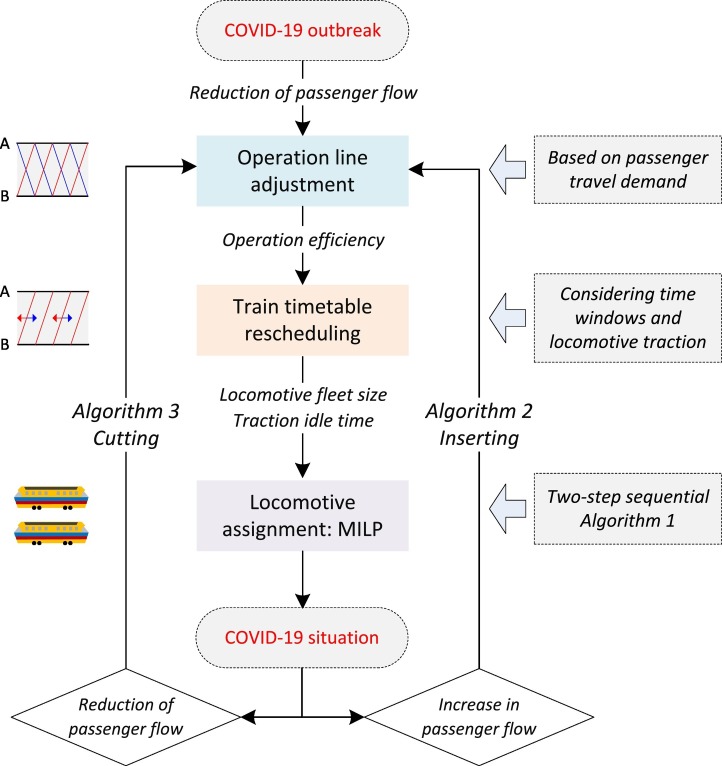
Travel restriction measures have been widely implemented to curb the continued spread of COVID-19 during the Chinese Lunar New Year celebrations. Many operation lines and train schedules of China's railway were either heavily adjusted or canceled. In this study, a mixed-integer linear programming model and a two-step solution algorithm were developed to handle such large-scale adjustments. The formulation considers a flexible time window for each operation line and locomotive traction operations, and minimizes the number of locomotives utilized with their total idle time for train rescheduling and locomotive assignment, respectively. The solution algorithm determines the minimum locomotive fleet size based on the optimal train rescheduling results; it then reduces the traction idle time of locomotives. In response to the uncertainty of COVID-19, two tailored approaches were also designed to recover and remove operation lines, which can insert and cut operation lines based on the results of locomotive assignment. Finally, we conducted a case study of the Beijing-Tianjin intercity railway from the start of the COVID-19 outbreak to the recovery of operations.
在中国农历新年庆祝活动期间,为遏制新冠病毒肺炎(COVID-19)的持续传播,旅行限制措施已广泛实施。中国铁路的许多运营线路和列车时刻表都进行了大幅调整或取消。在本研究中,开发了一个混合整数线性规划模型和一种两步求解算法来处理此类大规模调整。该模型为每条运营线路和机车牵引作业考虑了一个灵活的时间窗口,并分别在列车重新调度和机车分配中,以机车总闲置时间最小化的方式,使所使用的机车数量最少。该求解算法基于最优列车重新调度结果确定最小机车队规模;然后减少机车的牵引闲置时间。针对COVID-19的不确定性,还设计了两种定制方法来恢复和去除运营线路,这可以根据机车分配结果插入和切断运营线路。最后,我们对从COVID-19疫情爆发开始到运营恢复的京津城际铁路进行了案例研究。