Willem-Alexander Children's Hospital, Department of Pediatrics and Laboratory for Pediatric Immunology, Leiden University Medical Center, Leiden, Netherlands.
Leiden University Medical Center, Department of Medical Statistics and Bioinformatics, Leiden, Netherlands.
Front Immunol. 2021 May 7;12:684147. doi: 10.3389/fimmu.2021.684147. eCollection 2021.
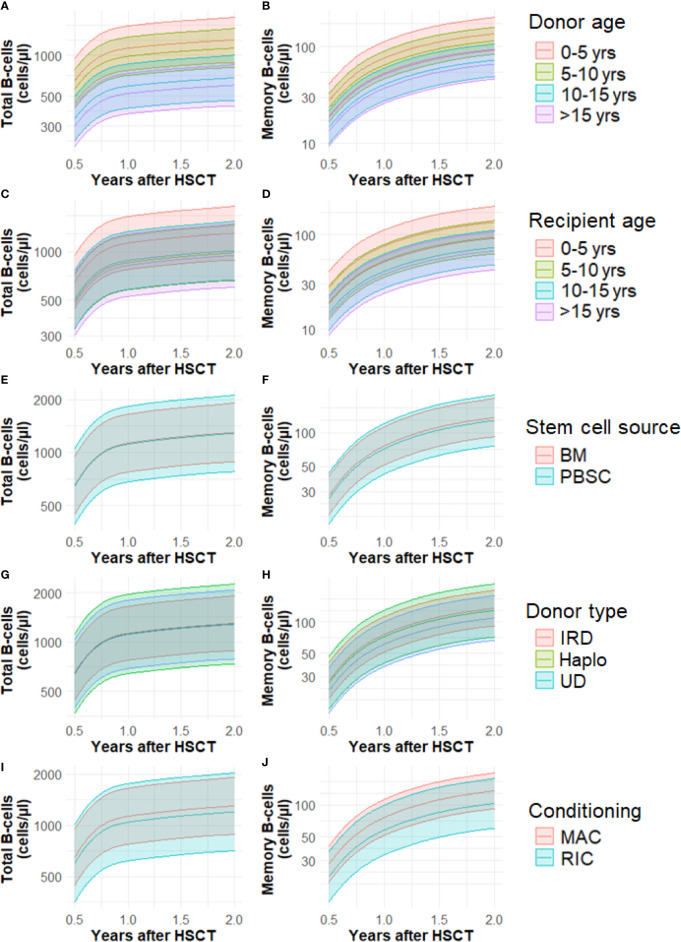
Reduced total and memory B-cell numbers in peripheral blood long term after hematopoietic stem cell transplantation (HSCT) are associated with an increased incidence of infections and immune complications. Using novel modelling strategies, baseline factors influencing B-cell reconstitution can be comprehensively studied. This study aims to investigate the numerical total and memory B-cell reconstitution in children and the association with baseline determinants 0.5-2 years after allogeneic HSCT. Eligible for inclusion were children transplanted in our center between 2004-2017 who received a first HSCT for malignant or non-malignant disorders. The continuous absolute counts of total and memory B-cells were evaluated as outcome measure. Exploratory analysis at one year was done to identify possible determinants. Linear mixed effect modelling was used to analyze the association of these determinants with total and memory B-cell reconstitution 0.5-2 years after HSCT. In a cohort of 223 evaluable patients analyzed at 1-year after HSCT donor age, stem cell source, donor type, recipient age and conditioning were identified as significant determinants for total and memory B-cell numbers. Multivariable analysis revealed that both donor and recipient age were inversely correlated with the size of total and memory B-cell reconstitution. In contrast, no correlation was found with stem cell source, donor type and conditioning. Making use of linear mixed modelling both stem cell donor and recipient age were identified as independent determinants of total and memory B-cell reconstitution 0.5-2 years after HSCT.
造血干细胞移植(HSCT)后长期外周血总 B 细胞和记忆 B 细胞数量减少与感染和免疫并发症的发生率增加有关。使用新的建模策略,可以全面研究影响 B 细胞重建的基线因素。本研究旨在调查异基因 HSCT 后 0.5-2 年内儿童的总 B 细胞和记忆 B 细胞重建的数量,并与基线决定因素相关联。符合纳入标准的是 2004-2017 年在本中心接受首次 HSCT 治疗恶性或非恶性疾病的儿童。将总 B 细胞和记忆 B 细胞的连续绝对计数作为观察指标。在 1 年时进行探索性分析以确定可能的决定因素。使用线性混合效应模型分析这些决定因素与 HSCT 后 0.5-2 年总 B 细胞和记忆 B 细胞重建的相关性。在分析了 223 例可评估患者在 HSCT 后 1 年的队列中,供者年龄、干细胞来源、供者类型、受者年龄和预处理方案被确定为总 B 细胞和记忆 B 细胞数量的显著决定因素。多变量分析显示,供者和受者年龄均与总 B 细胞和记忆 B 细胞重建的大小呈负相关。相比之下,与干细胞来源、供者类型和预处理方案无关。利用线性混合模型,供者和受者年龄均被确定为 HSCT 后 0.5-2 年总 B 细胞和记忆 B 细胞重建的独立决定因素。