Fa Jing
Department of Obstetrics and Gynecology, Linyi Cancer Hospital, Linyi, Shandong 276000, P.R. China.
Oncol Lett. 2021 Jul;22(1):524. doi: 10.3892/ol.2021.12785. Epub 2021 May 12.
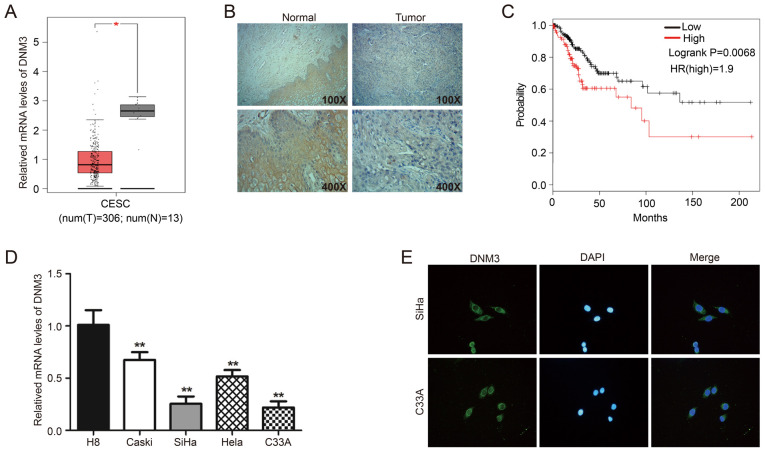
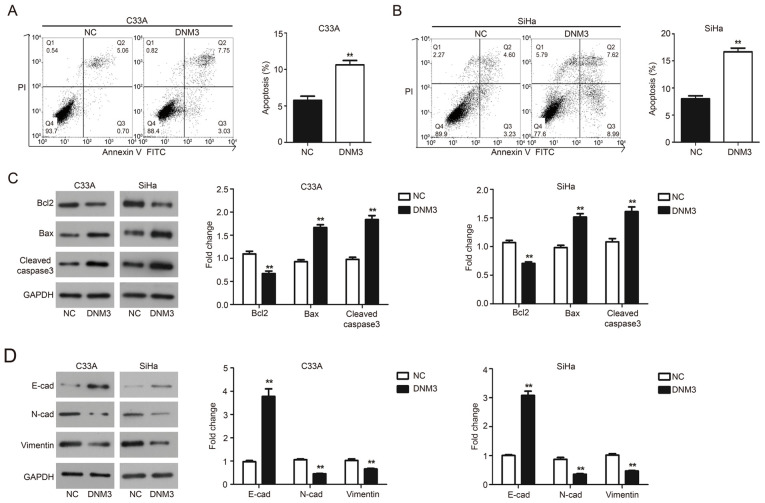
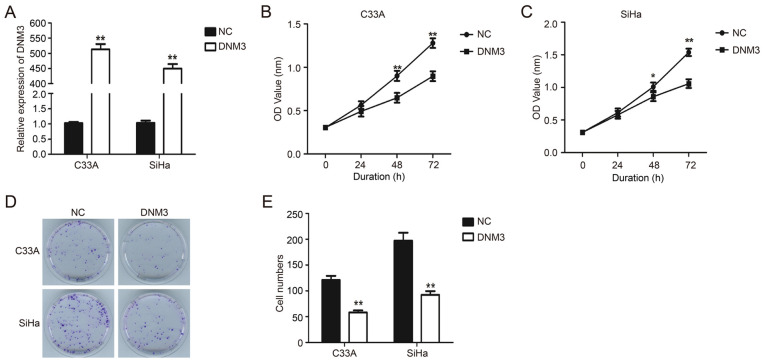
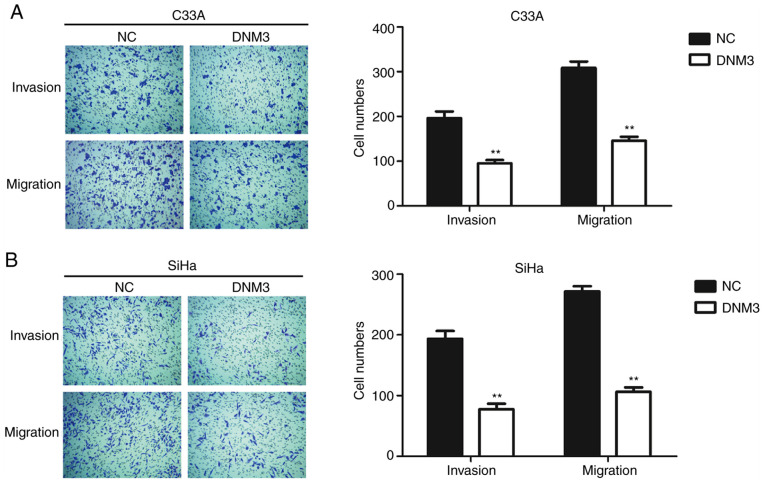
Dynamin 3 (DNM3) functions as a tumor suppressor in various malignancies. However, the underlying mechanism of DNM3 in cervical cancer remains to be elucidated. The present study aimed to indicate the function of DNM3 in cervical cancer. The expression of DNM3 in cervical tissues and cells was measured using bioinformatics analysis, immunohistochemistry and reverse transcription-quantitative PCR. The pcDNA3.1 plasmid was used to overexpress DNM3 in SiHa and C33A cells. The effects of DNM3 overexpression on cell proliferation, migration, invasion and apoptosis was detected by the CCK-8, clone formation, Transwell, flow cytometry and western blotting assays. In the present study, it was revealed that DNM3 was expressed at significantly low levels in cervical cancer tissues and cell lines compared with normal cervical tissues and cell lines. In addition, the low expression of DNM3 was significantly associated with high pathological grading of cervical cancer. The overall survival rate of patients with low DNM3 expression was significantly improved compared with patients with high DNM3 expression. In addition, the overexpression of DNM3 significantly inhibited the proliferation, migration and invasion of cervical carcinoma cells and induced cell apoptosis. The findings of the present study further revealed that the overexpression of DNM3 may inhibit cell migration and invasion by inactivating the epithelial mesenchymal transition process. In summary, the present study demonstrated that DNM3 was a tumor suppressor in cervical cancer progression and that it may serve as a potential prognostic biomarker for patients with cervical carcinoma.
发动蛋白3(DNM3)在多种恶性肿瘤中发挥肿瘤抑制作用。然而,DNM3在宫颈癌中的潜在机制仍有待阐明。本研究旨在明确DNM3在宫颈癌中的作用。通过生物信息学分析、免疫组织化学和逆转录-定量PCR检测DNM3在宫颈组织和细胞中的表达。使用pcDNA3.1质粒在SiHa和C33A细胞中过表达DNM3。通过CCK-8、克隆形成、Transwell、流式细胞术和蛋白质印迹分析检测DNM3过表达对细胞增殖、迁移、侵袭和凋亡的影响。在本研究中,发现与正常宫颈组织和细胞系相比,DNM3在宫颈癌组织和细胞系中的表达显著降低。此外,DNM3的低表达与宫颈癌的高病理分级显著相关。与DNM3高表达的患者相比,DNM3低表达患者的总生存率显著提高。此外,DNM3的过表达显著抑制宫颈癌细胞的增殖、迁移和侵袭并诱导细胞凋亡。本研究结果进一步表明,DNM3的过表达可能通过使上皮-间质转化过程失活来抑制细胞迁移和侵袭。总之,本研究表明DNM3是宫颈癌进展中的肿瘤抑制因子,并且它可能作为宫颈癌患者潜在的预后生物标志物。