Meng Jianghui
Charles Institute of Dermatology, School of Medicine and Medical Sciences, University College Dublin, Belfield, Dublin, Ireland.
International Centre for Neurotherapeutics, Dublin City University, Glasnevin, Dublin, Ireland.
Oncotarget. 2017 Jun 20;8(25):41701-41716. doi: 10.18632/oncotarget.16678.
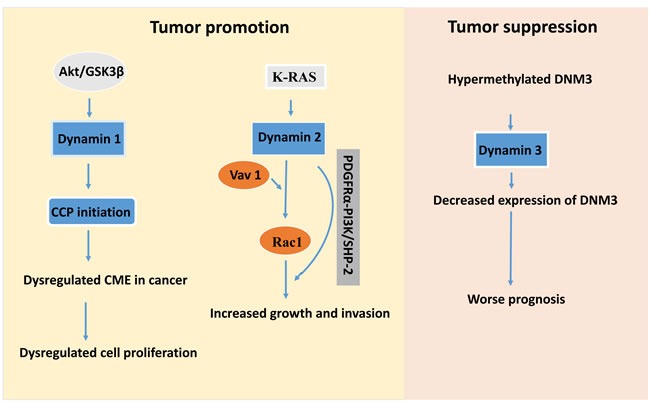
Dynamins and their related proteins participate in the regulation of neurotransmission, antigen presentation, receptor internalization, growth factor signalling, nutrient uptake, and pathogen infection. Recently, emerging findings have shown dynamin proteins can also contribute to the genesis of cancer. This up-to-date review herein focuses on the functionality of dynamin in cancer development. Dynamin 1 and 2 both enhance cancer cell proliferation, tumor invasion and metastasis, whereas dynamin 3 has tumor suppression role. Antisense RNAs encoded on the DNA strand opposite a dynamin gene regulate the function of dynamin, and manipulate oncogenes and tumor suppressor genes. Certain dynamin-related proteins are also upregulated in distinct cancer conditions, resulting in apoptotic resistance, cell migration and poor prognosis. Altogether, dynamins are potential biomarkers as well as representing promising novel therapeutic targets for cancer treatment. This study also summarizes the current available dynamin-targeted therapeutics and suggests the potential strategy based on signalling pathways involved, providing important information to aid the future development of novel cancer therapeutics by targeting these dynamin family members.
发动蛋白及其相关蛋白参与神经传递、抗原呈递、受体内化、生长因子信号传导、营养摄取和病原体感染的调节。最近,新出现的研究结果表明,发动蛋白也与癌症的发生有关。本文的最新综述重点关注发动蛋白在癌症发展中的功能。发动蛋白1和2均能增强癌细胞增殖、肿瘤侵袭和转移,而发动蛋白3具有肿瘤抑制作用。与发动蛋白基因位于DNA链相反位置编码的反义RNA调节发动蛋白的功能,并操控癌基因和肿瘤抑制基因。某些发动蛋白相关蛋白在不同的癌症条件下也会上调,导致凋亡抗性、细胞迁移和预后不良。总之,发动蛋白是潜在的生物标志物,也是癌症治疗有前景的新型治疗靶点。本研究还总结了目前可用的针对发动蛋白的疗法,并基于相关信号通路提出了潜在策略,为通过靶向这些发动蛋白家族成员辅助新型癌症疗法的未来发展提供重要信息。