Deng Qiaomu, Li Min, He Chengwei, Lu Qiaoe, Gao Yanli, Li Qiuhong, Shi Mengya, Wang Peikun, Wei Ping
Institute for Poultry Science and Health, Guangxi University, Nanning, Guangxi 530004, China.
Pingxiang Customs P. R. China, 341 Nanda Road, Pingxiang, Guangxi 532600, China.
Virus Evol. 2021 Apr 15;7(1):veab037. doi: 10.1093/ve/veab037. eCollection 2021 Jan.
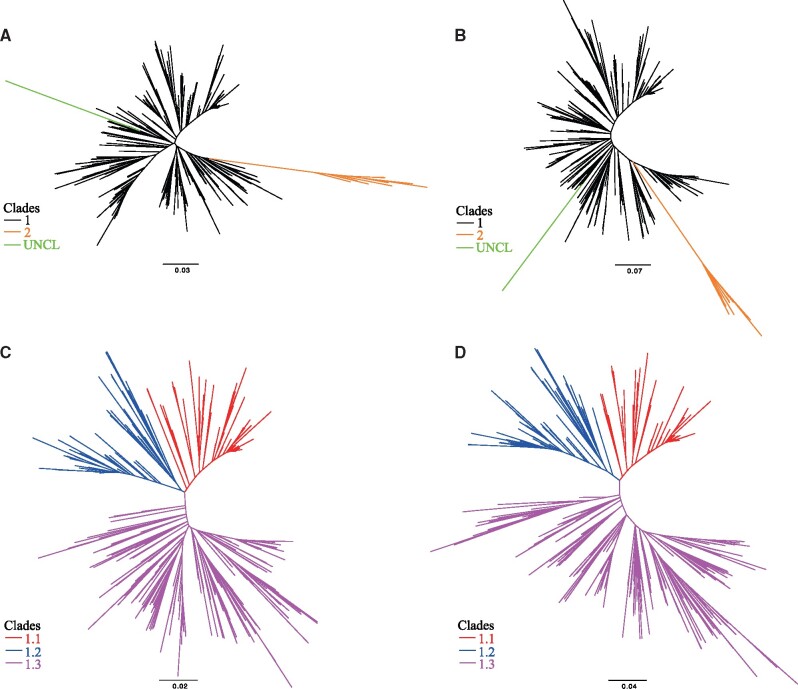
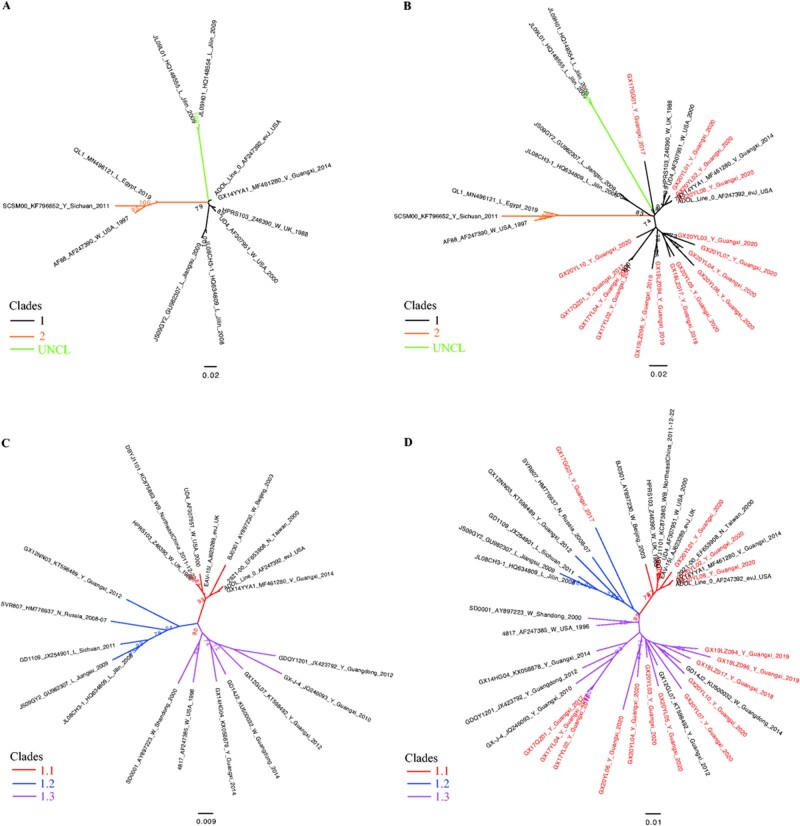
Avian leukosis virus subgroup J (ALV-J) has infected a variety of birds, causing major economic losses in China. Understanding the comprehensive criteria of classification and nomenclature of ALV-J would be useful for the investigation of the viral evolution and also for the prevention and control of this infection. An in-depth analysis of the genetic diversity of ALV-J was performed in the present study. Four hundred and seventy-five sequences of the gp85 gene, including thirteen of avian endogenous retrovirus designated ev/J and 462 of ALV-J, were used in the phylogenetic and the evolutionary distance analysis for this classification. The study identified that the current ALV-J strains were divided into two first-order clades (Clades 1 and 2) and three second-order clades (Clades 1.1, 1.2 and 1.3). The current Chinese ALV-J strains are predominantly in Clade 1.3, and the Chinese and Egyptian chicken flocks have been facing the emerging Clade 2 viruses. This system pioneers the classification efforts for ALV-J, which uses Pilot tree for rapid classification of the new isolates and also the addition of possible new clades. The proposed unified classification system will facilitate future studies of ALV-J epidemiology and genetic evolution and of the comparison of sequences obtained across the world.
禽白血病病毒J亚群(ALV-J)已感染多种禽类,给中国造成了重大经济损失。了解ALV-J的分类和命名综合标准,将有助于病毒进化研究以及该感染的预防和控制。本研究对ALV-J的遗传多样性进行了深入分析。gp85基因的475个序列,包括13个禽内源性逆转录病毒ev/J和462个ALV-J序列,用于此次分类的系统发育和进化距离分析。研究确定,当前的ALV-J毒株分为两个一级分支(分支1和分支2)和三个二级分支(分支1.1、1.2和1.3)。当前中国的ALV-J毒株主要分布在分支1.3中,中国和埃及的鸡群一直面临着新兴的分支2病毒。该系统开创了ALV-J分类工作的先河,它使用引导树对新分离株进行快速分类,并增加了可能的新分支。所提出的统一分类系统将有助于未来对ALV-J流行病学、遗传进化以及世界各地获得的序列比较的研究。