D'Oronzo Stella, Gregory Walter, Nicholson Simon, Chong Yuen Khong, Brown Janet, Coleman Robert
Department of Oncology and Metabolism, University of Sheffield Medical School, Sheffield, United Kingdom.
Department of Biomedical Sciences and Human Oncology, University of Bari Aldo Moro, Bari, Italy.
J Bone Oncol. 2021 May 4;28:100367. doi: 10.1016/j.jbo.2021.100367. eCollection 2021 Jun.
The prognosis for women with breast cancer has improved markedly over recent decades. However, mortality from breast cancer remains high and, for those developing metastatic disease, curative therapy is not possible. Here, we report the frequency and distribution of disease recurrence(s) in a large population of women with AJCC stage II/III breast cancer and evaluate the impact of adjuvant treatment with the bisphosphonate zoledronate on clinical outcomes.
In the context of the AZURE study (ISRCTN7981382), 3359 patients with histologically confirmed stage II/III breast cancer were randomised to receive standard adjuvant treatment ± zoledronate for five years. Patients were followed up for 10 years and all patients with recurrent disease in that time identified. The site of first recurrence, the first distant recurrence site(s) and bone metastasis at any time were recorded and outcomes in the control and zoledronate treatment groups compared. Survival after recurrence was also evaluated.
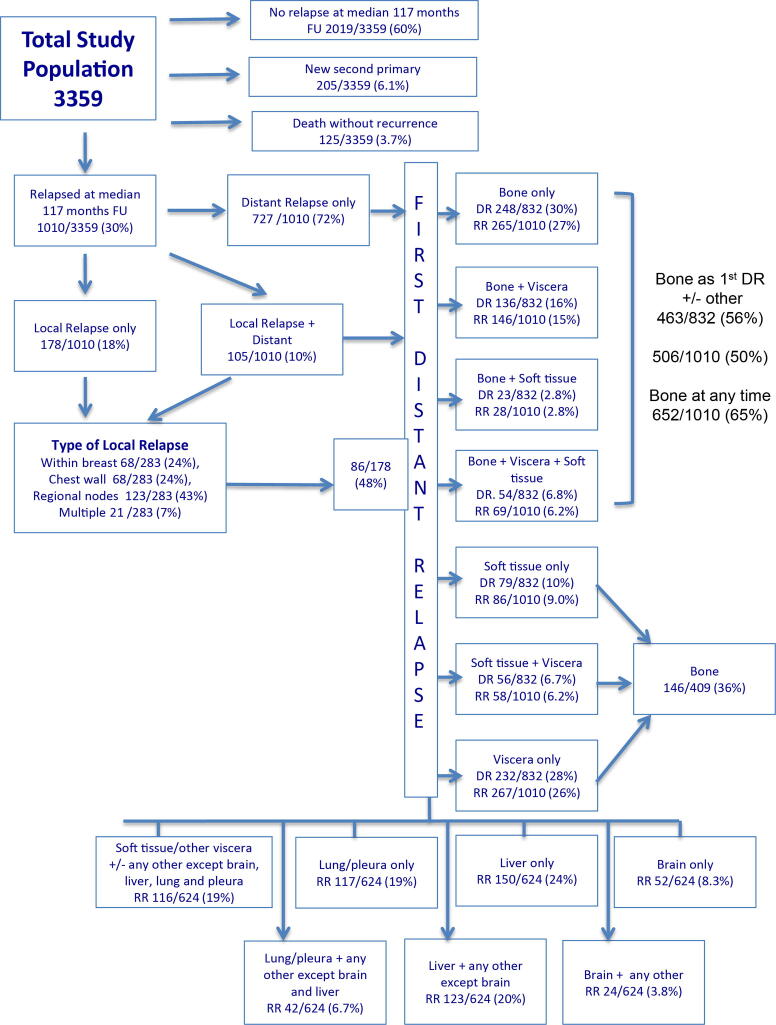
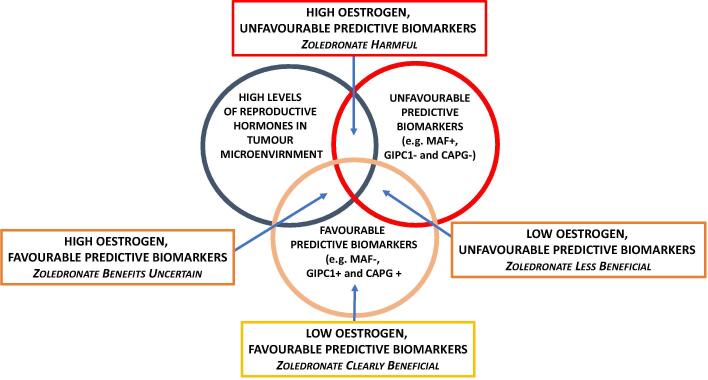
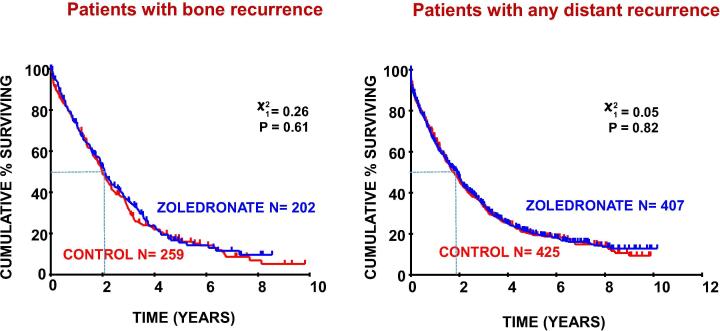
In the study population as a whole, disease recurrence at a median follow-up of 117 months occurred in 1010/3359 (30%) women with a relatively constant rate of disease relapse of around 3% per year. 727 (72%) first recurrences were at distant sites, 178 locoregional (18%) and 105 (10%) both locoregional and distant relapses occurred synchronously. Bone was the most frequent first recurrence site occurring in 463 (14%) of all patients and was the only distant metastatic site in 265 (7.9%). 69% of the control group who developed recurrent disease had bone metastases identified. Bone metastases were more frequent in those with oestrogen receptor (ER) positive disease and recurrences overall, especially at visceral sites, were more likely with ER negative disease. Zoledronate reduced bone metastases in both ER subgroups but increased the proportion with extra-skeletal metastases, particularly in women who were not definitely postmenopausal at study entry. Adjuvant zoledronate also reduced bone metastases after recurrence at an extra-skeletal site.
This analysis provides contemporary information on the frequency and pattern of recurrences after treatment for stage II/III breast cancer that may be of value in planning future adjuvant trials. It confirms the ongoing importance of bone metastases and describes in detail for the first time the effects of adjuvant zoledronate on the pattern of metastasis.
近几十年来,乳腺癌女性患者的预后有了显著改善。然而,乳腺癌死亡率仍然很高,对于那些发生转移性疾病的患者,无法进行治愈性治疗。在此,我们报告一大群美国癌症联合委员会(AJCC)II/III期乳腺癌女性患者疾病复发的频率和分布情况,并评估双膦酸盐唑来膦酸辅助治疗对临床结局的影响。
在AZURE研究(国际标准随机对照试验编号:ISRCTN7981382)中,3359例经组织学确诊为II/III期乳腺癌的患者被随机分配接受标准辅助治疗±唑来膦酸,为期五年。对患者进行了10年的随访,并确定了在此期间所有疾病复发的患者。记录首次复发部位、首个远处复发部位以及任何时间的骨转移情况,并比较对照组和唑来膦酸治疗组的结局。还评估了复发后的生存率。
在整个研究人群中,中位随访117个月时,1010/3359例(30%)女性出现疾病复发,疾病复发率相对稳定,约为每年3%。727例(72%)首次复发为远处部位,178例(18%)为局部区域复发,105例(10%)局部区域和远处复发同时发生。骨是最常见的首次复发部位,在所有患者中有463例(14%),是265例(7.9%)患者唯一的远处转移部位。复发疾病的对照组患者中有69%被确诊有骨转移。雌激素受体(ER)阳性疾病患者骨转移更常见,总体复发,尤其是内脏部位复发,ER阴性疾病患者更易发生。唑来膦酸在两个ER亚组中均减少了骨转移,但增加了骨骼外转移的比例,尤其是在研究入组时未明确绝经的女性中。辅助性唑来膦酸还减少了骨骼外部位复发后的骨转移。
本分析提供了关于II/III期乳腺癌治疗后复发频率和模式的当代信息,这可能对规划未来的辅助试验有价值。它证实了骨转移的持续重要性,并首次详细描述了辅助性唑来膦酸对转移模式的影响。