Department of Pharmacy, Quaid-I-Azam University, Islamabad, Pakistan.
School of Pharmacy, Monash University, Bander Sunway, Malaysia.
Front Public Health. 2021 Apr 26;9:629015. doi: 10.3389/fpubh.2021.629015. eCollection 2021.
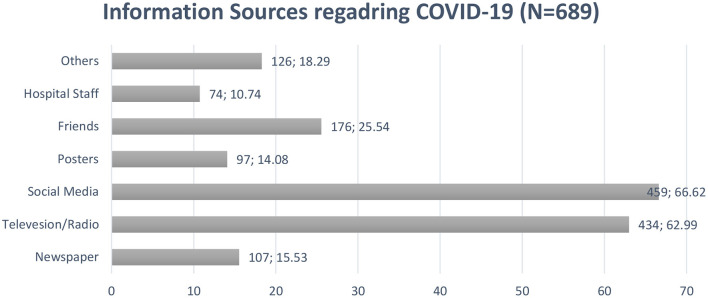
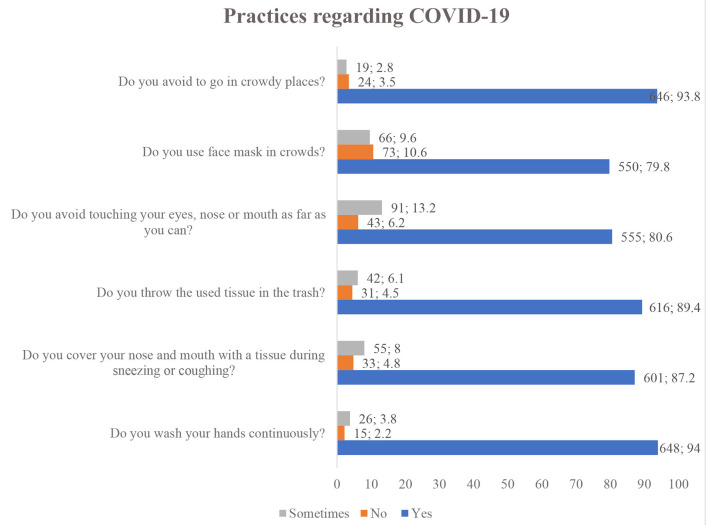
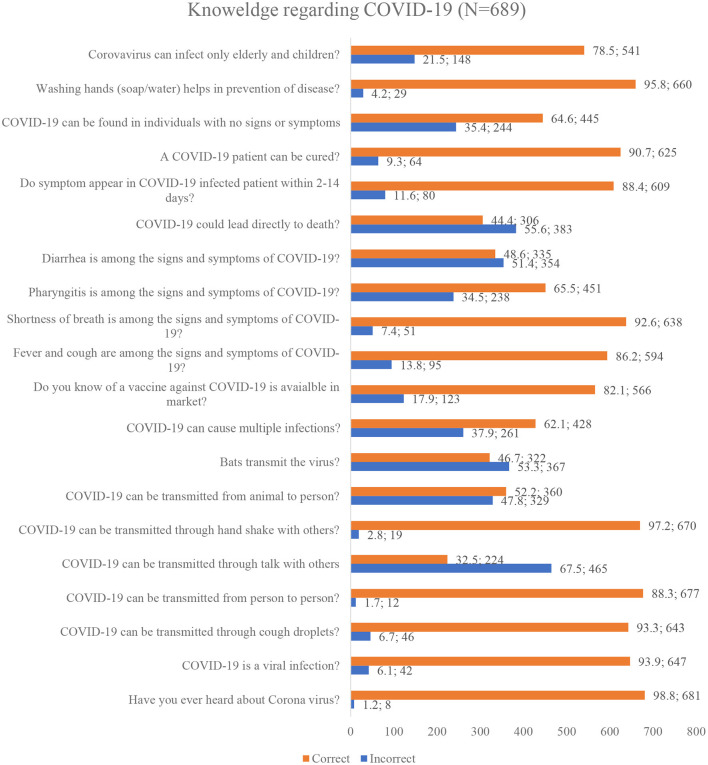
Effective mitigation of coronavirus diseases (COVID-19) pandemic requires true adoption of precautionary measures by the masses, that primarily depends upon their knowledge and practices behaviors. The current study aimed to assess the knowledge; practices of Pakistani residents regarding COVID-19 and factors associated with adequate knowledge and positive practices. A cross-sectional online survey was conducted from 15-April 2020 to 20 May 2020 among 689 Pakistanis by using a validated self-administered questionnaire (Cronbach's alpha 0.77). The questionnaire included questions on the assessment of demographics, the source of information, knowledge, and practice of COVID-19 on google forms and shared links with the WhatsApp groups, Facebook pages and other online platforms. Regression analysis was applied to find potential predictors of knowledge and practices. Of 689 participants, 431 (62.6%) were male, 64.3% ( = 443) were aged <30 years, and\328 (47.6%) of participants were married. 48.19% ( = 332) had adequate knowledge; 81% ( = 555) had positive practices regarding COVID-19 and majority (66.62%, = 459) seek knowledge from social media. Knowledge was significantly higher (OR > 1.00, < 0.05) among educated and higher income participants. Positive practices were significantly (OR > 1.00, < 0.05) related to the older age (≥50 years), higher education, higher income and good knowledge regarding COVID-19. The study concluded that Pakistani residents had average knowledge and good practices toward COVID-19 yet there are gaps in specific aspects of knowledge, and practice that should be focused in future awareness and educational campaigns. The study recommends the ministry of health authorities to promote all precautionary and preventive measures of COVID-19-consisting of a better-organized approach to all strata of society: less privileged people, older ones and less educated people, in order to have equilibrium of knowledge about COVID-19; hence effective implementation of precautionary measures.
有效缓解冠状病毒病(COVID-19)大流行需要民众真正采取预防措施,这主要取决于他们的知识和实践行为。本研究旨在评估巴基斯坦居民对 COVID-19 的知识;做法以及与充足知识和积极做法相关的因素。 2020 年 4 月 15 日至 5 月 20 日,通过使用经过验证的自我管理问卷(Cronbach 的 alpha 0.77),对 689 名巴基斯坦人进行了横断面在线调查。问卷包括对人口统计学评估、信息来源、COVID-19 知识和实践的评估。谷歌表格和与 WhatsApp 群组、Facebook 页面和其他在线平台共享的链接。应用回归分析寻找知识和实践的潜在预测因素。 在 689 名参与者中,有 431 名(62.6%)为男性,64.3%(=443 名)年龄<30 岁,有\328 名(47.6%)参与者已婚。有 48.19%(=332 名)具有足够的知识;81%(=555 名)对 COVID-19 有积极的做法,大多数(66.62%,=459 名)从社交媒体获取知识。知识水平较高(OR>1.00,<0.05)的参与者受教育程度较高,收入较高。积极的做法与年龄较大(≥50 岁)、较高的教育程度、较高的收入和对 COVID-19 的良好知识显著相关(OR>1.00,<0.05)。 该研究得出结论,巴基斯坦居民对 COVID-19 有平均的知识和良好的做法,但在知识和实践的某些方面存在差距,未来的意识和教育活动应重点关注这些差距。该研究建议卫生部主管当局为所有社会阶层(包括较贫困人群、老年人和受教育程度较低的人)推广 COVID-19 的所有预防和预防措施,以实现对 COVID-19 的知识平衡;因此,有效实施预防措施。