Salak B, Lindberg K, Kienast F, Hunziker M
Swiss Federal Institute for Forest, Snow and Landscape Research WSL, Social Sciences in Landscape Research Group, Research Unit Economics and Social Sciences, Zürcherstrasse 111, 8903 Birmensdorf, Switzerland.
Oregon State University-Cascades, Department of Forest Ecosystems and Society, 1500 SW Chandler Avenue, Bend, OR 97702, United States.
Data Brief. 2021 Apr 16;36:107025. doi: 10.1016/j.dib.2021.107025. eCollection 2021 Jun.
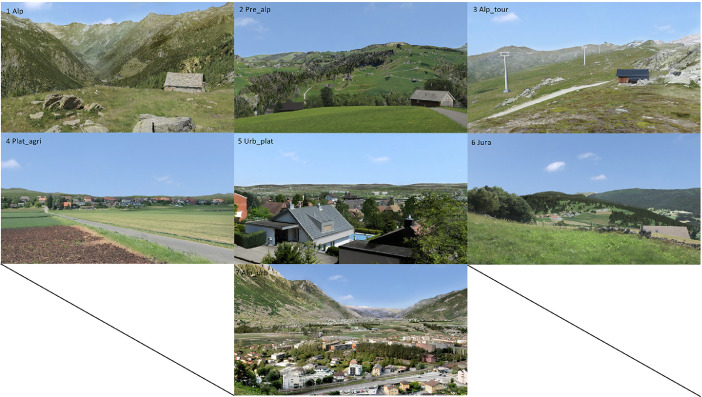
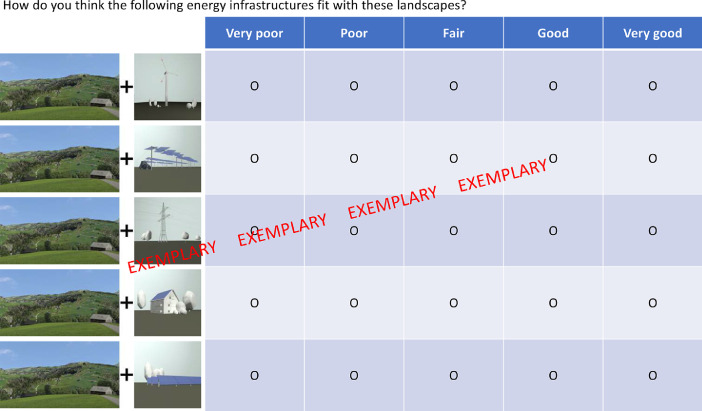
We present stated preference data based on a national representative Swiss online panel survey related to preference of mixed renewable energy infrastructure in landscapes. Data were collected between November 2018 and March 2019 via an online questionnaire and yielded 1026 responses. The online questionnaire consisted of two main parts - (1) questions covering meanings related to landscapes, nature and renewable energy infrastructure and questions regarding the "fit" of landscape/renewable energy infrastructure (REI) combinations and (2) a stated choice experiment. While in the first part of the questionnaire we asked respondents about their personal connection to certain landscapes, to nature and to specific REI, we also asked them to evaluate the fitting of seven different Swiss landscapes (near natural alpine areas, northern alps, touristic alpine areas, agricultural plateau, urban plateau, Jura ridges, urban alpine valley) with five different REI (wind, PV ground/agricultural, PV ground/other, PV roof, power lines) combinations. In the second part of the questionnaire, the stated choice experiment confronted respondents with 15 consecutive choice tasks, with each task involving a choice between two "energy system transformation" options and an opt-out option (none). Each choice option (beside the opt-out option) included four unlabeled attributes (landscape, wind energy infrastructure, photovoltaic energy infrastructure, high voltage overhead power line infrastructure) with varying levels. Due to data cleaning procedures (item nonresponse) the number of responses used within hybrid choice modeling and analysis was = 844 (12,660 choice observations). An analysis of the hybrid choice model and further insights are presented in the article "How landscape-technology fit affects public evaluations of renewable energy infrastructure scenarios. A hybrid choice model."
我们展示了基于一项全国代表性的瑞士在线小组调查得出的陈述性偏好数据,该调查与景观中混合可再生能源基础设施的偏好有关。数据于2018年11月至2019年3月通过在线问卷收集,共获得1026份回复。在线问卷由两个主要部分组成:(1)涵盖与景观、自然和可再生能源基础设施相关含义的问题,以及关于景观/可再生能源基础设施(REI)组合“适配性”的问题;(2)一个陈述性选择实验。在问卷的第一部分,我们询问了受访者与某些景观、自然以及特定REI的个人联系,还请他们评估七种不同的瑞士景观(近自然高山地区、北阿尔卑斯山、旅游高山地区、农业高原、城市高原、汝拉山脉、城市高山山谷)与五种不同的REI(风能、地面/农业光伏、地面/其他光伏、屋顶光伏、输电线)组合的适配性。在问卷的第二部分,陈述性选择实验让受访者面对15个连续的选择任务,每个任务都涉及在两个“能源系统转型”选项和一个退出选项(无)之间进行选择。每个选择选项(除退出选项外)都包括四个具有不同水平的未标记属性(景观、风能基础设施、光伏能源基础设施、高压架空电力线基础设施)。由于数据清理程序(项目无回应),混合选择建模和分析中使用的回复数量为 = 844(12660个选择观测值)。文章《景观 - 技术适配如何影响公众对可再生能源基础设施情景的评估。一个混合选择模型》中呈现了对混合选择模型的分析及进一步见解。