Arije Olujide, Madan Jason, Hlungwani Tintswalo
Institute of Public Health, Obafemi Awolowo University, Ile-Ife, Nigeria.
School of Public Health, University of Witwatersrand, Johannesburg, South Africa.
Health Econ Rev. 2024 Mar 22;14(1):24. doi: 10.1186/s13561-024-00497-4.
Barriers to utilization of sexual and reproductive health (SRH) services by adolescents and young people (AYP) have persisted despite evidence that youth-friendly services have a positive effect on contraceptive use, and patient knowledge and satisfaction.
The objective of this study was to elicit, and derive relative valuations for, attributes of SRH services that adolescents and young people value, and their willingness to pay for these services, in public health facilities.
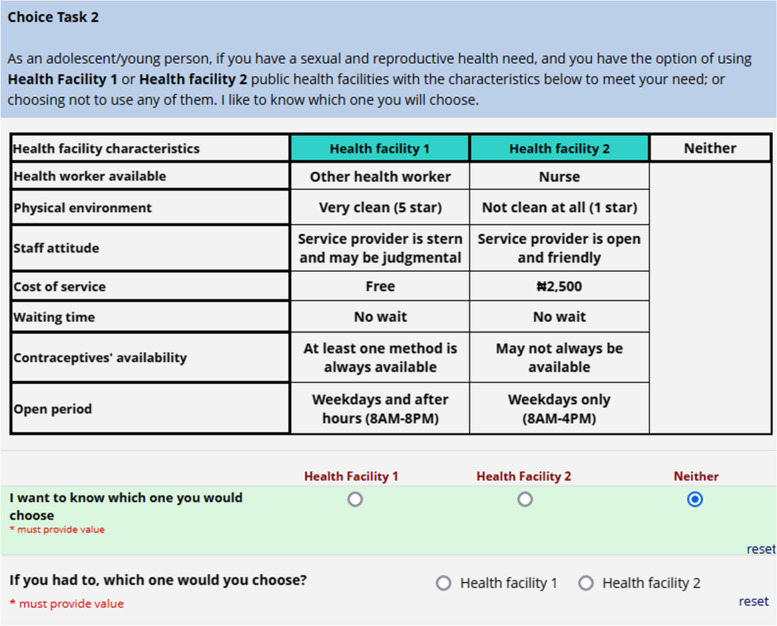
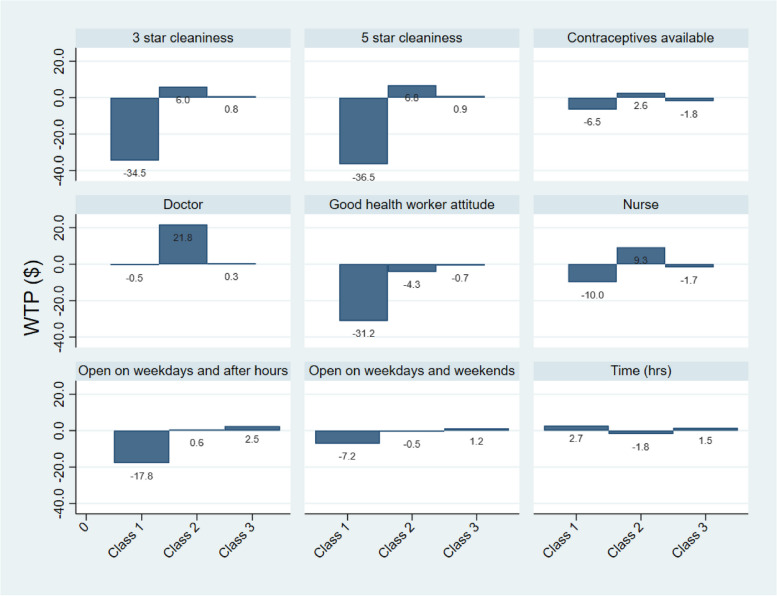
A discrete-choice-experiment (DCE) that was developed using a mixed methods approach was administered to AYP from Ogun State, Southwest Nigeria. The DCE attributes were: the type of staff; physical environment; health worker attitude; cost; waiting time; contraceptive availability; and opening hours. The choice tasks had two unlabeled alternatives and an opt-out option. Panel mixed logit choice model was used to fit the choice data, along with estimation of willingness to pay (WTP). Also, a latent class logit model was used to detect underlying preference heterogeneity among the respondents. Finally, the uptake of the services in health facilities was investigated by estimating the probabilities for selecting hypothetical health facilities under different scenarios.
A total of 859 AYP participated resulting in 6872 choice observations. The physical environment attribute had the highest utility rating relative to the other attributes, followed by preference for a doctor and for a service provider who was open and friendly. The cost and time coefficients were negative, revealing preference for lower cost and shorter waiting time. The latent class model had three classes that varied by their background characteristics. Probability of choosing any of the facility alternatives increased with introduction of more favorable facility characteristics.
The pattern of preferences identified are potential targets for service design and delivery optimization that may result in improvements in service acceptability and utilization. These results strengthen the call for involving AYP in decision-making in health interventions for them and developing context-specific SRH programs for AYP in public health facilities.
尽管有证据表明青年友好型服务对避孕药具的使用、患者知识和满意度有积极影响,但青少年和年轻人(AYP)在利用性与生殖健康(SRH)服务方面仍然存在障碍。
本研究的目的是在公共卫生设施中,引出青少年和年轻人所重视的SRH服务属性,并得出这些属性的相对估值,以及他们为这些服务付费的意愿。
采用混合方法开发的离散选择实验(DCE)应用于尼日利亚西南部奥贡州的AYP。DCE的属性包括:工作人员类型、物理环境、卫生工作者态度、成本、等待时间、避孕药具供应情况和开放时间。选择任务有两个无标签的选项和一个退出选项。使用面板混合逻辑选择模型来拟合选择数据,并估计支付意愿(WTP)。此外,使用潜在类别逻辑模型来检测受访者之间潜在的偏好异质性。最后,通过估计在不同情景下选择假设卫生设施的概率,来调查卫生设施中服务的接受情况。
共有859名AYP参与,产生了6872个选择观测值。相对于其他属性,物理环境属性的效用评级最高,其次是对医生以及开放友好的服务提供者的偏好。成本和时间系数为负,表明对低成本和更短等待时间的偏好。潜在类别模型有三个类别,因背景特征而异。引入更有利的设施特征后,选择任何设施选项的概率都会增加。
所确定的偏好模式是服务设计和交付优化的潜在目标,这可能会提高服务的可接受性和利用率。这些结果进一步呼吁让AYP参与针对他们的健康干预决策,并为公共卫生设施中的AYP制定因地制宜的SRH计划。