Poos Jackie M, Russell Lucy L, Peakman Georgia, Bocchetta Martina, Greaves Caroline V, Jiskoot Lize C, van der Ende Emma L, Seelaar Harro, Papma Janne M, van den Berg Esther, Pijnenburg Yolande A L, Borroni Barbara, Sanchez-Valle Raquel, Moreno Fermin, Laforce Robert, Graff Caroline, Synofzik Matthias, Galimberti Daniela, Rowe James B, Masellis Mario, Tartaglia Carmela, Finger Elizabeth, Vandenberghe Rik, de Medonça Alexandre, Tagliavini Fabrizio, Butler Chris R, Santana Isabel, Ber Isabelle Le, Gerhard Alex, Ducharme Simon, Levin Johannes, Danek Adrian, Otto Markus, Sorbi Sandro, Pasquier Florence, van Swieten John C, Rohrer Jonathan D
Department of Neurology Erasmus Medical Center Rotterdam the Netherlands.
Dementia Research Centre Department of Neurodegenerative Disease UCL Queen Square Institute of Neurology London UK.
Alzheimers Dement (Amst). 2021 May 13;13(1):e12185. doi: 10.1002/dad2.12185. eCollection 2021.
We aimed to assess episodic memory in genetic frontotemporal dementia (FTD) with the Free and Cued Selective Reminding Test (FCSRT).
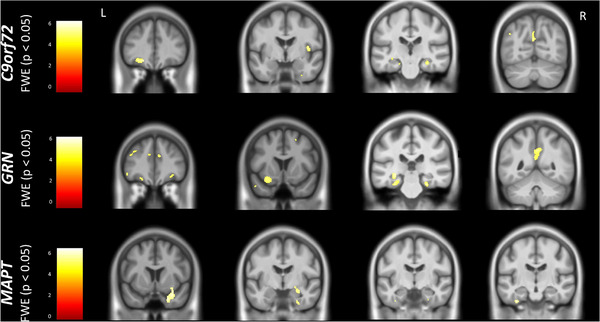
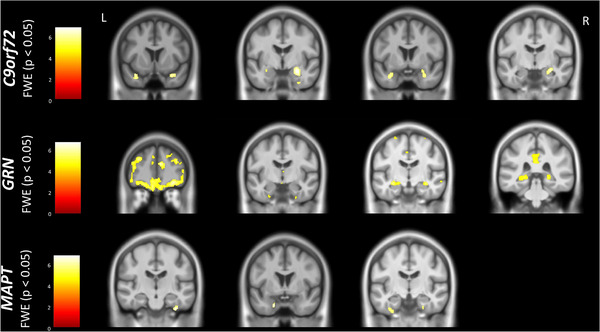
The FCSRT was administered in 417 presymptomatic and symptomatic mutation carriers (181 chromosome 9 open reading frame 72 [], 163 progranulin [], and 73 microtubule-associated protein tau []) and 290 controls. Group differences and correlations with other neuropsychological tests were examined. We performed voxel-based morphometry to investigate the underlying neural substrates of the FCSRT.
All symptomatic mutation carrier groups and presymptomatic mutation carriers performed significantly worse on all FCSRT scores compared to controls. In the presymptomatic group, deficits were found on all scores except for the delayed total recall task, while no deficits were found in presymptomatic mutation carriers. Performance on the FCSRT correlated with executive function, particularly in mutation carriers, but also with memory and naming tasks in the group. FCSRT performance also correlated with gray matter volumes of frontal, temporal, and subcortical regions in and , but mainly temporal areas in mutation carriers.
The FCSRT detects presymptomatic deficits in - and -associated FTD and provides important insight into the underlying cause of memory impairment in different forms of FTD.
我们旨在通过自由和线索选择性回忆测试(FCSRT)评估遗传性额颞叶痴呆(FTD)的情景记忆。
对417名症状前和有症状的突变携带者(181名9号染色体开放阅读框72 []、163名原颗粒蛋白 []和73名微管相关蛋白tau [])以及290名对照者进行了FCSRT测试。检查了组间差异以及与其他神经心理学测试的相关性。我们进行了基于体素的形态测量学研究,以探究FCSRT潜在的神经基础。
与对照组相比,所有有症状的突变携带者组和症状前突变携带者在所有FCSRT评分上的表现均显著更差。在症状前 组中,除延迟总回忆任务外,所有评分均发现缺陷,而症状前 突变携带者未发现缺陷。FCSRT的表现与执行功能相关,特别是在 突变携带者中,但在 组中也与记忆和命名任务相关。FCSRT表现还与 和 中额叶、颞叶和皮质下区域的灰质体积相关,但在 突变携带者中主要与颞叶区域相关。
FCSRT可检测出与 和 相关的FTD的症状前缺陷,并为不同形式FTD中记忆障碍的潜在原因提供重要见解。