Li Ke Xuan, Diendéré Gisele, Galanaud Jean-Philippe, Mahjoub Nada, Kahn Susan R
Faculty of Medicine McGill University Montreal QC Canada.
Centre of Excellence in Thrombosis and Anticoagulation Care (CETAC) Center for Clinical Epidemiology of the Lady Davis Institute for Medical Research Montreal QC Canada.
Res Pract Thromb Haemost. 2021 May 8;5(4):e12527. doi: 10.1002/rth2.12527. eCollection 2021 May.
Postthrombotic syndrome (PTS) is a form of secondary chronic venous insufficiency (CVI) that occurs after deep vein thrombosis (DVT). Effective treatments for PTS are lacking. Micronized purified flavonoid fraction (MPFF) is a venoactive drug used in the treatment of CVI.
To determine whether MPFF is a good candidate to explore as a therapeutic agent for PTS.
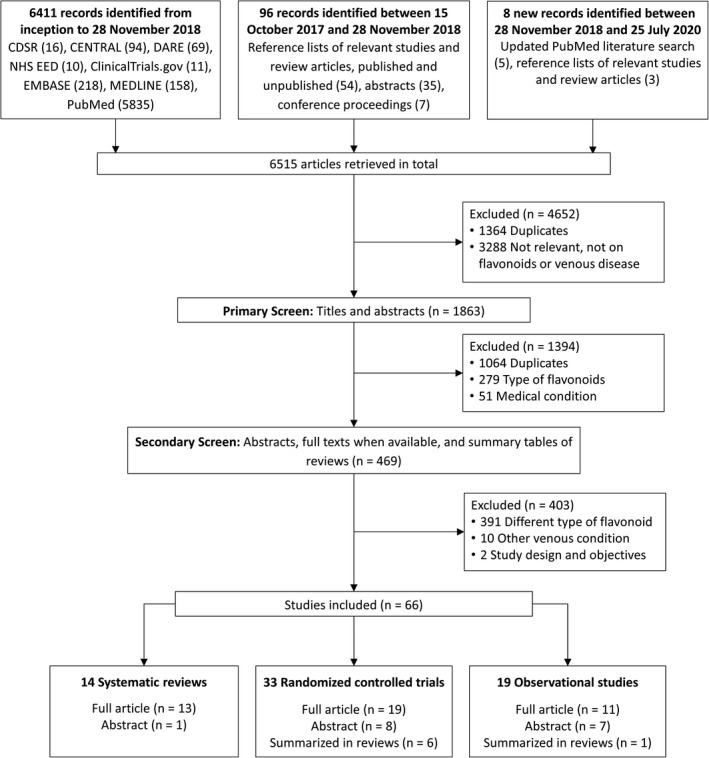
We performed a narrative review in which we identified 14 systematic reviews, 33 randomized controlled trials, and 19 observational studies that discussed the use of MPFF in CVI, as well as studies that reported on the mechanistic action of MPFF in relation to the pathophysiology of PTS.
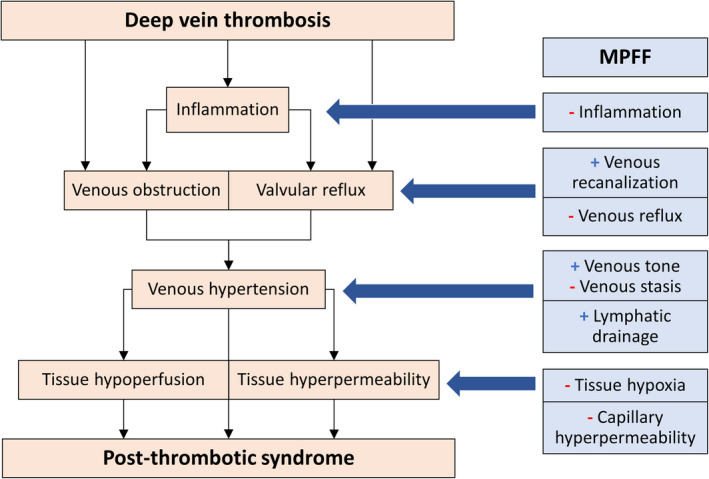
MPFF targets a number of pathophysiologic components of PTS. Based on animal models and human studies investigating objective vascular and lymphatic measures, MPFF promotes venous recanalization after DVT, decreases venous remodeling and reflux, inhibits inflammatory processes, improves venous tone and stasis, improves lymphatic circulation, improves capillary hyperpermeability, and decreases tissue hypoxia. Furthermore, MPFF shows promise in improving clinical manifestations, quality of life, and objective venous parameters of CVI. Studies suggest good patient acceptability and tolerability with the use of MPFF in CVI.
MPFF is a good candidate to explore as a potential therapy for PTS. Confirmatory high-quality studies are still needed to reinforce the evidence supporting the use of MPFF in CVI. Double-blind randomized controlled trials with clinical endpoints are needed to assess the clinical efficacy of MPFF in the treatment of PTS.
血栓形成后综合征(PTS)是深静脉血栓形成(DVT)后发生的一种继发性慢性静脉功能不全(CVI)形式。目前缺乏针对PTS的有效治疗方法。微粉化纯化黄酮类化合物(MPFF)是一种用于治疗CVI的静脉活性药物。
确定MPFF是否是探索作为PTS治疗药物的良好候选者。
我们进行了一项叙述性综述,确定了14项系统评价、33项随机对照试验和19项观察性研究,这些研究讨论了MPFF在CVI中的应用,以及报道MPFF与PTS病理生理学相关作用机制的研究。
MPFF针对PTS的多种病理生理成分发挥作用。基于动物模型和对客观血管及淋巴指标进行研究的人体研究,MPFF可促进DVT后的静脉再通,减少静脉重塑和反流,抑制炎症过程,改善静脉张力和淤血,改善淋巴循环,改善毛细血管高通透性,并减轻组织缺氧。此外,MPFF在改善CVI的临床表现、生活质量和客观静脉参数方面显示出前景。研究表明,MPFF用于CVI时患者接受度和耐受性良好。
MPFF是探索作为PTS潜在治疗方法的良好候选者。仍需要进行验证性高质量研究以加强支持MPFF用于CVI的证据。需要进行具有临床终点的双盲随机对照试验来评估MPFF治疗PTS的临床疗效。